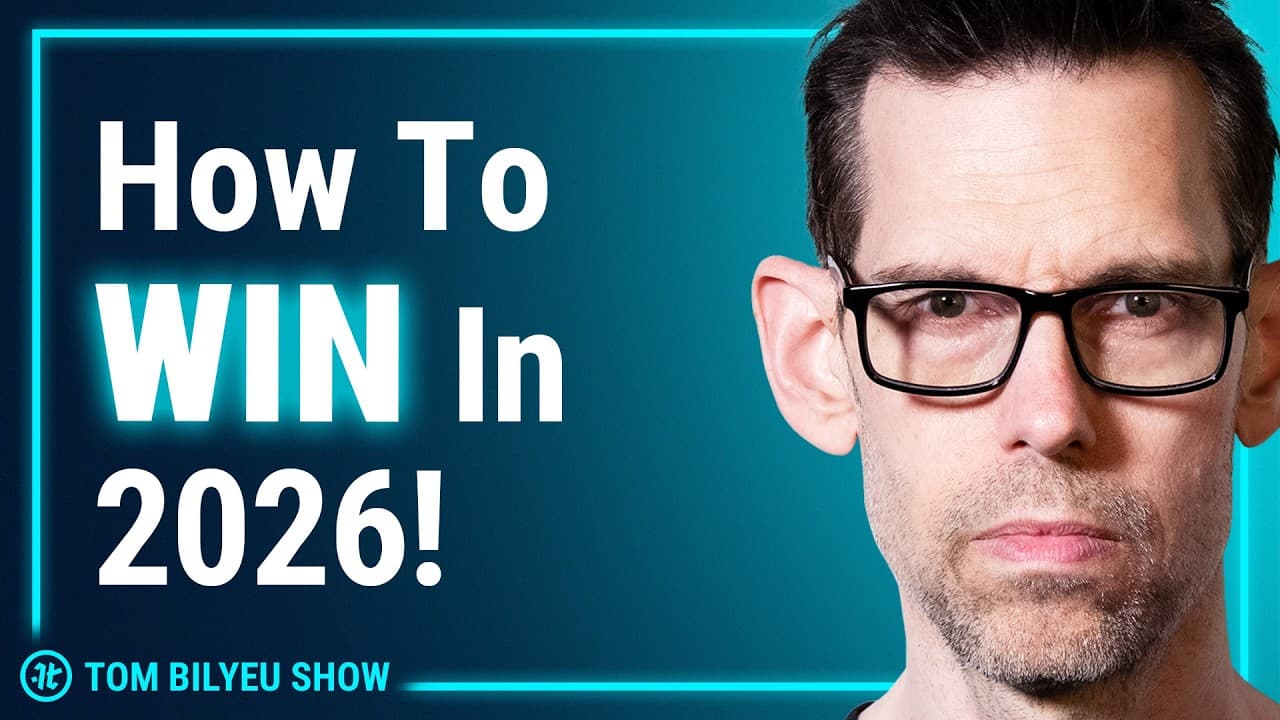
How to Win in 2026: 26 Essential Strategies
TL;DR
To win in 2026, change the beliefs and values shaping your behavior, take responsibility for outcomes, and relentlessly build skills that serve clear goals. Drawing on about 25 years as an entrepreneur and one year as a game developer, the speaker presents 26 lessons and frames life as a competitive but cooperative PvPvE game. Read on for practical principles about adaptability, environment, failure, fulfillment, and economic awareness.
Transcript
I've been an entrepreneur for about 25 years, but the last year as a game developer has taught me 26 critical lessons that are going to help you make 2026 the best year of your life. [music] One, you are programmed just like a character in a video game. If you want different outcomes, you got to change the programming. Your life is controlled by yo... Read More
Key Insights
- Beliefs and values are your personal programming, influencing how you perceive and interact with the world.
- Life is akin to a PvPvE game, where you compete against others and navigate environmental challenges.
- Skills have utility; relentlessly build them to achieve your goals and outperform others.
- Clear goals are essential; fulfillment, not money or fame, is the ultimate win condition.
- Understanding the economy is crucial; without it, you risk being left behind in a rapidly changing world.
- Failure is an information-rich data stream; embrace it to learn and improve.
- The meta is constantly changing; adaptability is key to staying ahead.
- Your environment can either enhance or hinder your progress; choose it wisely to support your goals.
Install to Summarize YouTube Videos and Get Transcripts
Explore YouTube Video Summarizer or Get YouTube Transcript Extractor
Questions & Answers
Q: What are the 26 essential strategies for winning in 2026?
The strategies center on changing limiting beliefs and values, accepting responsibility for outcomes, developing useful skills, setting fulfilling goals, understanding the economy, learning from failure, adapting as conditions change, and choosing a supportive environment. The speaker presents these ideas as 26 critical lessons drawn from about 25 years as an entrepreneur and the last year as a game developer.
Q: How can changing beliefs and values improve your life?
Beliefs and values act like programming: they influence what you notice, how you interpret events, and how you behave. Changing them can help you view a difficulty as a solvable challenge instead of an insurmountable problem, provided your interpretation remains consistent with physical reality.
Q: Why does the speaker describe life as a PvPvE game?
Life involves competing with other people while also navigating environmental forces such as politics, the economy, geopolitics, and AI. The speaker calls it competitive but cooperative, emphasizing that people can work together even while pursuing finite resources and their own goals.
Q: What does taking responsibility for outcomes mean?
It means treating life as a system governed by rules rather than assuming the world is personally working against you. By learning those rules, investing time and energy in improvement, and anticipating consequences, you can improve your outcomes.
Q: Why is skill development essential for achieving goals?
Skills have utility because they increase what you are capable of doing. The speaker recommends relentlessly building your skill tree and becoming able to do things others cannot, whether your goal is performing better at work, parenting, or growing a business.
Q: What role does adaptability play in success?
Humans rely on adaptation, so improvement requires responding to changing circumstances rather than remaining fixed. The page’s central principle is that putting time and energy into getting better will help you get better.
Q: What should you build and collect in the game of life?
The speaker compares life to an open-world survival crafting game with three priorities: stay alive, collect resources, and make incredible things. Those creations can include a family, a business, or models; the specific form matters less than the joy of building and creating.
Q: Why does the speaker recommend finding a romantic partner?
Although many of the lessons can make life sound like a solo game, the speaker says it is better played with someone who tries to help you and whom you can help. A romantic partnership therefore reflects the cooperative side of life alongside its competitive demands.
Summary & Key Takeaways
-
To succeed in 2026, you must reprogram your beliefs and values, as they shape your reality and potential outcomes. Life is a competitive game against others and your environment, requiring strategic navigation and skill development.
-
Skills are essential tools for success; continuously build and refine them to surpass others and achieve your objectives. Clear, fulfilling goals are crucial, as they provide direction and motivation.
-
Understanding the economy is vital in today's world, as it influences your financial stability and opportunities. Embrace failure as a learning opportunity and adapt to the ever-changing landscape to thrive.
Read in Other Languages (beta)
Share This Summary 📚
Summarize YouTube Videos and Get Video Transcripts with 1-Click
Try YouTube Summary with ChatGPT & Claude or YouTube Transcript Generator
Explore More Summaries from Tom Bilyeu 📚

Summarize YouTube Videos and Get Video Transcripts with 1-Click
Try YouTube Summary with ChatGPT & Claude or YouTube Transcript Generator