How Does Cybercriminal Psychology Shape Behavior?
TL;DR
Understanding how cybercriminals perceive victims, status, ethics, and risk can improve defensive decisions and disruption strategies. Eastern European operators may rationalize fraud against banks as victimless, while relying heavily on underground reputations and communities, so investigators can target both their technical behavior and the trust structures that support their criminal activity.
Transcript
Hello, my name is Vitaly Kremetz. Uh, the title of my talk is Psychology of an Eastern European Cybercriminal: Mindset Drives Behavior. Um, let me introduce myself. My name is Vitaly. I'm a senior intelligence analyst at Flashpoint, where I specialize in researching, mitigating complex cyberattacks, net-network intrusions, data breaches, and hackin... Read More
Key Insights
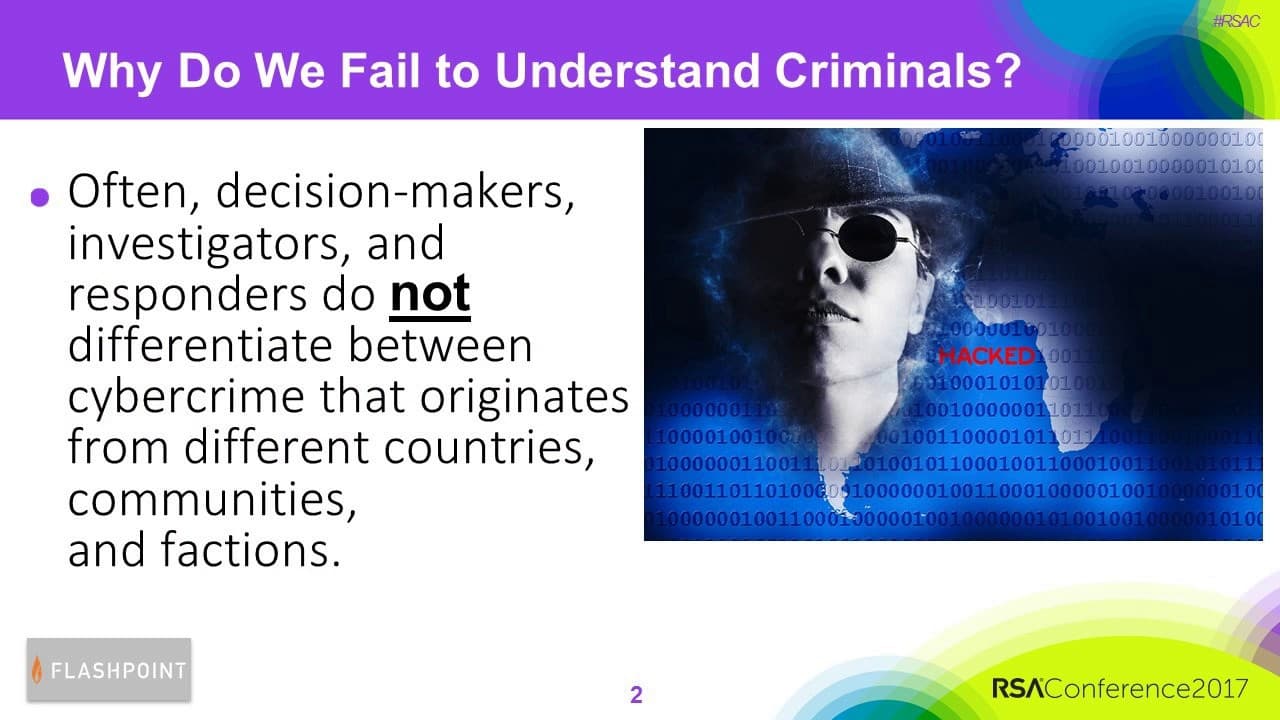
- Cybercriminal psychology is a practical security concern because motivations, beliefs, relationships, and perceptions influence observable behavior. Treating criminals from different countries, factions, and communities as identical can lead investigators, responders, and system designers toward ineffective decisions and recurring breaches.
- The romanticized image of cybercriminals is misleading because attackers are not necessarily wealthy, unreachable, exceptionally intelligent, or unstoppable. Replacing this mythology with evidence about their actual communities and behavior can help defenders identify realistic weaknesses and design more appropriate interventions.
- Underground reputation is a critical criminal asset because forum members depend on trust and status to communicate, exchange information, and sell malicious kits. Damaging an operator’s reputation can therefore disrupt the relationships and infrastructure that sustain cybercriminal activity.
- Inc. is portrayed as a powerful Russian underground arbitrator who influences information flows across elite forums. His ability to punish or ban malware sellers for infractions illustrates how individual authority and community governance can affect which ransomware variants remain available.
- Radamond is presented as a Russian-speaking ransomware developer who progressed from lower-tier forums to a vetted, top-tier community. His path shows that criminal status can be built through experience, information seeking, social attention, communication, and participation in underground networks.
- Ideological justification is part of financially motivated cybercrime because some Eastern European criminals view attacks against insured Western banks and other impersonal institutions as victimless. This belief helps them rationalize fraud by assuming institutions, rather than individuals, absorb the costs.
- Ransomware creates an ethical dilemma for some top-tier criminals because its harm to individuals conflicts with the belief that cybercrime against large institutions is victimless. The talk describes ransomware as a lower-end maneuver that some operators may use while waiting for better opportunities.
- Psychological traits can produce technical indicators because an operator’s habits, protections, communication patterns, and community role shape activity on networks and underground forums. Studying these links can help defenders identify distinctive tactics, techniques, and procedures and mitigate associated threats.
Install to Summarize YouTube Videos and Get Transcripts
Explore YouTube Video Summarizer or Get YouTube Transcript Extractor
Questions & Answers
Q: Why should defenders study cybercriminal psychology?
Defenders should study cybercriminal psychology because an attacker’s beliefs, motivations, social relationships, and perception of victims influence criminal decisions. The talk argues that cybersecurity professionals often fail to distinguish among criminals from different countries, communities, and factions. That lack of understanding can hinder investigations, encourage poor system-design choices, and contribute to repeated breaches. Better behavioral knowledge supports more informed defensive decisions.
Q: How do Eastern European cybercriminals justify financial fraud?
Some Eastern European cybercriminals justify financial fraud by describing it as a victimless crime directed against large, impersonal institutions. They may believe that insured Western banks absorb the financial damage, allowing them to distance their actions from harm to individuals. The talk presents this belief as an ideological framework that helps offenders rationalize their conduct, even though their assumptions do not eliminate the consequences of crime.
Q: Why can ransomware create an ethical dilemma for cybercriminals?
Ransomware can create an ethical dilemma because its damage to individuals conflicts with the idea that cybercrime against large institutions is victimless. The talk suggests that some top-tier, financially motivated criminals distinguish ransomware from fraud aimed at banks because ransomware produces more visible personal harm. Within that mindset, ransomware may be regarded as a lower-end maneuver used until a more attractive opportunity appears.
Q: How can underground reputation be used to disrupt cybercrime?
Underground reputation can be targeted because cybercriminals rely on community trust to communicate, exchange information, and sell malicious kits. The talk argues that attacking an offender’s standing within these communities can weaken the relationships supporting criminal activity. When combined with assistance for international arrests, reputational disruption can interfere with the underground infrastructure that operators need to maintain influence, conduct business, and reach collaborators.
Q: Who is Inc. in the Russian cybercrime underground?
Inc. is described as a prominent figure and rough arbitrator within elite Russian underground forums, including Verified and Korovka. He is portrayed as both revered and reviled, with influence over information flowing through multiple communities. His authority reportedly includes banning malware sellers for infractions. That control can help explain why particular ransomware variants or sellers disappear from underground markets.
Q: What does Radamond’s career reveal about cybercrime communities?
Radamond is presented as a Russian-speaking ransomware developer who created a notorious ransomware kit and participated in a ransomware-as-a-service affiliate campaign. He gained experience in lower-tier forums before advancing to the vetted forum Exploit. His progression illustrates how operators can build status within underground communities through experience, information seeking, social interaction, humor, attention, and the development of malicious products.
Q: How can criminal behavior reveal technical threat indicators?
Criminal behavior can reveal technical threat indicators because psychological traits and habits are expressed through operational choices. The talk states that studying Radamond’s behavior helped identify specific signs of his network presence and the technical protections he used. More broadly, analyzing an operator’s communication, role, and preferences can expose distinctive tactics, techniques, and procedures that defenders can use to identify and mitigate threats.
Q: How does cybercrime relate to nationalism or patriotism?
Cybercrime can become a form of misdirected nationalism or patriotism when offenders frame attacks against financial institutions as serving a broader political or national cause. The talk connects this framing to the belief that large Western banks and insurers absorb fraud losses. Such ideas can provide offenders with ideological justification, showing that cybercriminal actions may reflect political identity and moral rationalization as well as financial motivation.
Summary & Key Takeaways
-
Cybersecurity professionals often treat attackers from different countries, communities, and factions as interchangeable. The talk argues that this weakens investigations and system design because an attacker’s worldview affects motivations, choices, relationships, and methods. Understanding those differences gives defenders a stronger foundation for designing responses and preventing repeated breaches.
-
The discussion profiles Inc., a prominent Russian underground arbitrator who controls information flows, and Radamond, a ransomware developer who advanced from lower-tier communities to a vetted forum. Their reputations, communication styles, creative expression, and ideological frameworks provide clues about how underground markets operate and why particular criminal behaviors emerge.
-
Effective disruption combines international arrests with attacks on underground reputation and infrastructure. Criminals depend on trusted communities to communicate and sell malicious tools, making social standing a practical vulnerability. Psychological analysis can also reveal technical indicators, tactics, techniques, and procedures that help defenders identify operators and mitigate their threats.
Read in Other Languages (beta)
Share This Summary 📚
Summarize YouTube Videos and Get Video Transcripts with 1-Click
Try YouTube Summary with ChatGPT & Claude or YouTube Transcript Generator
Explore More Summaries from RSAC Cybersecurity 📚






Summarize YouTube Videos and Get Video Transcripts with 1-Click
Try YouTube Summary with ChatGPT & Claude or YouTube Transcript Generator