This Beautiful House Is Made of Snot
TL;DR
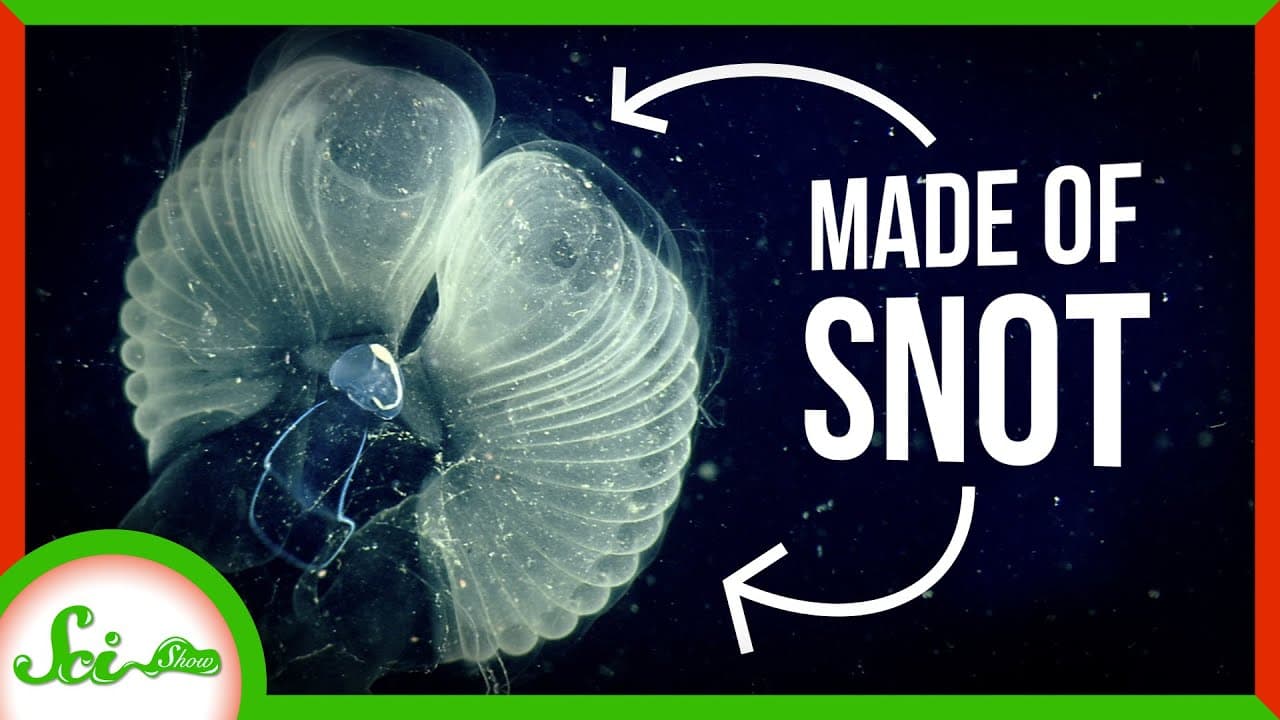
The beautiful “house” is a giant larvacean’s mucus structure, built to filter marine snow from seawater and direct edible particles into its mouth. Some houses reach a meter wide even though their builders are less than 10 centimeters long, and each may last only a day or less. Read on to discover how these structures feed larvaceans, hide them from predators, and transport carbon into the deep ocean.
Transcript
Thanks to the Monterey Bay Aquarium and their research and technology partner MBARI for partnering with us on this episode of SciShow. They hope that you LARVA this episode! [♪ INTRO] This is a giant larvacean. Sorry, let me zoom in. THIS is a giant larvacean. The huge structure around it is it’s home — a palace it built for itself… out of snot... Read More
Key Insights
- 😋 Giant larvaceans build and inhabit intricate snot mansions that serve as effective food filters.
- ❓ Researchers have used advanced technology to visualize and explore the complex chambers and passageways within these structures.
- 😋 The discarded snot mansions become food for deeper-sea creatures and contribute to the global carbon cycle.
- 🛟 Larvaceans serve as model organisms for studying developmental genetics due to their shared characteristics with humans.
Install to Summarize YouTube Videos and Get Transcripts
Explore YouTube Video Summarizer or Get YouTube Transcript Extractor
Questions & Answers
Q: Why is this beautiful house made of snot?
A giant larvacean creates the house from mucus produced by cells around its head, then inflates its chambers like balloons. The resulting structure filters food from seawater while concealing the animal’s exact location from predators.
Q: How large are giant larvacean mucus houses?
In some species, a mucus house can easily reach a meter wide. The larvacean living inside is less than 10 centimeters long, making the structure enormous compared with its builder.
Q: How do giant larvaceans catch their food?
The larvacean flaps its tail to move water through several layers of filters that collect marine snow falling from above. The outer filter blocks particles that are too large, while inner filters direct ideally sized food into the animal’s mouth.
Q: How did MBARI researchers study the fragile mucus houses?
Because the structures are too fragile to bring up from the depths intact, MBARI researchers scanned them in their natural environment. They used lasers attached to a remotely operated vehicle, then converted the scans into three-dimensional visualizations that could be explored with a virtual reality headset.
Q: Why do larvaceans abandon their mucus houses?
Each house may last only a day or less before its filters become clogged. The larvacean then abandons it and can produce and inflate a replacement in less than an hour.
Q: What happens to discarded larvacean houses?
A discarded, food-filled mucus house can sink as fast as 800 meters per day. It becomes food for animals in deeper water and for seafloor scavengers such as sea cucumbers.
Q: How do larvacean mucus houses affect the carbon cycle?
As the discarded houses sink, they carry trapped carbon into deep water, where it can remain locked away for millions of years. In some places, larvaceans might transfer more carbon to the ocean floor than any other kind of plankton.
Q: Why are larvaceans useful model organisms?
Larvaceans are chordates, like humans, and share similarities in which genes are active early in life. Their rapid growth and clear bodies also make them useful for studying how genes affect development.
Summary & Key Takeaways
-
Giant larvaceans are small, tadpole-like creatures that build impressive structures out of mucus.
-
These mucus mansions serve as filters to catch food particles that rain down from above.
-
Researchers have used lasers and virtual reality to uncover the intricate chambers and passageways within these structures.
Read in Other Languages (beta)
Share This Summary 📚
Summarize YouTube Videos and Get Video Transcripts with 1-Click
Try YouTube Summary with ChatGPT & Claude or YouTube Transcript Generator
Explore More Summaries from SciShow 📚
Summarize YouTube Videos and Get Video Transcripts with 1-Click
Try YouTube Summary with ChatGPT & Claude or YouTube Transcript Generator