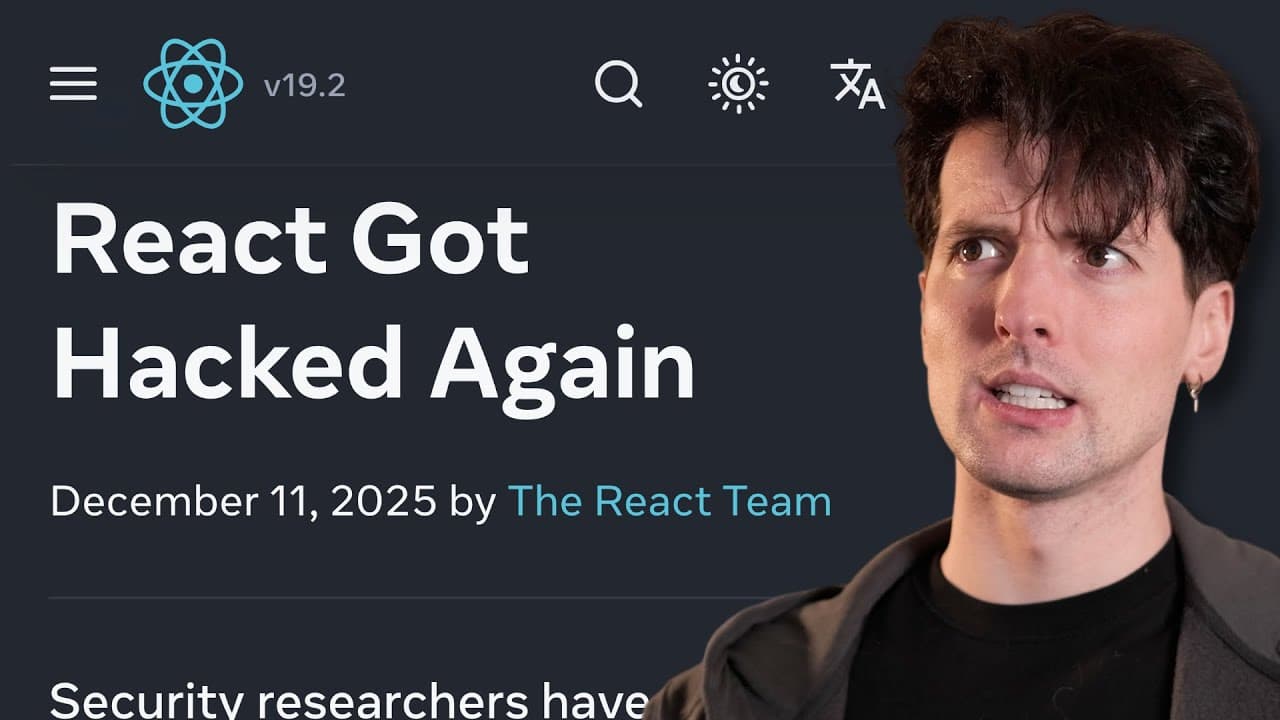
How Serious Are the New React Security Flaws?
TL;DR
React 19 users should update to version 19.2.3 immediately, while Next.js users should update the framework itself to the latest applicable release. The newly disclosed flaws can hang servers through malicious requests or expose parts of server-function source code, but they do not enable the remote code execution associated with the earlier React2Shell vulnerability.
Transcript
Man, that React hack last week was really, really bad. I'm thankful we have so many security people looking at the React project and making sure there's nothing else like this. I'm sure going forward we're not going to find any other major uh Oh, two new exploits were just found in React. Great. I have a feeling this is going to be a long rant, esp... Read More
Key Insights
- React 19.2.3 is the recommended safe version identified in the transcript. Users should update immediately because version 19.2.2 did not fully mitigate the denial-of-service problem, requiring the React team to issue another correction.
- The denial-of-service vulnerability works by sending a malicious HTTP request that React deserializes into an infinite loop. The loop hangs the server process and consumes CPU, potentially making the application unavailable to legitimate users.
- Applications can remain vulnerable even without explicitly implemented React server-function endpoints. According to the disclosure discussed, supporting server components may be sufficient to expose an endpoint to the malicious request and its resulting denial-of-service behavior.
- The denial-of-service flaw has a severity score of 7.5. It does not directly create the same user-data risk as the earlier remote code execution exploit, but it can take down a service and increase costs on compute-backed deployments.
- The source-code exposure flaw has a severity score of 5.3 and may return the source of a server function. Successful exploitation requires a server function that explicitly or implicitly exposes an argument converted into a string.
- Runtime secrets such as environment variables are not exposed by the source-code vulnerability described. Exposure is limited to code inside the affected server function, although additional functions may appear when a bundler has inlined them into that function.
- Next.js projects should update Next.js itself instead of assuming that changing only the React dependency is sufficient. The transcript describes the relationship between Next.js and its React package as making a React-only upgrade less straightforward.
- Follow-up vulnerabilities are common after a critical disclosure because researchers examine neighboring code paths and test variants or mitigation bypasses. The React team characterized additional findings as frustrating but generally consistent with a healthy security-response cycle.
Install to Summarize YouTube Videos and Get Transcripts
Explore YouTube Video Summarizer or Get YouTube Transcript Extractor
Questions & Answers
Q: How do you fix the new React security vulnerabilities?
React 19 users should update to version 19.2.3 immediately. The transcript identifies that release as the safe version after an earlier denial-of-service mitigation proved insufficient. Next.js users should also update Next.js itself to the latest applicable release, rather than merely changing the React package, because the framework and its React dependency have a relationship that complicates isolated upgrades.
Q: How does the React denial-of-service vulnerability work?
The denial-of-service vulnerability uses a specially crafted malicious HTTP request sent to a server-functions endpoint. When React deserializes the request, it can enter an infinite loop that hangs the server process and consumes CPU. This can prevent legitimate users from accessing the application and may also create substantial compute costs for deployments backed by fluid compute or lambda-style server environments.
Q: Are React Server Components vulnerable without server functions?
An application may still be vulnerable even when it does not explicitly implement React server-function endpoints. The disclosure discussed in the transcript says that support for server components can be enough to create exposure. A malicious request may therefore reach infrastructure that React deserializes, trigger the infinite loop, consume server resources, and deny users access to the product.
Q: Does the new React flaw expose user data or secrets?
The denial-of-service issue is primarily an availability problem rather than a direct user-data exposure comparable to the earlier remote code execution vulnerability. The separate source-code flaw can reveal code contained inside a server function, but the transcript states that runtime secrets such as environment variables are not affected. Secrets written directly into exposed source code could still become visible.
Q: What source code can the React exposure flaw reveal?
The source-exposure flaw may return the source code of a particular server function after a malicious HTTP request. Exploitation requires that the function explicitly or implicitly expose a stringified argument. The returned material is limited to code inside that server function, although it may include other functions when the bundler has inlined them. The transcript also shows that minified code can be exposed.
Q: How severe are the newly disclosed React vulnerabilities?
The denial-of-service vulnerability has a severity score of 7.5, while the source-code exposure issue has a score of 5.3. Both are serious and warrant immediate updates, but neither reaches the earlier remote code execution vulnerability's score of 10. The denial-of-service flaw can disable a site, while the source exposure depends more heavily on how the affected service is implemented.
Q: Why did React require multiple security updates?
React's initial attempt to stop the denial-of-service vulnerability did not fully resolve the problem. Another report demonstrated that the protection was insufficient, so the project issued an additional update. The transcript describes the progression from version 19.2.2 to version 19.2.3 and recommends the latter because it includes the subsequent mitigation that prevents the infinite-loop behavior.
Q: Why are more React vulnerabilities appearing after React2Shell?
Critical disclosures attract concentrated scrutiny from security researchers. Researchers inspect adjacent code paths, search for variations of the original exploit, and test whether initial mitigations can be bypassed. The React team compared this pattern with the follow-up findings after Log4Shell and argued that additional disclosures, although frustrating, generally indicate an active and healthy security-response process rather than inactivity.
Summary & Key Takeaways
-
Two follow-up React vulnerabilities affect server-component infrastructure. A denial-of-service flaw can make deserialization enter an infinite loop, consuming CPU and preventing users from accessing a service. A separate source-exposure flaw can return server-function code when a function explicitly or implicitly exposes a stringified argument. Both require immediate patching.
-
The denial-of-service issue carries a 7.5 severity score, while the source-code exposure issue carries a 5.3 score. Neither matches the earlier remote code execution vulnerability, which received the maximum score of 10. The new issues remain serious because attackers can disrupt services, increase compute costs, or inspect proprietary implementation details.
-
React users on version 19 should move to 19.2.3 because an earlier denial-of-service mitigation was insufficient and required another patch. Next.js users should update Next.js itself because its relationship with the React package makes a React-only upgrade unreliable. Continued disclosures are presented as evidence that researchers are thoroughly examining adjacent code paths.
Read in Other Languages (beta)
Share This Summary 📚
Summarize YouTube Videos and Get Video Transcripts with 1-Click
Try YouTube Summary with ChatGPT & Claude or YouTube Transcript Generator
Explore More Summaries from Theo - t3․gg 📚






Summarize YouTube Videos and Get Video Transcripts with 1-Click
Try YouTube Summary with ChatGPT & Claude or YouTube Transcript Generator