Synchronous Induction Motor | Power flow equations | Synchronous Machines | Lec-38
TL;DR
The session explains synchronous induction motor methods and their operational principles.
Transcript
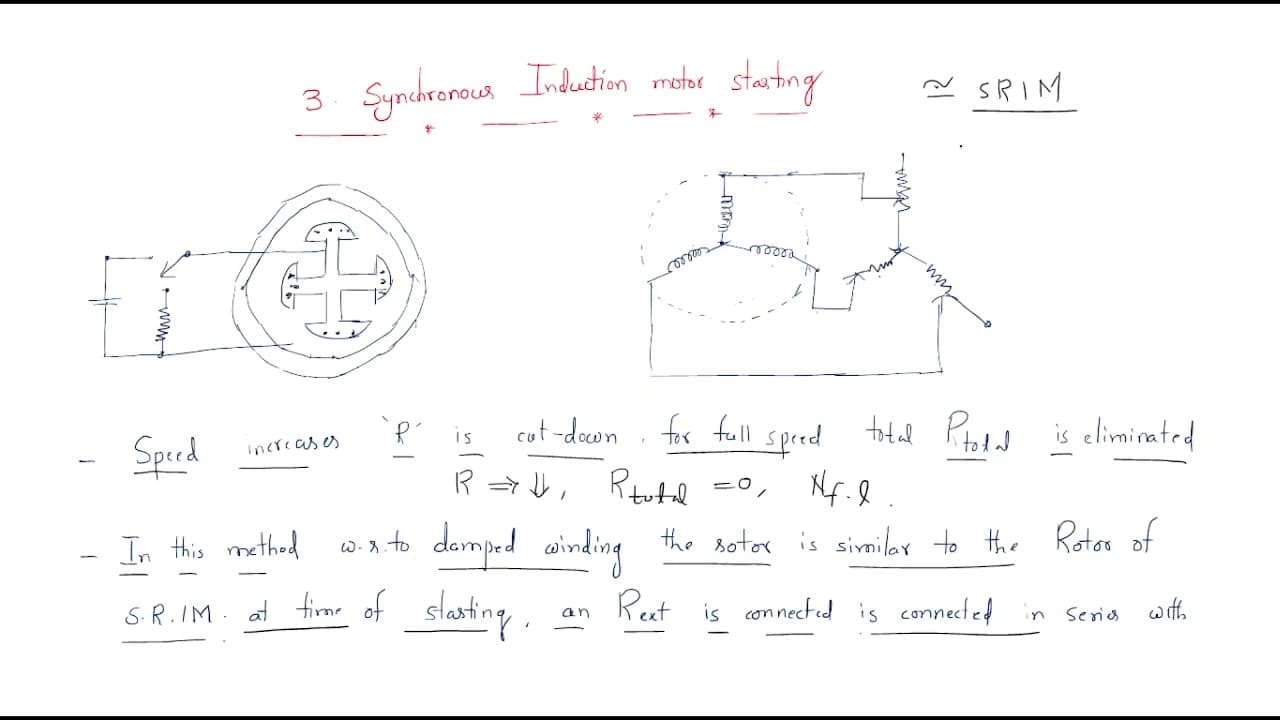
hello everyone in this session we will continue the previous session that is starting methods of synchronous mode third method is synchronous induction motor method synchronous induction motor method so this is the diagram of synchronous induction motor just look at here here the speed increases resistor is cut down and for full load speed the tota... Read More
Key Insights
- 🧑🦼 Synchronous induction motors utilize a unique three-phase winding system that relies on resistive starting methods for enhanced performance.
- 🚄 Reducing resistance at higher speeds optimizes efficiency and allows the motor to operate at desired synchronous speeds without unnecessary energy loss.
- 🧑🦼 Magnetic locking is a critical phenomenon in synchronous motors that ensures proper synchronization of rotor and stator components for effective energy conversion.
- ✊ The vector diagram analysis illustrates the relationship between different electrical parameters, providing a visual understanding of power flow and performance metrics.
- 🧑🦼 Efficient torque generation and hunting prevention are achieved using damper windings, crucial for stable motor operation.
- ✊ Understanding power flow equations is vital for analyzing motor performance, allowing for precise control of power input and output interactions.
- 🧑🦼 The electrical characteristics of synchronous induction motors involve complex relationships between voltage, current, and impedance, necessitating detailed technical comprehension for effective application.
Install to Summarize YouTube Videos and Get Transcripts
Explore YouTube Video Summarizer or Get YouTube Transcript Extractor
Questions & Answers
Q: What is the starting method for synchronous induction motors?
The starting method for synchronous induction motors involves three windings connected to resistors. As the speed of the motor increases, resistance is gradually decreased until it reaches zero at full load speed, which allows for efficient motor operation and performance.
Q: How does magnetic locking work in synchronous motors?
Magnetic locking occurs when rotor poles align with stator poles, enabling the motor to achieve synchronous speed. When excitation is supplied, the rotor is effectively pulled into synchronism, allowing for stable operation and enhanced performance output of the synchronous induction motor.
Q: What role do damper windings play in synchronous induction motors?
Damper windings in synchronous induction motors help to provide starting torque and mitigate hunting phenomena. They initially provide resistance during motor start-up, which increases starting torque, and are essential for stabilizing motor operation during transient conditions.
Q: Can you explain the relationship between terminal voltage and generated EMF?
The terminal voltage (VT) is directly related to the generated EMF (E) and voltage drops, such as resistive and reactive drops. The voltage equation shows that VT equals E plus the product of current and synchronous reactance, highlighting the importance of these electrical parameters in motor operation.
Summary & Key Takeaways
-
The synchronous induction motor operates with a starting method that involves gradually reducing resistance as speed increases, ensuring efficient performance at full load.
-
Magnetic locking is a key concept wherein rotor poles synchronize with stator poles, allowing the motor to achieve synchronous speed using effective excitation.
-
The analysis includes vector diagrams to illustrate relationships between terminal voltage, generated EMF, and current, emphasizing the electrical characteristics critical for power calculations.
Read in Other Languages (beta)
Share This Summary 📚
Summarize YouTube Videos and Get Video Transcripts with 1-Click
Try YouTube Summary with ChatGPT & Claude or YouTube Transcript Generator