Logic 5 - Propositional Modus Ponens | Stanford CS221: AI (Autumn 2021)
TL;DR
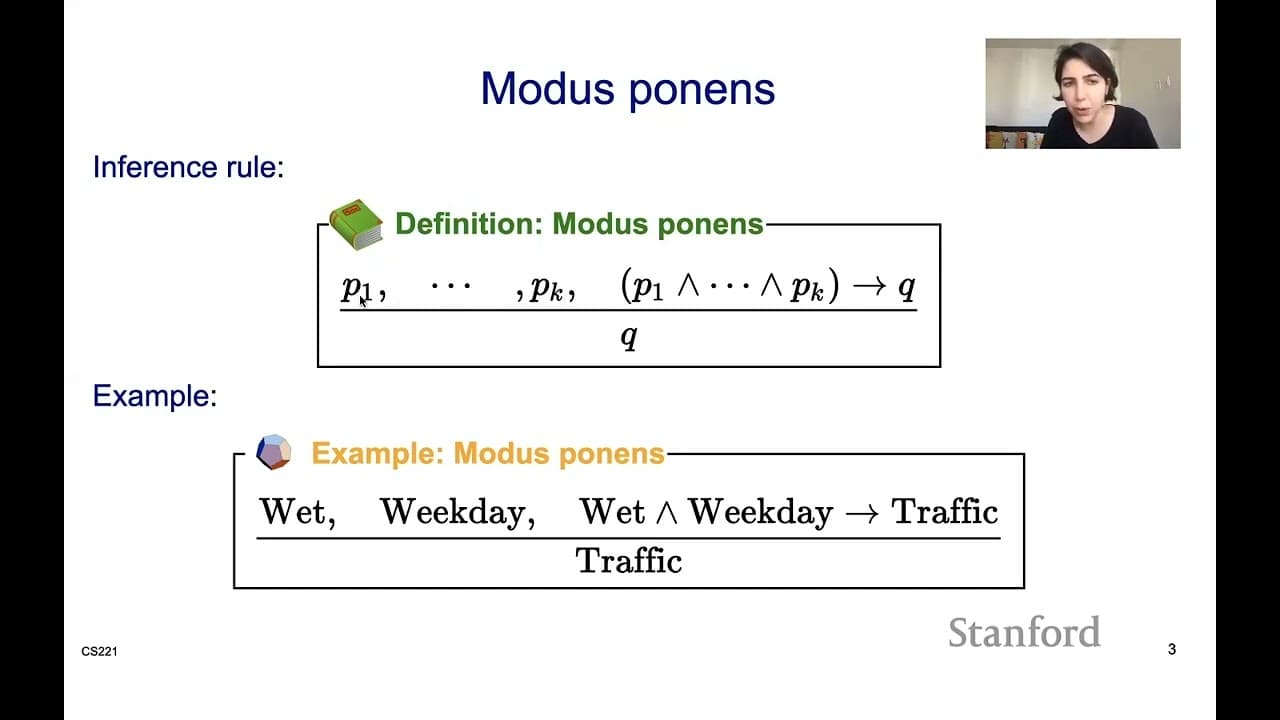
This module discusses how modus ponens applies to propositional logic with only horn clauses, and how completeness and soundness can be achieved in this setting.
Transcript
okay so in this module we would like to talk about foreign clauses specifically how modus ponens applies to propositional logic with only horned clauses and how we can show uh completeness and soundness in that setting okay so to do that you have to define a few other things uh so let me go back to my definitions here so here we've been talking abo... Read More
Key Insights
- ⚾ Modus ponens is an inference rule used to derive conclusions based on premises in propositional logic.
- 😈 Horn clauses are a type of clause that can either be definite clauses or goal clauses.
- 💁 Definite clauses have the form of positive information implying something positive, while goal clauses have the form of positive information implying false.
- 😈 Modus ponens is complete when applied only to horn clauses, meaning that any symbol entailed by a knowledge base consisting of only horn clauses can be derived using modus ponens.
- 😈 Derivation and entailment are equivalent when modus ponens is used with horn clauses, allowing for a simpler way to check if a proposition is true.
- 😈 Restricting formulas to horn clauses and using modus ponens with horn clauses ensures both soundness and completeness in propositional logic.
- 📏 The next module will discuss resolution, a fancier inference rule that can also achieve soundness and completeness.
- ❓ Formulas in propositional logic have syntax and semantic meaning, with models corresponding to the semantic interpretation.
Install to Summarize YouTube Videos and Get Transcripts
Explore YouTube Video Summarizer or Get YouTube Transcript Extractor
Questions & Answers
Q: What is the form of a definite clause?
A definite clause has the form of p1 anded through pk implying q. It consists of positive information implying something positive. It can also have just one propositional symbol, resulting in a form of true implies q.
Q: Is the negation of a propositional symbol a definite clause?
No, the negation of a propositional symbol is not a definite clause because it introduces negations, which are not allowed in definite clauses.
Q: What is a goal clause?
A goal clause is a clause of the form p1 anded through pk implying false. It can be thought of as the negation of the propositions in the clause.
Q: What is a horn clause?
A horn clause is a clause that can be either a definite clause or a goal clause. It is a more general form that allows for both positive information implying something positive and negation of propositions.
Summary & Key Takeaways
-
Modus ponens is an inference rule that can be used to derive conclusions based on premises in propositional logic.
-
Horn clauses are a type of clause that can either be a definite clause or a goal clause.
-
Modus ponens is complete when applied only to horn clauses, meaning that if a knowledge base consists of only horn clauses, any symbol that is entailed by the knowledge base can be derived using modus ponens.
Read in Other Languages (beta)
Share This Summary 📚
Summarize YouTube Videos and Get Video Transcripts with 1-Click
Try YouTube Summary with ChatGPT & Claude or YouTube Transcript Generator
Explore More Summaries from Stanford Online 📚


Summarize YouTube Videos and Get Video Transcripts with 1-Click
Try YouTube Summary with ChatGPT & Claude or YouTube Transcript Generator