How Do Voltages and Currents Work in RLC Circuits?
TL;DR
Voltages and currents in RLC circuits can be understood through a second-order differential equation that incorporates resistance, inductance, and capacitance. The concept of impedance combines these elements, affecting circuit behavior and allowing for analysis similar to mechanical systems. This foundational knowledge is essential for electrical engineering and circuit analysis.
Transcript
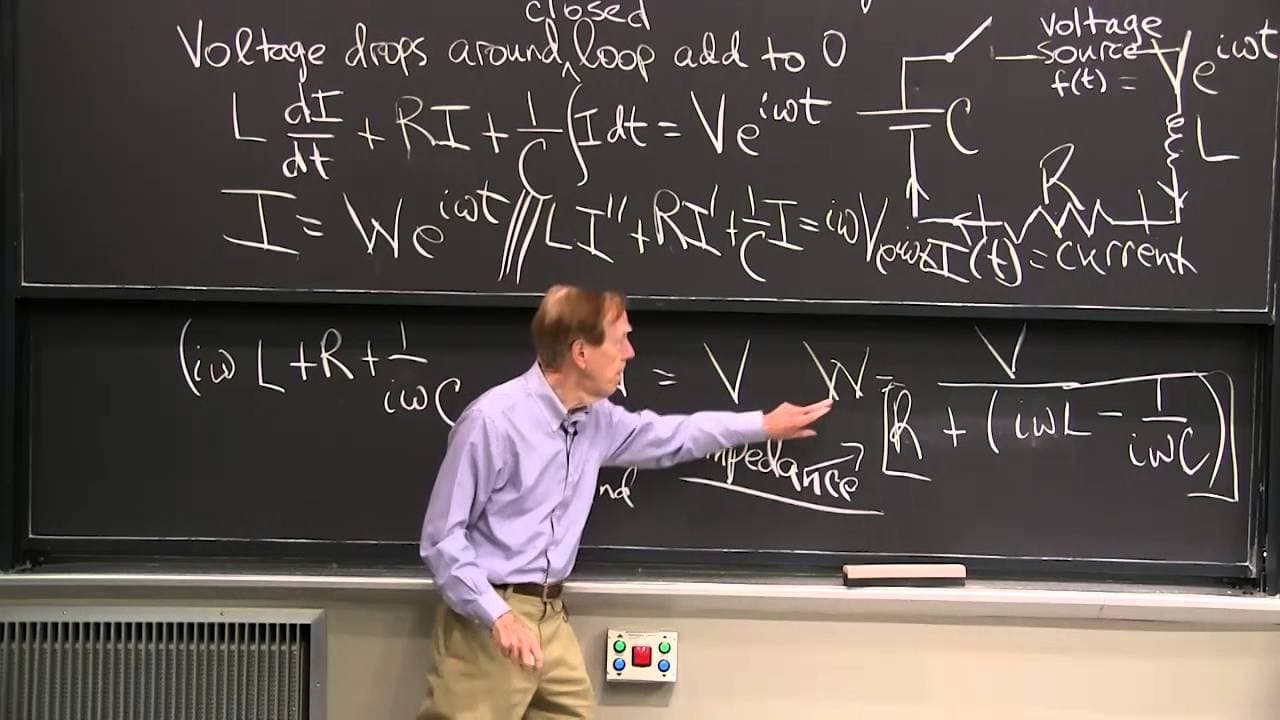
GILBERT STRANG: This video is about one of the key applications of ordinary differential equations to electrical flow, flow of currents in a network. And so I drew a network, a very simple network. It's just called an RLC loop. It's only got one loop, so it's a really simple network. The R stands for resistance to the flow. The L stands for an indu... Read More
Key Insights
- 💐 The RLC loop is a fundamental concept in electrical engineering, representing the flow of currents in a network.
- 😑 The voltage law in the RLC loop can be expressed as a second-order constant coefficient linear differential equation.
- 🖐️ The impedance, which includes the resistance, inductance, and capacitance, plays a crucial role in determining the behavior of the current in the RLC loop.
- 👻 The parallel between electrical engineering (RLC loop) and mechanical engineering (mass, damping, and stiffness) allows for analog computers to solve these equations.
Install to Summarize YouTube Videos and Get Transcripts
Explore YouTube Video Summarizer or Get YouTube Transcript Extractor
Questions & Answers
Q: What are the three elements of a simple RLC loop?
The three elements of an RLC loop are resistance (R), inductance (L), and capacitance (C). These elements determine the behavior of electrical flow in the loop.
Q: What is the purpose of the voltage source in the RLC loop?
The voltage source supplies the alternating current to the loop. It is represented by a voltage value multiplied by e to the i omega t, where omega represents the frequency of the alternating current.
Q: How is the voltage law expressed in the RLC loop?
The voltage law states that the sum of the voltage drops across the resistive, inductive, and capacitive elements, as well as the voltage source, should be zero in a closed loop.
Q: What is the significance of the impedance in the RLC loop?
The impedance represents the combined effect of resistance, inductance, and capacitance. It determines the magnitude and phase of the current flowing through the loop.
Summary & Key Takeaways
-
The video discusses the RLC loop, which consists of resistance, inductance, and capacitance, as the key elements of an electrical flow network.
-
The differential equation describing the voltage law in the loop is derived, taking into account the changing current and voltage sources.
-
The solution to the differential equation is found using the standard approach for constant coefficient problems with exponential forcing.
-
The impedance, which represents the resistance, inductance, and capacitance combined, is introduced as an important concept in electrical engineering.
Read in Other Languages (beta)
Share This Summary 📚
Summarize YouTube Videos and Get Video Transcripts with 1-Click
Try YouTube Summary with ChatGPT & Claude or YouTube Transcript Generator
Explore More Summaries from MIT OpenCourseWare 📚


Summarize YouTube Videos and Get Video Transcripts with 1-Click
Try YouTube Summary with ChatGPT & Claude or YouTube Transcript Generator