What Happens When a Light Bulb is Placed in Hydrofluoric Acid?
TL;DR
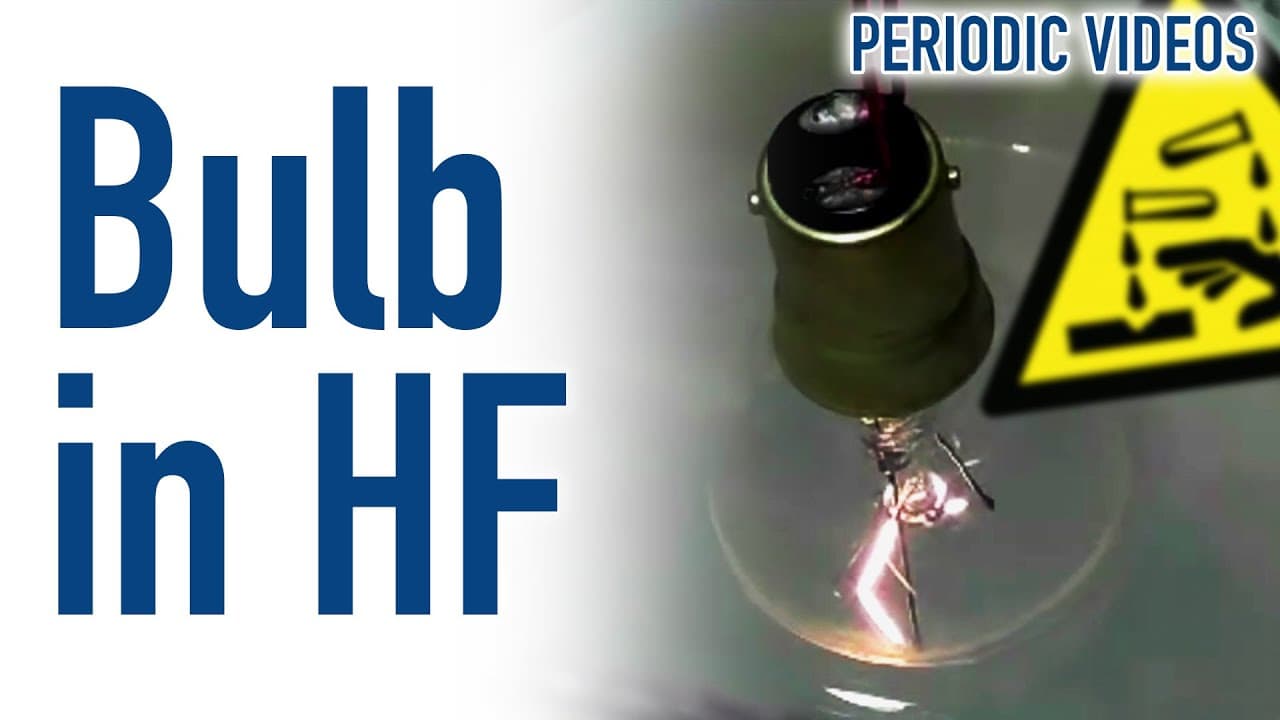
When a light bulb is submerged in hydrofluoric acid (HF), it undergoes a surprising reaction where the glass neatly cracks at the air-liquid interface before the filament dissolves, extinguishing the light. HF effectively dissolves glass by breaking silicon-oxygen bonds, demonstrating its corrosive power and raising important safety considerations.
Transcript
HF - hydrofluoric acid is probably the most feared chemical compound that there is. The reason it's so feared is that is that it is very corrosive. It will burn through human skin. Even quite a small exposure on your skin can cause a heart attack. And I really wanted--and I still want--to do an experiment with HF. ... or rather, I want Neil to do a... Read More
Key Insights
- 😣 Hydrofluoric acid is highly corrosive and can cause severe harm to human skin.
- 😎 HF can dissolve glass by breaking specific chemical bonds.
- 😎 The experiment demonstrated the neat cracking of a lightbulb when submerged in HF, highlighting the compound's ability to dissolve glass.
- 🥵 The reaction between HF and glass produces some heat.
- 💖 The lightbulb's electrodes continued to spark due to the remaining HF and alternating current.
- ❓ Sodium carbonate is used to neutralize HF and create sodium fluoride.
- ❓ Every experiment offers learning opportunities, as unexpected aspects can occur.
Install to Summarize YouTube Videos and Get Transcripts
Explore YouTube Video Summarizer or Get YouTube Transcript Extractor
Questions & Answers
Q: Why is hydrofluoric acid (HF) considered the most feared chemical compound?
HF is highly corrosive and can burn through human skin, causing severe damage and even heart attacks.
Q: What happens when HF comes into contact with glass?
HF breaks the silicon-oxygen bonds in glass and forms silicon-fluorine bonds, causing the glass to dissolve.
Q: What was the purpose of the experiment with a lightbulb and HF?
The experiment aimed to observe the reaction between HF and a lightbulb, which can serve as a demonstration of HF's ability to dissolve glass.
Q: Describe the outcome of the experiment.
The lightbulb experienced a neat crack along the surface where the glass was exposed to the HF. The acid dissolved the filament, leading to the lightbulb going out.
Summary & Key Takeaways
-
Hydrofluoric acid (HF) is a feared compound due to its corrosive nature and ability to burn through human skin.
-
HF can dissolve glass by breaking silicon-oxygen bonds and forming silicon-fluorine bonds.
-
In an experiment, a lightbulb was placed in HF, resulting in a neat crack along the surface and the acid dissolving the filament.
Read in Other Languages (beta)
Share This Summary 📚
Summarize YouTube Videos and Get Video Transcripts with 1-Click
Try YouTube Summary with ChatGPT & Claude or YouTube Transcript Generator
Explore More Summaries from Periodic Videos 📚

Summarize YouTube Videos and Get Video Transcripts with 1-Click
Try YouTube Summary with ChatGPT & Claude or YouTube Transcript Generator