How to Make Diethyl Ether Safely in the Lab
TL;DR
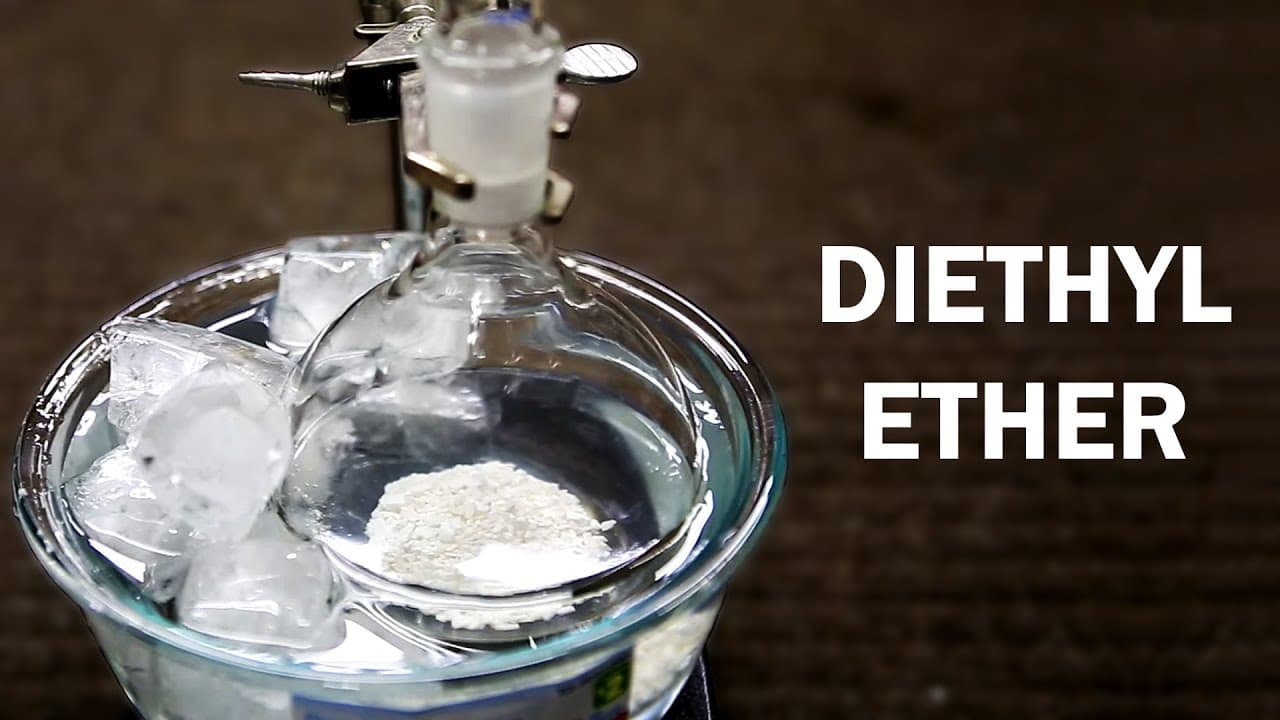
To make diethyl ether, mix anhydrous ethanol with concentrated sulfuric acid in a well-ventilated area, heating to 140-145°C for optimal production. After distillation, wash the ether with sodium bicarbonate and sodium chloride to remove impurities, and dry with anhydrous calcium chloride. The final yield should be around 208 mL, achieving a 70% yield.
Transcript
as a warning this experiment involves strong acids and high heat either is extremely volatile and ignites easily this experiment must absolutely only be carried out in an extremely well ventilated area ether can also be ignited by things like a hot plate and not necessarily just a flame ether is heavier than air and can travel along surfaces like a... Read More
Key Insights
- 🤲 Diethyl ether production involves a reaction between ethanol and sulfuric acid at a temperature of around 140 to 145 degrees Celsius.
- 😒 The use of a fractional column in the distillation process helps reduce the presence of impurities in the final product.
- ✳️ Proper ventilation is crucial during all steps of the experiment to minimize the risk of ignition.
- 🤲 Washing the crude ether with sodium bicarbonate and sodium chloride solutions helps remove impurities and aqueous layers.
- 💦 Anhydrous calcium chloride is used to dry the ether, absorbing any remaining water or ethanol.
- 🤲 The final yield of diethyl ether in this experiment was approximately 208 milliliters, representing a yield of about 70%.
Install to Summarize YouTube Videos and Get Transcripts
Explore YouTube Video Summarizer or Get YouTube Transcript Extractor
Questions & Answers
Q: What is diethyl ether, and why is it important?
Diethyl ether, also known as ethoxyethane, is a volatile and highly flammable organic compound commonly used as a solvent, anesthetic, and starting material in chemical synthesis.
Q: Why is it crucial to carry out this experiment in a well-ventilated area?
Diethyl ether is highly volatile and can easily ignite. It is also heavier than air, meaning it can accumulate along surfaces and create a potential ignition source. Therefore, proper ventilation is essential to prevent accidents.
Q: What is the purpose of adding sulfuric acid to the ethanol mixture?
Sulfuric acid acts as a catalyst in the reaction, facilitating the condensation of ethanol molecules to form diethyl ether and water.
Q: How can the formation of ethylene gas be avoided during the experiment?
The temperature during the reaction should be maintained between 140 to 145 degrees Celsius. Going above 150 degrees Celsius favors the production of ethylene gas instead of diethyl ether.
Summary & Key Takeaways
-
This content provides a step-by-step guide on how to produce diethyl ether using strong acids and high heat in a laboratory setting.
-
The experiment involves adding anhydrous ethanol and concentrated sulfuric acid to a round bottom flask, heating the mixture, and collecting the distillate.
-
Additional steps include washing the crude ether with sodium bicarbonate and sodium chloride solutions, drying it with anhydrous calcium chloride, and finally distilling the ether to obtain the final yield.
Read in Other Languages (beta)
Share This Summary 📚
Summarize YouTube Videos and Get Video Transcripts with 1-Click
Try YouTube Summary with ChatGPT & Claude or YouTube Transcript Generator
Explore More Summaries from NileRed 📚



Summarize YouTube Videos and Get Video Transcripts with 1-Click
Try YouTube Summary with ChatGPT & Claude or YouTube Transcript Generator