How to Build a Personal Brand People Love
TL;DR
Build a memorable personal brand by practicing one meaningful craft consistently for decades, embracing difficulty, and improving through repeated work. Obsess over quality instead of short-term metrics, trust your own taste before chasing audience approval, use setbacks as motivation, and maintain enough self-belief to continue when your vision looks unreasonable to others.
Transcript
To everyone who's ever told anyone with a dream they can't, this video is for you. Every iconic brand started with a founder that focused on a key principle to create something legendary. You're not in it for the money. I don't think anyone at the company's in it for the money. If today were the last day of my life, would I want to do what I am abo... Read More
Key Insights
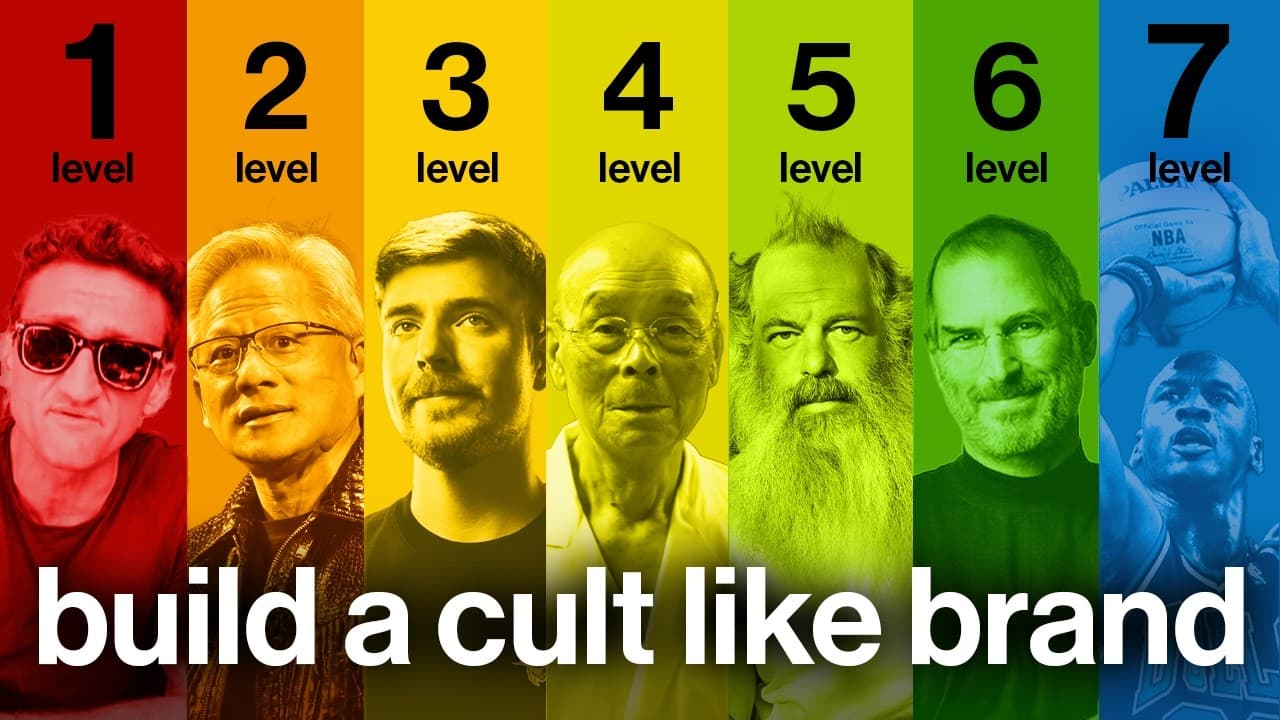
- Consistency is the most important foundation presented for building an iconic personal brand. Casey Neistat's 800 consecutive days of vlogging illustrate how daily filming, editing, and storytelling can produce extensive practice while establishing a dependable creative identity over a long period.
- Repeated practice is described as a compounding process rather than a linear one. The speaker claims that completing 100 repetitions while becoming 10 percent better with each repetition results in being 13,800 times better, emphasizing why sustained execution can matter more than immediate performance.
- Long-term commitment is more useful than short-term scorekeeping when developing a brand. The recommended strategy is to choose a craft you would genuinely enjoy practicing for the next 10 years, complete the work every day, avoid breaking the chain, and think in decades rather than years.
- Resilience is strengthened by hardship and moderated expectations. Jensen Huang argues that people with very high expectations can have low resilience, while Nvidia's survival after nearly going out of business in 1995 is presented as evidence that enduring painful periods can refine both founders and companies.
- Obsession with craft is a differentiator in crowded online markets. MrBeast is presented as focusing intensely on each video's quality rather than numbers or money, while repeatedly betting heavily on his projects and thinking about problems more than other creators to discover different solutions.
- Focused experimentation is more effective than casual participation for standing out on social platforms. The speaker recommends obsessing over one format on one platform, citing handwritten founder concepts that were shared thousands of times and reportedly produced more than 110,000 LinkedIn followers in one month.
- Authenticity is developed by creating from personal taste rather than constantly guessing what an audience wants. Rick Rubin's audience-last principle prioritizes the creator's intuition and judgment, because excessive concern about existing preferences can weaken the originality, depth, beauty, and personal essence of the work.
- Self-belief is a practical response to rejection and intimidating challenges. Michael Jordan used competitive criticism as fuel, while the speaker responded to a government raid by emailing 3,000 people in 48 hours, helping the situation trend on Twitter in Canada before receiving an operating exemption.
Install to Summarize YouTube Videos and Get Transcripts
Explore YouTube Video Summarizer or Get YouTube Transcript Extractor
Questions & Answers
Q: How do you build a personal brand people remember?
Build a memorable personal brand by selecting a craft you genuinely care about, practicing it consistently, and committing to it for decades rather than expecting rapid results. Focus intensely on improving the work, trust your taste, and explore the unusual qualities that make your perspective authentic. Difficult periods, criticism, rejection, and modest early numbers should become reasons to strengthen your resilience rather than abandon the effort.
Q: Why is consistency important for personal branding?
Consistency creates repeated opportunities to improve your skills, strengthen your message, and produce a recognizable body of work. Casey Neistat's 800 straight days of vlogging show the commitment involved: he filmed, edited, and assembled a story every day. The speaker recommends choosing a craft worth pursuing for the next 10 years, working daily, and allowing the score to take care of itself over time.
Q: How does repeated practice improve creative work?
Repeated practice improves creative work because every completed repetition provides another opportunity to refine judgment, execution, and technique. The speaker frames this improvement as compounding rather than linear, claiming that 100 repetitions with 10 percent improvement each time would make the final result 13,800 times better. The larger lesson is to prioritize sustained repetition instead of waiting for immediate recognition or perfect early work.
Q: How can hardship make a founder more resilient?
Hardship can force a founder to develop endurance, reconsider unsustainable methods, and discover better approaches. Jensen Huang connects high expectations with low resilience and treats suffering as a way to refine a company's character. The speaker similarly says that working 80 hours a week in his first business was painful, but that experience pushed him to find a better way because his original approach could not continue.
Q: How can obsession help a creator stand out?
Obsession helps a creator stand out by concentrating more attention, experimentation, and problem-solving on a craft than casual participants are willing to invest. MrBeast is presented as repeatedly betting heavily on each video and focusing on craft rather than money or audience numbers. The practical recommendation is to choose one format on one platform and work toward making that specific output exceptionally useful and distinctive.
Q: Should creators make content for themselves or their audience?
Creators should begin with their own taste, intuition, and judgment rather than allowing audience expectations to control the creative process. Rick Rubin's audience-last principle does not remove the audience from the equation, but it places the creator first. The argument is that audiences mainly recognize what has already existed, while creators can discover originality by exploring their own interests, values, and unusual ideas without excessive external filtering.
Q: How can rejection and criticism support personal brand growth?
Rejection and criticism can provide motivational fuel when they are converted into action rather than accepted as final judgments. Michael Jordan is presented as using competitive slights personally and returning stronger, despite being cut from his high school basketball team and missing game-winning shots. The broader principle is to pair setbacks with strong self-belief, then respond through more practice, persistence, outreach, or problem-solving.
Q: How long does it take to master a personal brand craft?
Mastery should be treated as a decades-long pursuit rather than something completed after three or five years. Jiro Ono is presented as making sushi in a subway station for 70 years while still saying he had not perfected rice. The example supports continuous improvement: creators should choose work they can sustain for 20 or 40 years and remain willing to practice even after achieving recognition.
Summary & Key Takeaways
-
Consistency creates the foundation of an iconic personal brand because repeated practice compounds skill over time. The recommended approach is to choose a craft you would enjoy pursuing for the next decade, work on it every day, avoid breaking the chain, and let long-term results emerge from sustained improvement rather than short-term scorekeeping.
-
Resilience and intense commitment help creators survive the difficult periods that accompany ambitious work. Jensen Huang, MrBeast, and Michael Jordan illustrate different aspects of this principle: enduring hardship, obsessing over craft, taking unusually large creative risks, and converting criticism, rejection, missed opportunities, or low early numbers into motivation for further effort.
-
Originality develops when creators trust their taste, intuition, judgment, and unusual interests instead of letting audience expectations control every decision. Rick Rubin's audience-last principle supports creating what you genuinely love. Combined with decades of deliberate practice, this authenticity can produce distinctive work that separates a personal brand from crowded platforms and familiar ideas.
Read in Other Languages (beta)
Share This Summary 📚
Summarize YouTube Videos and Get Video Transcripts with 1-Click
Try YouTube Summary with ChatGPT & Claude or YouTube Transcript Generator
Explore More Summaries from Matt Gray 📚
Summarize YouTube Videos and Get Video Transcripts with 1-Click
Try YouTube Summary with ChatGPT & Claude or YouTube Transcript Generator