#36 Machine Learning Specialization [Course 1, Week 3, Lesson 3]
TL;DR
Learn how to implement logistic regression, a powerful and widely-used learning algorithm, and understand the process of finding optimal parameter values using gradient descent.
Transcript
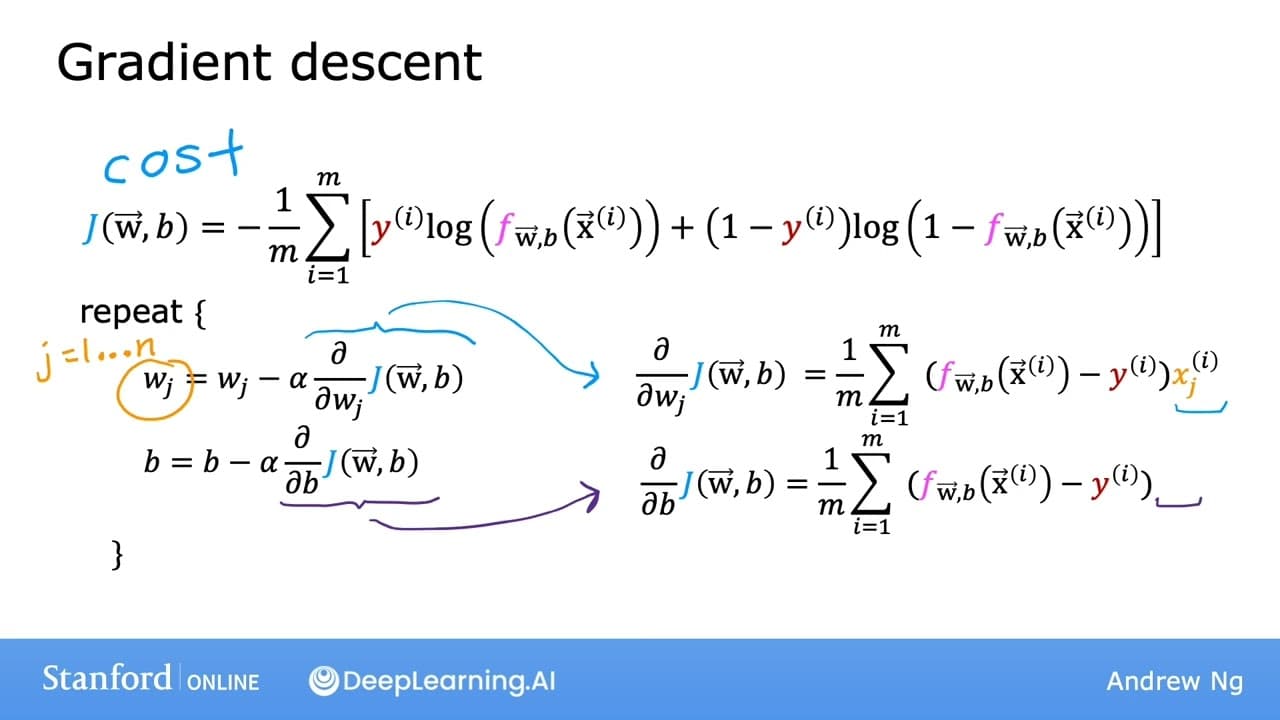
to fit the parameters of a logistic regression model we're going to try to find the values of the parameters W and B that minimize the cost function J of w and B and we'll again apply gradient descent to do this let's take a look at how in this video we'll focus on how to find a good choice of the parameters W and B after you've done so if you give... Read More
Key Insights
- 🇨🇷 Logistic regression finds the optimal values of parameters using gradient descent to minimize the cost function.
- 🫡 The derivative of the cost function with respect to W and B are crucial in the gradient descent algorithm.
- 🍉 Logistic regression and linear regression may appear similar in terms of update equations, but they differ in the definition of the function f(x).
Install to Summarize YouTube Videos and Get Transcripts
Explore YouTube Video Summarizer or Get YouTube Transcript Extractor
Questions & Answers
Q: How does logistic regression differ from linear regression?
Although the update equations for gradient descent look similar, the difference lies in the definition of the function f(x). In linear regression, f(x) is WX + B, whereas in logistic regression, it is the sigmoid function applied to WX + B.
Q: How can we ensure that gradient descent converges in logistic regression?
Similar to linear regression, monitoring the convergence of gradient descent in logistic regression can be done by applying the same methods. By observing the progression of the cost function, convergence can be confirmed.
Q: How does feature scaling affect gradient descent in logistic regression?
Feature scaling, which involves scaling all features to have similar value ranges, can speed up the convergence of gradient descent in logistic regression. This can be achieved by scaling the different features to have similar ranges of values (e.g., between -1 and +1).
Q: Can logistic regression be implemented using the scikit-learn library?
Yes, the scikit-learn library (cycle learn) provides functions to train logistic regression models for classification tasks. Many machine learning practitioners and companies regularly use scikit-learn for training models, making it a useful tool to explore.
Summary & Key Takeaways
-
Logistic regression aims to find the optimal values of parameters (W and B) that minimize the cost function (J) through the use of gradient descent.
-
By finding the right parameter values, the model can make predictions or estimate the probability of a label being 1 based on new inputs.
-
The derivative of J with respect to W and B are key components in the gradient descent algorithm for logistic regression.
Read in Other Languages (beta)
Share This Summary 📚
Summarize YouTube Videos and Get Video Transcripts with 1-Click
Try YouTube Summary with ChatGPT & Claude or YouTube Transcript Generator
Explore More Summaries from DeepLearningAI 📚


![How Does the Logistic Regression Decision Boundary Work? — #33 Machine Learning Specialization [Course 1, Week 3, Lesson 1] thumbnail](/_next/image?url=https%3A%2F%2Fi.ytimg.com%2Fvi%2F0az8RjxLLPQ%2Fhqdefault.jpg&w=750&q=75)

Summarize YouTube Videos and Get Video Transcripts with 1-Click
Try YouTube Summary with ChatGPT & Claude or YouTube Transcript Generator