What Were the Vanaras in the Ramayana?
TL;DR
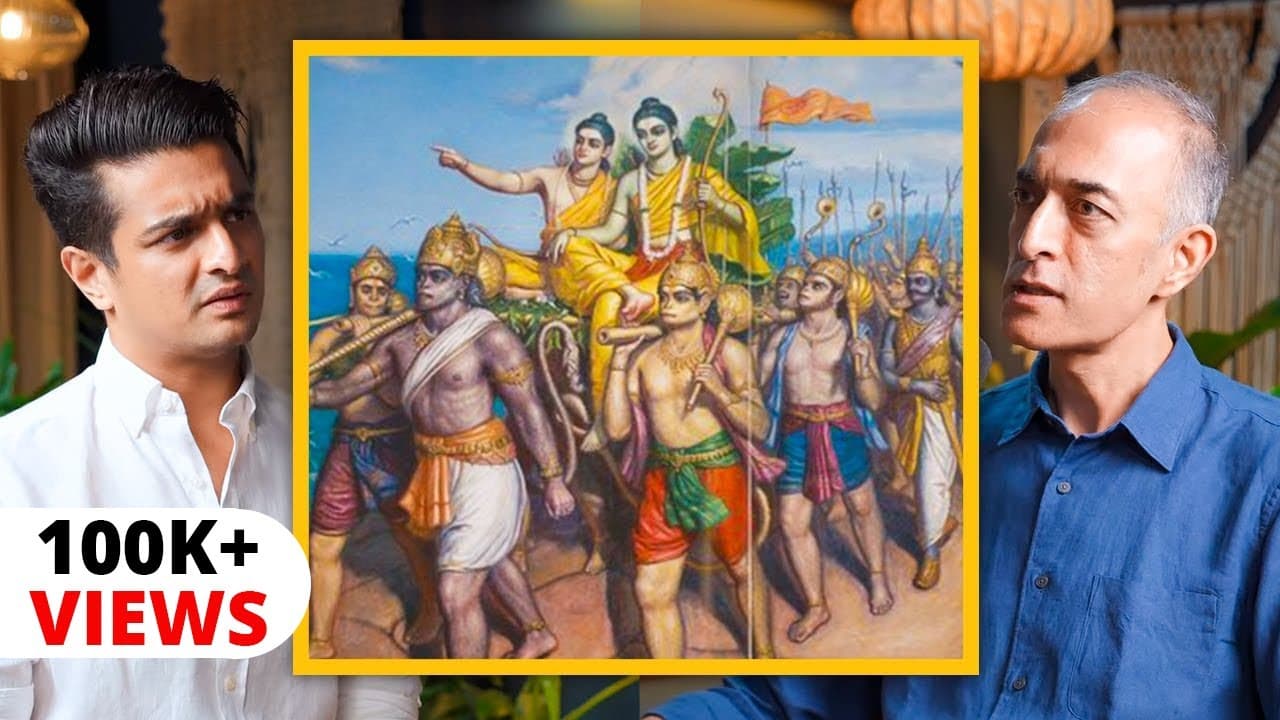
The Vanaras, often mistaken for monkeys, were actually human forest dwellers with cultural ties to urban society, as described in Valmiki's texts. Their appearance was likely a costume, and despite not practicing agriculture, they had an advanced city called Kishkindha, showcasing their complex societal structure.
Transcript
Happ through Curiosity on the ren show do want to answer the age-old question about the rakshasas and the vanaras I've asked this to a lot of guess uh no one's given me an a solid answer till date so after all your study what do you make of the rasas and theas the vanas sure and in fact see again the reference text is theik Ram that is the IAS so w... Read More
Key Insights
- 🙈 The term 'Vanara' should not be strictly interpreted as 'monkey'; it also denotes forest-dwelling humans adept at survival.
- ❓ The attire and appearance of the Vanaras exemplify cultural practices, indicating their ability to modify appearances for various contexts.
- 💆 Their connection to sages indicates a lineage that integrates with mythological heritage, blending human capabilities with supernatural narratives.
- 🏙️ Contrary to modern perceptions, not all forest-dwellers are primitive; the Vanaras exhibit complex societal structures, having established a prominent city.
- 🪡 The interpretation of Vanaras reveals challenges in historical perspectives, emphasizing the need to reconsider tribal designations and cultural identities.
- 👳 The rituals described in Valmiki's Ramayana reflect shared practices between urban and forest cultures, illustrating interconnected societal values.
- 🍌 The dietary habits of the Vanaras, embracing fruits and roots, propose a unique non-agricultural lifestyle that still supported a structured community.
Install to Summarize YouTube Videos and Get Transcripts
Explore YouTube Video Summarizer or Get YouTube Transcript Extractor
Questions & Answers
Q: What evidence supports the claim that Vanaras were humans?
Valmiki’s texts provide clarity on the nature of the Vanaras, using descriptors that emphasize their humanness. Various adjectives used to describe them indicate their cultural practices and societal structures, aligning them closely with human communities rather than viewing them as a separate species. For instance, references to their capital city, Kishkindha, and terms like 'Jana', which refers to human beings, reinforce this notion.
Q: Why did Hanuman change his appearance when meeting Rama and Lakshmana?
Hanuman was advised to greet Rama and Lakshmana in his natural form, suggesting a closer alignment with human aesthetics rather than his usual appearance. This emphasizes the duality of his identity, where he could adopt different forms for various circumstances, highlighting the adaptability of the Vanara community in their interactions with other beings.
Q: What cultural similarities existed between Vanaras and city dwellers?
Valmiki illustrates that the Vanaras shared cultural elements, such as rituals and celebrating significant events in a manner similar to those in city communities. The last rites of Valin, a Vanara, were described in ways that mirrored traditional rituals, showcasing how their social customs, despite different lifestyles, were intertwined through shared heritage.
Q: How does the geographical context of the Vanaras influence their characterization?
Geographically, the Vanaras were depicted as residing in forests and mountains, extending across regions like Karnataka to the Himalayas. This setting naturally influenced their lifestyle, where they relied on forest resources for sustenance. Valmiki's references to their habitation patterns emphasize that the Vanaras, despite their forest-dwelling status, did possess an organized society with substantial urban structures.
Summary & Key Takeaways
-
The Vanaras, often depicted as monkeys, were actually human forest dwellers with similar cultural roots as city inhabitants, as supported by Valmiki's texts.
-
Their appearance, including features like tails, was likely an elaborate costume or attire, suggesting they could shed their "monkey" guise when necessary.
-
Despite not practicing agriculture, the Vanaras had a significant city, Kishkindha, and maintained unique practices, challenging modern interpretations of tribal communities.
Read in Other Languages (beta)
Share This Summary 📚
Summarize YouTube Videos and Get Video Transcripts with 1-Click
Try YouTube Summary with ChatGPT & Claude or YouTube Transcript Generator
Explore More Summaries from TRS Clips 📚




Summarize YouTube Videos and Get Video Transcripts with 1-Click
Try YouTube Summary with ChatGPT & Claude or YouTube Transcript Generator