What Is the Best Cooking Oil for Health and Cooking?
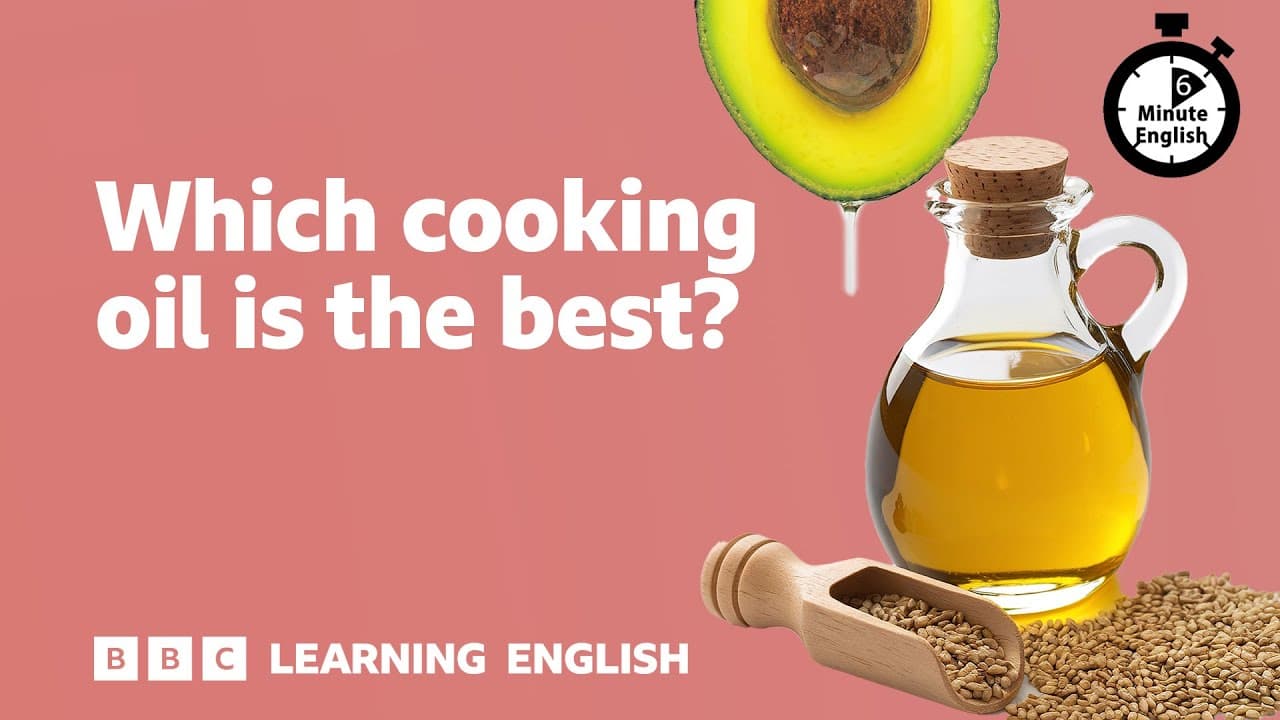
TL;DR
The best cooking oil varies based on health benefits and cooking methods. Extra-virgin olive oil is often recommended despite concerns about high-temperature cooking, while avocado oil offers health advantages but may not justify its cost for all consumers. Ultimately, the choice of oil should consider both health factors and personal preferences.
Transcript
Hello and welcome to 6 Minute English from BBC Learning English. I'm Georgie. And I'm Neil. Georgie, today we're talking about cooking oils and which products are best for our health. What do you use to cook with? Olive oil? Butter? Maybe avocado oil? Hmm, when I want my food to be rich and creamy, I use butter, but usually for everyday meals I jus... Read More
Key Insights
- The discussion focuses on various cooking oils and their health benefits, including olive oil, butter, avocado oil, and sesame oil.
- Many expensive oils claim to offer significant health benefits, but experts question the validity of these claims.
- Listener Alastair expresses confusion over conflicting advice about cooking oils, highlighting the complexity of choosing the right oil.
- The term 'wok-load' is used humorously to describe the large number of emails received about cooking oils.
- Some experts advocate for extra-virgin olive oil despite concerns about its use at high temperatures.
- Avocado oil is seen as beneficial, but its high cost is justified only if one is a connoisseur of its taste.
- The expression 'knock yourself out' is used to suggest going ahead with a decision, while 'hogwash' refers to baseless claims.
- Spain is the largest producer of olive oil, contrary to the common belief that it might be Italy.
Install to Summarize YouTube Videos and Get Transcripts
Explore YouTube Video Summarizer or Get YouTube Transcript Extractor
Questions & Answers
Q: What is the main focus of the discussion in the video?
The main focus of the discussion is to evaluate different cooking oils and their health benefits. The hosts, Georgie and Neil, explore whether expensive oils like avocado oil are worth the cost and if the health claims associated with them are legitimate. The conversation also touches on the confusion consumers face due to conflicting advice about cooking oils.
Q: What confusion does listener Alastair express in the video?
Listener Alastair expresses confusion over the conflicting advice he has received about cooking oils. He mentions that while some sources advocate for polyunsaturated oils like sunflower oil, others warn against seed oils and recommend extra-virgin olive oil. He is particularly concerned about the suitability of olive oil for frying and roasting, given the warnings about its use at high temperatures.
Q: What humorous expression is used to describe the volume of inquiries about cooking oils?
The humorous expression 'wok-load' is used to describe the large volume of inquiries received about cooking oils. This term is a play on words, combining 'wok'—a type of cooking pan—with 'load,' to emphasize the substantial number of emails sent to the program about this topic. It's a light-hearted way to convey the widespread interest in cooking oils.
Q: What stance does Nita Forouhi take on expensive cooking oils?
Nita Forouhi, a professor of population health and nutrition, acknowledges that avocado oil has some health benefits but questions whether these benefits justify its high cost. She suggests that unless someone is a connoisseur of its taste and willing to spend the money, the health claims surrounding such expensive oils are often exaggerated and can be considered 'hogwash'—meaning nonsense or not true.
Q: What vocabulary terms are introduced in the video?
The video introduces several vocabulary terms, including 'wok-load,' which means a large amount of something; 'advocate,' meaning to encourage the use of something; 'what the heck,' an expression of frustration or surprise; 'wonder product,' referring to something perceived as highly effective; 'knock yourself out,' meaning go ahead; and 'hogwash,' which describes something as nonsense or untrue.
Q: What is the correct answer to the quiz question about olive oil production?
The correct answer to the quiz question about which country produces the most olive oil is Spain. Despite common beliefs that Italy might be the largest producer, Spain actually holds this title. This information is revealed at the end of the program, correcting the initial guess made by Georgie.
Q: How does the video address the health claims of cooking oils?
The video addresses the health claims of cooking oils by questioning their validity and discussing expert opinions. While some oils are marketed as 'wonder products' with significant health benefits, experts like Nita Forouhi argue that these claims are often exaggerated. The video emphasizes the need for consumers to critically evaluate such claims and consider whether the benefits justify the cost.
Q: What advice does the video offer to consumers about choosing cooking oils?
The video advises consumers to be critical of the health claims associated with expensive cooking oils and to consider their personal preferences and budget. It suggests that while some oils may offer health benefits, these are not always proportional to their cost. Consumers should weigh the taste, cost, and purported benefits before deciding on which oil to use regularly in their cooking.
Summary & Key Takeaways
-
The episode discusses various cooking oils, such as olive oil, butter, and avocado oil, and their purported health benefits. It questions whether these oils are worth their cost and examines the validity of health claims associated with them.
-
Listener Alastair's confusion about cooking oils highlights the mixed messages consumers receive. The program humorously refers to the large volume of inquiries as a 'wok-load,' emphasizing the widespread interest in the topic.
-
Experts suggest that while some oils like avocado oil have health benefits, the claims about them being 'wonder products' are often exaggerated. The discussion also includes vocabulary like 'knock yourself out' and 'hogwash' to describe decision-making and dubious claims.
Read in Other Languages (beta)
Share This Summary 📚
Summarize YouTube Videos and Get Video Transcripts with 1-Click
Try YouTube Summary with ChatGPT & Claude or YouTube Transcript Generator
Explore More Summaries from BBC Learning English 📚

Summarize YouTube Videos and Get Video Transcripts with 1-Click
Try YouTube Summary with ChatGPT & Claude or YouTube Transcript Generator