Stanford CS229M - Lecture 17: Implicit regularization effect of the noise
TL;DR
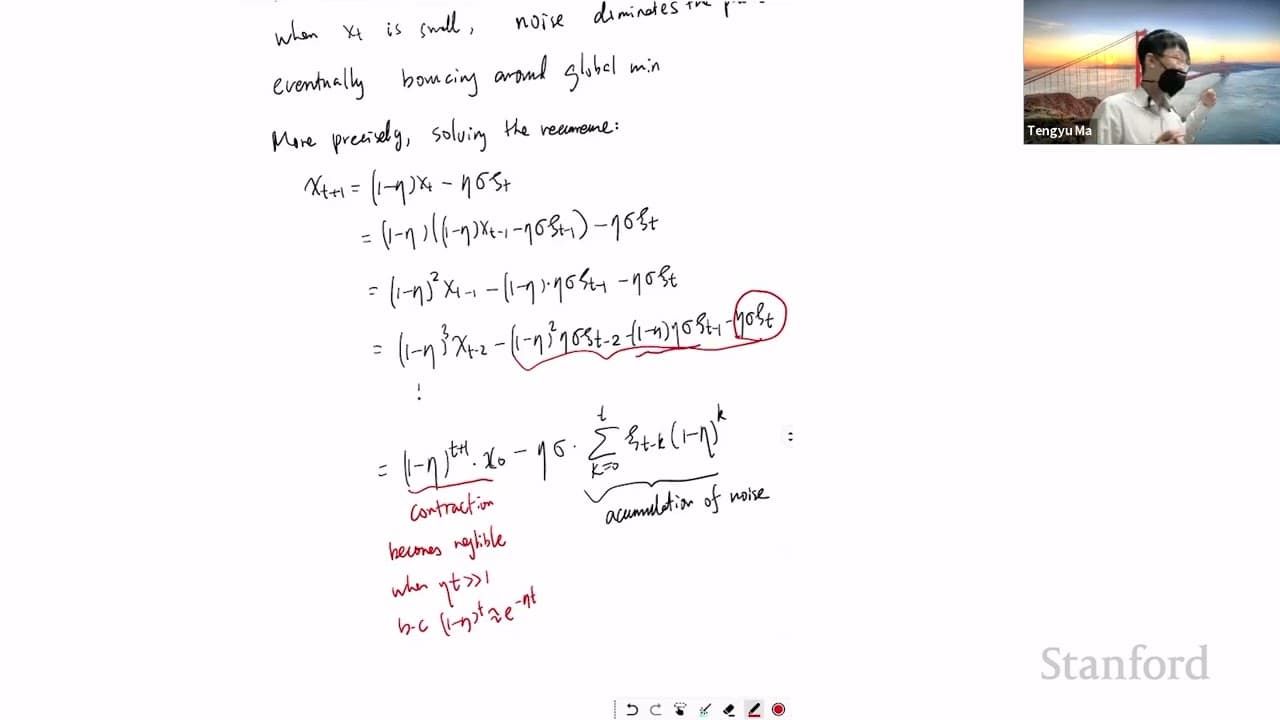
This analysis explores the impact of noise and third-order terms in optimization algorithms, highlighting their effects on convergence and implicit regularization.
Transcript
uh okay cool let's get started so guys um today we're going to talk about um implicit regularization of the noise so and the plan today is that um because this is a pretty challenging topic and and I think the the research Community is still in some sense doing research on this um so we have some results um it's pretty complicated so what I'm gonna... Read More
Key Insights
- 🥺 Noise in optimization algorithms can cause oscillatory behavior in the iteration process, leading to convergence near the global minimum.
- 🥺 The third-order term in non-quadratic loss functions introduces bias and regularization effects, potentially leading to convergence to a different minimum.
- 👾 The dimensionality of the problem space can influence the impact of noise and third-order terms on the optimization process.
Install to Summarize YouTube Videos and Get Transcripts
Explore YouTube Video Summarizer or Get YouTube Transcript Extractor
Questions & Answers
Q: How does noise affect the convergence of optimization algorithms?
Noise in optimization algorithms introduces fluctuations in the iteration process. In the case of quadratic loss functions, the noise causes the iteration to oscillate around the global minimum. However, in non-quadratic loss functions, the effects of noise are smaller and the iteration is more biased towards certain directions.
Q: What role does the third-order term play in optimization algorithms?
The third-order term introduces biased effects in the optimization process. In non-quadratic loss functions, this term accumulates over time and can lead the optimization algorithm to converge to a different minimum than anticipated. It acts as a form of regularization, influencing the final solution.
Q: Can noise and third-order terms be analyzed separately in optimization algorithms?
Yes, noise and third-order terms can be analyzed separately. Noise affects the iteration process by introducing fluctuations, while the third-order term leads to biased effects and regularization. Understanding the impact of both components is crucial for comprehensively analyzing optimization algorithms.
Q: How does the dimensionality of the problem space affect optimization algorithms' implicit regularization?
In the presence of noise and third-order terms, the convergence behavior and implicit regularization of optimization algorithms can be influenced by the dimensionality of the problem space. For example, if the problem space is low-dimensional, the effects of noise and regularization may be more pronounced.
Summary & Key Takeaways
-
The lecture introduces the concept of implicit regularization in optimization algorithms, focusing on the effects of noise and third-order terms.
-
In a quadratic loss function, the noise component in the stochastic algorithm causes the iteration to oscillate around the global minimum, eventually converging to a stable level near the minimum.
-
In non-quadratic loss functions, the third-order term introduces bias and regularizes the optimization process, potentially leading to a different minimum than that of the original loss function.
Read in Other Languages (beta)
Share This Summary 📚
Summarize YouTube Videos and Get Video Transcripts with 1-Click
Try YouTube Summary with ChatGPT & Claude or YouTube Transcript Generator
Explore More Summaries from Stanford Online 📚

Summarize YouTube Videos and Get Video Transcripts with 1-Click
Try YouTube Summary with ChatGPT & Claude or YouTube Transcript Generator