How to Calculate Acceleration Components for a Truck on a Runaway Ramp
TL;DR
To calculate the acceleration components of a truck using a runaway ramp, first determine the average acceleration, which is -5 m/s². The X component is found using the cosine of the slope angle, resulting in approximately -4.33 m/s², and the Y component is calculated using the sine, yielding -2.5 m/s².
Transcript
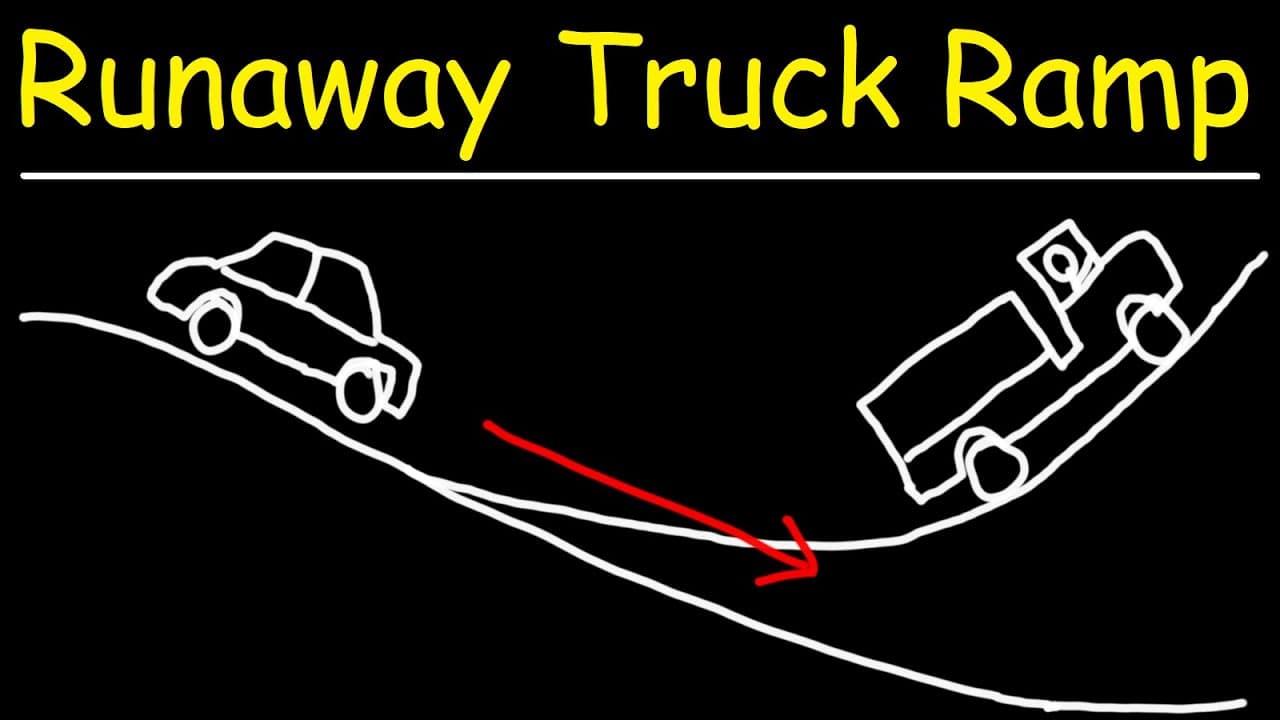
a truck is going down a mountainous Hill when its brakes begin to fail the truck uses the next available Escape Route by turning into a runaway ramp the truck that celebrates from a speed of 40 meters per second to a complete stop in 8 Seconds now this particular wrap has a constant upward slope of 30 degrees our goal in this problem is to calculat... Read More
Key Insights
- 🚙 Runaway ramps provide a safe escape for vehicles with brake failures.
- 🤩 The average acceleration of the truck is negative due to deceleration.
- 🇾🇪 The X and Y components of acceleration are calculated using trigonometry.
- 🌍 Understanding physics concepts like acceleration, vectors, and components is important for analyzing real-world scenarios.
- 🥶 The video creator offers additional resources on related topics like kinematics, free fall physics, and projectile motion.
- 🎮 The full versions of the videos provide more practice problems to help with exam preparation.
- 🍻 The description section of the YouTube videos contains links to access the full versions.
Install to Summarize YouTube Videos and Get Transcripts
Explore YouTube Video Summarizer or Get YouTube Transcript Extractor
Questions & Answers
Q: How does a runaway ramp work?
A runaway ramp is a sloped area that allows a truck with failed brakes to safely slow down using gravity. The ramp's uphill slope causes the truck to decelerate until it comes to a complete stop.
Q: How is the acceleration of the truck calculated?
The acceleration is calculated using the formula: acceleration = (change in velocity) / (time). In this case, the initial velocity is 40 m/s, final velocity is 0 m/s, and time is 8 seconds, resulting in an average acceleration of -5 m/s^2.
Q: How can the X and Y components of the acceleration be determined?
To find the X component, the formula X component = acceleration * cos(theta) is used, and for the Y component, the formula Y component = acceleration * sin(theta) is used. In this case, the X component is approximately -4.33 m/s^2 and the Y component is approximately -2.5 m/s^2.
Q: Have you ever seen a truck use a runaway truck ramp?
Feel free to share your experiences in the comment section below.
Summary & Key Takeaways
-
A truck's brakes fail while going downhill, prompting it to use a runaway ramp to safely stop.
-
The truck decelerates from 40 m/s to 0 m/s in 8 seconds.
-
The average acceleration of the truck is calculated to be -5 m/s^2.
Read in Other Languages (beta)
Share This Summary 📚
Summarize YouTube Videos and Get Video Transcripts with 1-Click
Try YouTube Summary with ChatGPT & Claude or YouTube Transcript Generator
Explore More Summaries from The Organic Chemistry Tutor 📚




Summarize YouTube Videos and Get Video Transcripts with 1-Click
Try YouTube Summary with ChatGPT & Claude or YouTube Transcript Generator