Mastering Pleat Folding Techniques for Paper
TL;DR
Master efficient pleat folding techniques for hyperbolic paraboloids to optimize your folding workflow. Learn to navigate through various folding methods and the importance of achieving specific patterns with minimal operations.
Transcript
PROFESSOR: So this lecture was about hyperbolic paraboloids, and the extent to which they don't exist or exist. Here is a regular non-existing hyperbolic paraboloid with the concentric squares, no diagonals, folded here. And so, those are just a few questions about this. What does it mean, other things. These are all asked by [INAUDIBLE] I believe,... Read More
Key Insights
- 💁 Hyperbolic paraboloids have both existing and non-existing forms, which depend on various factors.
- 😥 Smoothness of functions can be categorized into different levels (C0, C1, C2, C∞), which describe the continuity and existence of derivatives at different points.
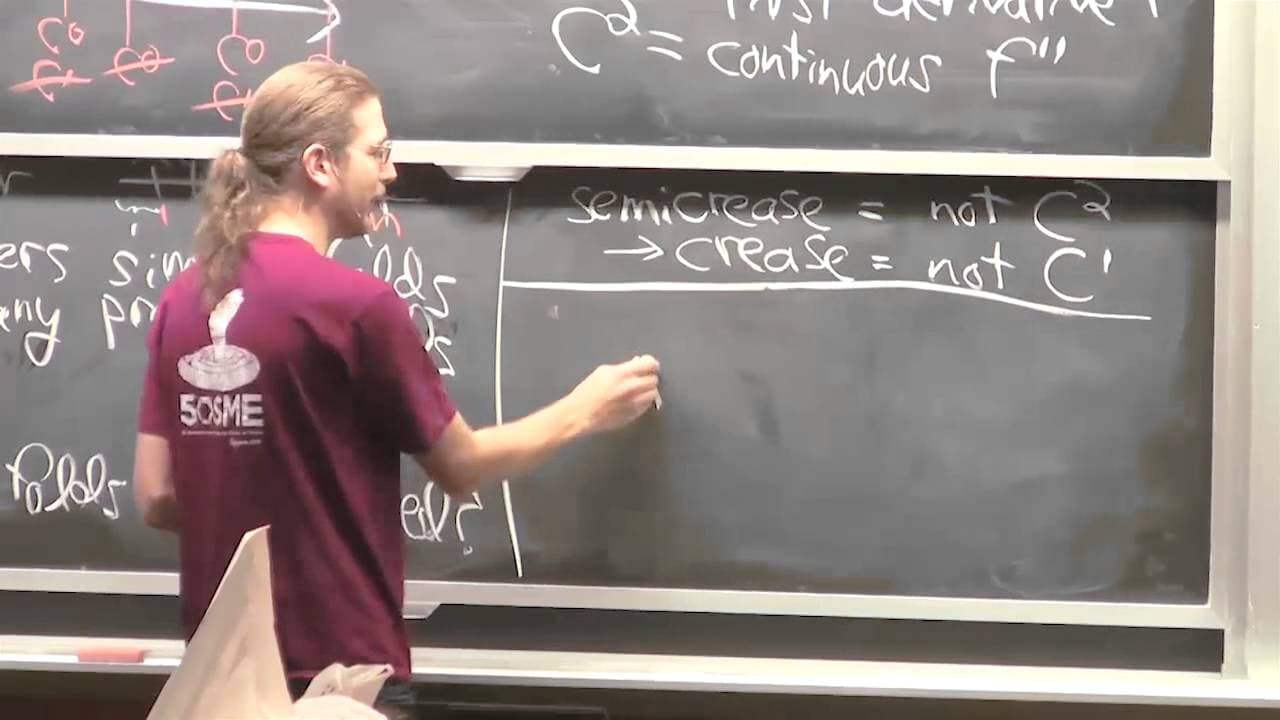
- 🖐️ Creases and semi-creases play a role in understanding the folding and smoothness of paper.
- 🪭 Efficient folding techniques, such as pleat folding, can reduce the number of folding operations for specific patterns.
Install to Summarize YouTube Videos and Get Transcripts
Explore YouTube Video Summarizer or Get YouTube Transcript Extractor
Questions & Answers
Q: What is the difference between continuous, C0, C1, and C2 smoothness for functions?
Continuous means no sudden jumps or breaks in the function, C0 adds the requirement of continuity at individual points, C1 requires continuous and existing first derivative, and C2 requires a continuous second derivative.
Q: What are creases and semi-creases in paper folding?
Creases occur when two different tangent planes converge, resulting in a discontinuity in the first derivative. Semi-creases, on the other hand, are discontinuities in the second derivative.
Q: Why is it important to fold along the diagonals when starting to fold hyperbolic paraboloids?
Folding along the diagonals helps to establish the center point of the paper and creates a reference line for subsequent folds.
Q: How can efficiency be achieved in pleat folding for specific mountain-valley (mv) patterns?
By identifying repetitions and patterns within the mv string, it is possible to reduce the number of folding operations required. The efficiency is determined by the specific mv pattern.
Summary & Key Takeaways
-
The lecture covers hyperbolic paraboloids and their existence/non-existence.
-
It discusses the concepts of C0, C1, C2, and C∞ smoothness for functions.
-
The lecture also mentions the terms creases and semi-creases in relation to paper folding.
Read in Other Languages (beta)
Share This Summary 📚
Summarize YouTube Videos and Get Video Transcripts with 1-Click
Try YouTube Summary with ChatGPT & Claude or YouTube Transcript Generator
Explore More Summaries from MIT OpenCourseWare 📚


Summarize YouTube Videos and Get Video Transcripts with 1-Click
Try YouTube Summary with ChatGPT & Claude or YouTube Transcript Generator