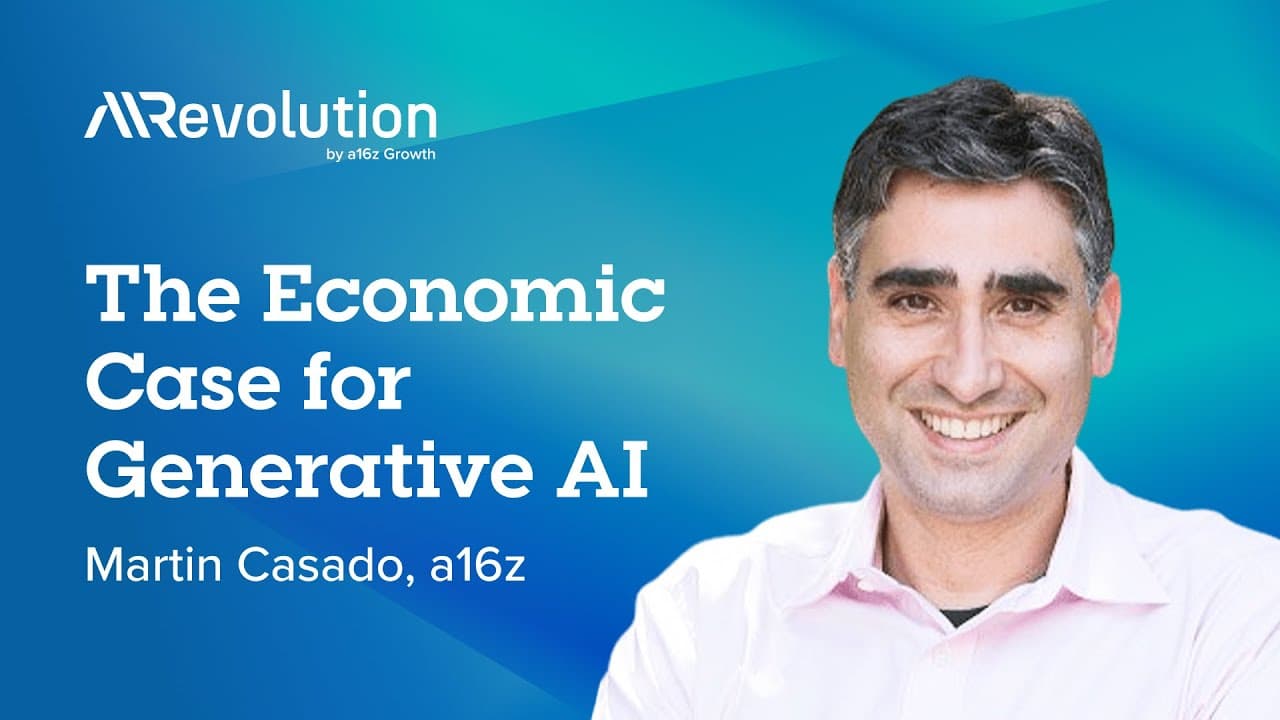
The Economic Case for Generative AI with a16z's Martin Casado
TL;DR
Startups struggle with generative AI economics due to niche markets, the need for high correctness, and competition with human capabilities, making profitability elusive. However, the latest AI models tap into large markets without strict correctness requirements, which could reduce costs significantly and enable the rise of new transformative companies.
Transcript
we should all get ready for a new wave of iconic companies I don't think we know what they're going to look like but the economics are just too compelling okay so what has the narrative been for AI over the last 50 years right the narrative is this this episodic thing with Summers and Winters and all of these false promises I remember when I joined... Read More
Key Insights
- ❓ AI has made progress in solving real problems over the years but struggled with monetization and platform shifts.
- 😀 Startups have faced challenges due to niche markets, correctness requirements, high investment costs, and competition with human capabilities.
- 👋 The current wave of AI models is different, with potential for market transformation and the emergence of new iconic companies.
- 🌥️ These models are applicable to large markets, do not require strict correctness, are software-based, and leverage the advantages of the Silicon stack.
- ⌛ The economics of AI models offer significant cost and time advantages, making them economically attractive for various applications.
- 🥺 Javon's Paradox suggests that the demand for AI compute is elastic, leading to increased productivity and new job opportunities.
Install to Summarize YouTube Videos and Get Transcripts
Explore YouTube Video Summarizer or Get YouTube Transcript Extractor
Questions & Answers
Q: Why haven't there been many new AI-native companies that have displaced incumbents like in other industries?
Startups have faced challenges in niche markets, achieving correctness in tail solutions, high investment costs, and competition with the human brain's efficiency and capabilities. These factors have favored the incumbents in AI monetization.
Q: What are the limitations of startups in the AI space?
Startups struggle with niche markets, the need for correctness in tail solutions, high investment costs, and competition with the human brain's capabilities. These factors make it difficult for startups to achieve breakthrough economics and displace incumbents.
Q: How are the current wave of AI models different from previous AI efforts?
The current models are applicable to large markets, do not require strict correctness, are primarily software-based, and leverage the advantages of the Silicon stack. These factors make them more economically viable for startups and have the potential for market transformation.
Q: How do the economics of AI models compare to traditional methods?
AI models offer significant cost and time advantages compared to traditional methods like hiring human experts. The difference can be as high as four to five orders of magnitude, making them economically attractive for various applications.
Summary
In this video, the speaker discusses the progress and challenges of AI over the past 70 years. They explain that while AI has made tremendous strides and solved many real problems, it has not resulted in a platform shift or the emergence of new AI-native companies. The speaker argues that this is due to the difficult economics for startups, as many AI use cases are niche markets and require correctness in the tail of the solution space. They also highlight the high investment and lower margins associated with AI startups, as well as the competition with the human brain in areas like perception. However, the speaker believes that the current wave of AI, powered by models that can generate natural language conversation, images, and more, is different. They describe how these models are being applied to large markets, such as creativity, companionship, and copilot tasks, and how the economics are more compelling for startups to break away. The speaker suggests that this could lead to a new generation of iconic companies and a transformation of the industry.
Questions & Answers
Q: What has been the narrative for AI over the last 50 years?
The narrative for AI has been one of love-hate, with periods of enthusiasm and periods of skepticism. While there have been many false promises and episodic trends, AI has made significant progress and solved real problems in areas like expert systems, chess, self-driving cars, and vision. However, every time a problem is solved, it is often dismissed as not being "true AI," resulting in a constant shifting of the goalposts.
Q: Why hasn't the value of AI accrued to new AI-native companies and resulted in a platform shift?
The speaker argues that the economics of AI for startups have been challenging. Many AI use cases are niche markets, and traditional use cases often require correctness in the long tail of the solution space, making it hard for startups to compete. Hiring people to provide solutions becomes a variable cost, and the investment required to stay ahead increases while the value decreases. Additionally, hardware, such as robotics, poses difficulties and the competition with the human brain in areas like perception is tough. These challenges have resulted in the value accruing to large companies instead of new AI-native startups.
Q: Why is the current wave of AI different and more promising for startups?
The current wave of AI, powered by models that can generate natural language conversation, images, and more, is more promising for startups due to several reasons. Firstly, these models are being applied to large markets, such as creativity, companionship, and copilot tasks, which presents significant opportunities. Secondly, correctness is not as much of an issue in these use cases, as creativity has no formal notion of correctness and the iterative behavior allows for constant feedback and correction from users. Lastly, these use cases are primarily software-based, reducing the complexity of hardware and competition with the human brain.
Q: What are the competitive advantages of AI models over traditional human processes?
AI models have competitive advantages over traditional human processes in several ways. Firstly, they can generate outputs at a significantly lower cost and in a fraction of the time compared to hiring human experts. This is especially evident in tasks like generating images or automating legal brief analysis. The cost and time differences can be several orders of magnitude, making AI models economically more advantageous. Secondly, AI models can perform iterative tasks, allowing for continuous improvement and correction based on user feedback. This reduces errors and enhances efficiency compared to humans. Finally, AI models have a higher capability to handle complex tasks that traditionally required human expertise, leading to increased productivity and new opportunities.
Q: How does the economics of AI differ from previous technology revolutions, like microchips and the internet?
The speaker argues that the economics of AI differ from previous technology revolutions, but in a similar transformative manner. The microchip revolution brought about significant compute power, which reduced the marginal cost of computation and led to the emergence of new companies and transformative changes in the industry. Similarly, the internet reduced the marginal cost of distribution, resulting in new business models and market dislocations. The current wave of AI, powered by large models, is bringing down the marginal cost of creation in terms of content, conversation, and other creative assets. This economic shift is expected to lead to the creation of new iconic companies and significant productivity gains, just as previous technology revolutions have done.
Takeaways
The speaker highlights that the current wave of AI, driven by large models, is different and more promising than previous phases. The economics of AI have become compelling for startups, as AI is being applied to large markets and offers significant cost and time advantages compared to traditional human processes. The reduction in the marginal cost of creation creates economic inflections similar to previous technology revolutions. This wave of AI has the potential to bring forth a new generation of iconic companies, transform industries, and generate increased productivity and job opportunities.
Summary & Key Takeaways
-
AI has had a love-hate relationship over the years, with progress made in solving real problems but facing challenges in startup monetization and platform shifts.
-
Startups have struggled due to niche markets, the difficulty of achieving correctness in tail solutions, high investment costs, and competition with human capabilities.
-
The current wave of AI models is different, with potential for market transformation, as they are applicable to large markets, do not require strict correctness, are software-based, and leverage the advantages of the Silicon stack.
Read in Other Languages (beta)
Share This Summary 📚
Summarize YouTube Videos and Get Video Transcripts with 1-Click
Try YouTube Summary with ChatGPT & Claude or YouTube Transcript Generator
Explore More Summaries from a16z 📚






Summarize YouTube Videos and Get Video Transcripts with 1-Click
Try YouTube Summary with ChatGPT & Claude or YouTube Transcript Generator