Pie chart | Students from Cities | Data Interpretation | Reasoning | Part - 22 | Bharath Kumar
TL;DR
This session covers pie chart analysis for student distribution by branch and city in an engineering college.
Transcript
hi everyone welcome to the session in this session I am continuing pie chart date and reparation and continuing fighter data interpretation first of all we need to read the information carefully after that we need to solve the questions accordingly right so first read the information carefully which is given in the pie chart first one pie chart 1 g... Read More
Key Insights
- 🥧 Accurate pie chart interpretation requires understanding the relationship between different categories represented, here, branches and cities.
- ❓ Percentage calculations can be executed without knowing the absolute total, leveraging relationships among given values.
- 🥳 When solving problems involving percentages, it’s essential to understand how incrementing or decrementing values affects overall distribution and ratios.
- 🧑🎓 One must pay attention to terms like "at most" to avoid misinterpretation when answering questions about limits of student counts from specific locations.
- 🥺 By contextualizing the distribution based on city or branch, it leads to deeper insights into student demographics and trends within engineering colleges.
- 🤔 The session illustrates common misconceptions surrounding total student numbers and highlights the need for analytical thinking in data interpretation.
- 🏃 Exercise problems emphasize the importance of clarity and precision in mathematical reasoning, particularly in educational settings.
Install to Summarize YouTube Videos and Get Transcripts
Explore YouTube Video Summarizer or Get YouTube Transcript Extractor
Questions & Answers
Q: What is the significance of the total number of students in the pie charts?
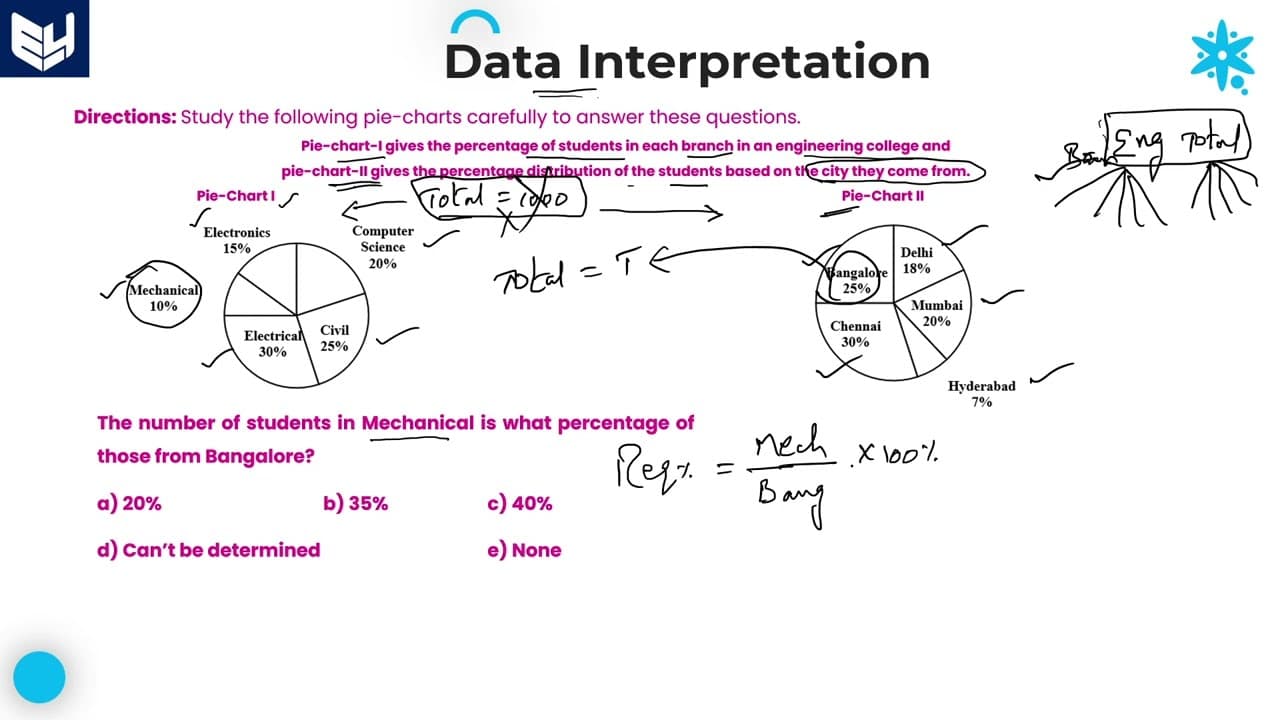
The total number of students is crucial for understanding the percentage distribution of students across different branches and cities. Although not explicitly given, it is implied that the same total applies to both pie charts, enabling accurate calculations based on percentage values relative to a consistent total.
Q: How can we determine the percentage of mechanical students from Bangalore?
To find the percentage of mechanical students compared to those from Bangalore, use the formula: mechanical students (10% of total) divided by Bangalore students (25% of total) multiplied by 100. The shared total allows for cancellation when calculating.
Q: Why is there a distinction between "at most" and actual counts regarding students from Hyderabad?
The term "at most" indicates the maximum potential number of students from Hyderabad enrolled in computer science. Even if the computer science department has a larger number of total students, only a subset from Hyderabad, specifically 182 students, is counted as the maximum possible due to their percentage.
Q: How does increasing Delhi's student count affect the overall percentage?
Increasing the count of Delhi students by 25 impacts the overall percentage calculation, shifting from 18% to 20%. By calculating the number of students corresponding to these percentages and establishing a proportional relationship, we can derive the total student population.
Summary & Key Takeaways
-
The session focuses on analyzing pie charts representing student distribution among engineering branches and cities, emphasizing the importance of reading the data carefully before solving related questions.
-
Two pie charts are presented: one showing branch distribution (computer science, civil, electrical, mechanical, electronics) and the other indicating student origin cities (Delhi, Mumbai, Hyderabad, Chennai, Bangalore), both having the same total student count.
-
Detailed calculations are provided for various questions, showcasing methods to find percentages, ratios, and comparisons while stressing that total values can be derived even without explicitly stated numbers.
Read in Other Languages (beta)
Share This Summary 📚
Summarize YouTube Videos and Get Video Transcripts with 1-Click
Try YouTube Summary with ChatGPT & Claude or YouTube Transcript Generator