MET#49, Solving a Rational Equation
TL;DR
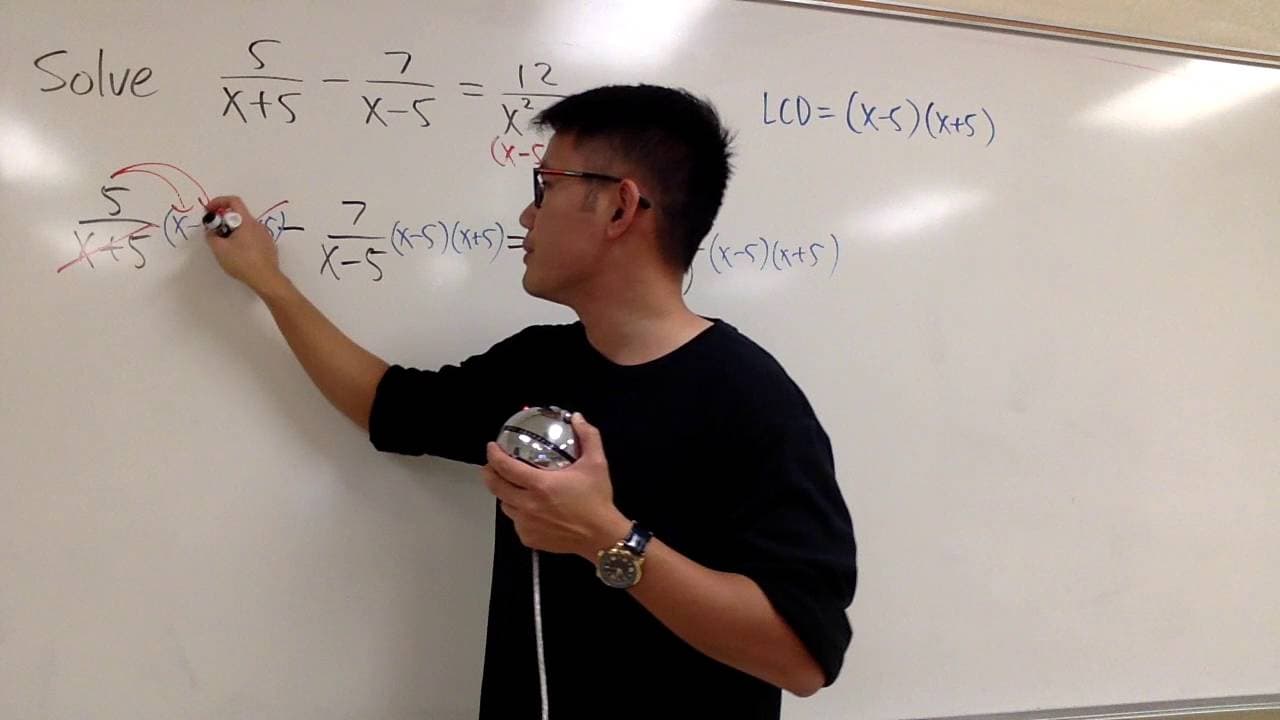
Learn how to solve rational equations by identifying the lowest common denominator and multiplying everything by it.
Transcript
in this question we can solve this rational equation and the way that we are going to do this is that we will first identify the lowest common denominator and then we will multiply everything by the lowest common denominator this way after that we will not have any more fractions in the equation so the way to identify the lowest common denominator ... Read More
Key Insights
- 🤩 Identifying the lowest common denominator is the key step in solving rational equations.
- 😘 Multiplying everything by the lowest common denominator eliminates the fractions and simplifies the equation.
- 🧑🏭 Canceling out common factors simplifies the equation further, making it easier to solve.
- ➗ Checking the obtained solution is crucial to ensure it is valid and does not result in division by zero.
- ❓ Rational equations can be solved by transforming them into regular equations using algebraic techniques.
- 🧑🏭 The process of solving rational equations involves factoring and identifying common factors among the denominators.
- ❓ By following a systematic approach, solving rational equations can become straightforward and manageable.
Install to Summarize YouTube Videos and Get Transcripts
Explore YouTube Video Summarizer or Get YouTube Transcript Extractor
Questions & Answers
Q: How do you solve rational equations?
To solve rational equations, you first need to identify the lowest common denominator by factoring all the denominators. Then, multiply everything by the lowest common denominator to eliminate the fractions.
Q: Why do we multiply everything by the lowest common denominator?
When we multiply everything by the lowest common denominator, the fractions in the equation cancel out, and we are left with a regular equation. This makes it easier to solve using standard algebraic techniques.
Q: What happens if the lowest common denominator includes factors that aren't present in all the denominators?
It is not necessary for all the denominators to have the same factors. The factors present in some denominators but not others will still be multiplied by the entire equation, ensuring that all terms are accounted for.
Q: How do we check if the obtained solution is valid?
After solving the equation and obtaining a value for the variable, it is important to check if this value would cause any denominator to be zero. If a denominator evaluates to zero, the solution is invalid.
Summary & Key Takeaways
-
This video provides a step-by-step explanation of how to solve rational equations by finding the lowest common denominator and eliminating fractions.
-
The process involves factoring and identifying common factors among the denominators, then multiplying the entire equation by the lowest common denominator.
-
By canceling out common factors and simplifying, the equation transforms into a regular equation that can be solved easily.
Read in Other Languages (beta)
Share This Summary 📚
Summarize YouTube Videos and Get Video Transcripts with 1-Click
Try YouTube Summary with ChatGPT & Claude or YouTube Transcript Generator
Explore More Summaries from blackpenredpen 📚
Summarize YouTube Videos and Get Video Transcripts with 1-Click
Try YouTube Summary with ChatGPT & Claude or YouTube Transcript Generator