Satya Nadella on AI Agents and the Future of Knowledge Work
TL;DR
Coding shows where all knowledge work is heading: it moved from next-edit suggestions to chat, then actions, then full autonomous agents running in foreground, background, cloud, or locally, and people use all of those form factors at once. Microsoft is extending human identities to agents through Agent 365, because tracing who did what to whom is the organization's most important query.
Transcript
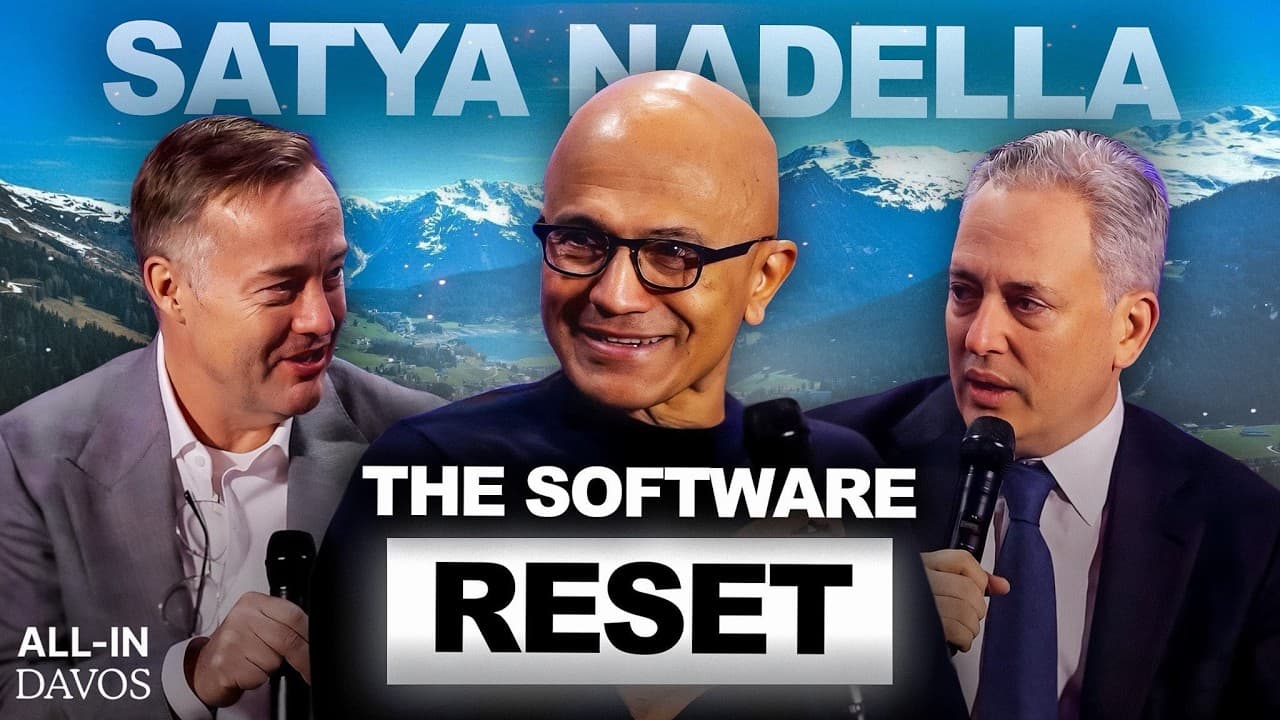
All right, everybody. We're thrilled to have the one, the only Tata Nadella here, the third CEO of Microsoft for a uh impromptu fireside chat with David Saxs, Arzar of AI and crypto. Satia third, CEO of Microsoft, born in India. What an incredible story. came here right after college and uh you had a little round trip to pick up your wife in your b... Read More
Key Insights
- Coding is the clearest example of how AI form factors evolve in knowledge work, moving from next edit suggestions, to chat, to actions, to fully autonomous agents that can run foreground or background, in the cloud or locally.
- Developers do not settle on a single AI form factor. Nadella describes running a foreground agent and a background agent from a CLI while editing directly in VS Code, all happening in parallel, showing how the form factors compose.
- The organizing metaphor for AI-age computing, borrowed from the CEO of Notion, is manager of infinite minds, a successor to Steve Jobs's bicycle for the mind and Bill Gates's information at your fingertips.
- Macro delegate and micro steer is the operating pattern Nadella names for working with agents: hand off a large chunk of work, then give instructions in parallel while the agent is still executing, exactly as developers already do when coding.
- Agent 365 is Microsoft's answer to digital coworkers, giving agents identities by extending the identity system already used for humans and the endpoint protection already applied to their compute devices.
- The most important query in an organization is who did what to whom, because the organization needs to know what work got done, what the provenance of that work is, and how to trace it back once agents are involved.
- Microsoft added $90 billion to its top line and doubled its income while holding headcount roughly flat, a shift Nadella frames as the biggest structural change in knowledge work since the arrival of PCs.
- LinkedIn merged product managers, designers, and front-end engineers into a single full stack builder role with increased scope, changing both the work artifact and the workflow rather than just adding tools to existing roles.
Install to Summarize YouTube Videos and Get Transcripts
Explore YouTube Video Summarizer or Get YouTube Transcript Extractor
Questions & Answers
Q: How does Satya Nadella describe the evolution of AI coding tools?
Nadella traces four stages. It began with next edit suggestions, which he says first worked with real accuracy on an early Codex model that predated GPT-3.5, and that was when his own belief in this generation of technology formed. From there it moved to chat, where reasoning and chain of thought go beyond simple request and response. Then came actions, executed either through computer use or through skills and agent calls. Finally came full autonomous agents, which can run in the foreground or background, in the cloud or locally.
Q: What is Agent 365 and why did Microsoft build it?
Agent 365 is a Microsoft offering introduced to give identities to AI agents. Nadella describes it as extending the identity system Microsoft already provides for human employees, along with the endpoint protection it provides for their compute devices, so that agents can be governed the same way. The motivation is that identity is one of the key things you have to get right for digital coworkers to work at all. It underpins permissions, decision making, and the ability to trace what an agent did and under whose authority.
Q: What does macro delegate and micro steer mean?
It is the phrase Nadella uses for how people should work with AI agents. You delegate a large task at a high level, then continue to give the agent instructions while it is already doing the work, steering it in small increments rather than specifying everything upfront or walking away entirely. He says coders already have this pattern: you hand off a chunk of work and then issue further direction in parallel. When a human works with many agents under their own passed-on identity, this is the operating model.
Q: How did Microsoft grow revenue without growing headcount?
Nadella says Microsoft has about the same number of employees it had four years earlier while adding $90 billion to its top line and doubling its income over that period. He frames the cause as structural change in how knowledge work happens, which he calls the biggest change since PCs, rather than simply cutting staff or automating jobs one for one. The concrete example he gives is role consolidation at LinkedIn, where several separate functions were merged into a broader single role.
Q: What is a full stack builder at LinkedIn?
At LinkedIn, Microsoft took the roles of product manager, designer, and front-end engineer and combined them into one role called a full stack builder, with increased scope rather than reduced scope. Systems engineers on the backend remain separate and build the infrastructure that supports the science that supports the product. Nadella likes the change because it alters both the work artifact and the workflow between functions, and the interviewer adds that velocity improves because one person vibe coding replaces four people communicating.
Q: What does the new AI product development workflow look like?
Nadella describes a new loop that starts with evals. Evals lead to science, and science leads to infrastructure. The evals are run by the full stack builders and by product managers in their new form. The infrastructure is built by backend systems engineers, because the infrastructure supports the science, and the science supports the product. He stresses that Microsoft cannot only live in this future: shipping quality hot patches on Windows and building evals that improve Copilot quality both have to be first class work at the same time.
Q: Why does Nadella say a new metaphor for computers is needed?
He points to two earlier metaphors that defined their eras. Steve Jobs called the computer a bicycle for the mind, and Bill Gates described information at your fingertips. Nadella argues the AI age needs its own concept metaphor for how people use computers. The one he prefers came from the CEO of Notion: a manager of infinite minds. He says that is a good way to think about it once you look at all the agents a person ends up working with at the same time.
Q: How will AI agents connect work across tools and meetings?
Nadella says software developers do not sit in isolation working only on a repo. They attend meetings, they write specs, and they implement specs written by others, and the repo needs to stay consistent with all of that. The form factor he is excited about is calling into work IQ from inside GitHub Copilot using either a straightforward MCP server or a skill, bringing that context in. He gives a parallel security example: dropping logs into a file system, writing code on top of them, and creating a dashboard.
Summary & Key Takeaways
-
Nadella traces the evolution of AI-assisted coding through four stages: next edit suggestions from an early Codex model that predated GPT-3.5, chat with reasoning and visible chain of thought, actions taken through computer use or skills and agent calls, and finally autonomous agents that run in the foreground, in the background, in the cloud, or locally. Developers use all of these simultaneously rather than picking one.
-
The proposed metaphor for computing in the AI age, credited to the CEO of Notion, is being a manager of infinite minds, following Jobs's bicycle for the mind and Bill Gates's information at your fingertips. The working method Nadella describes is to macro delegate and micro steer: hand off a large task, then issue instructions in parallel while the agent works.
-
Microsoft introduced Agent 365 to give agents identities, extending the identity system used for humans and the endpoint protection used for their compute devices. Two modalities follow: every knowledge worker gets infinite minds under their own passed-on identity, or agents get separate identities entirely. Either way permissions, decision making, and provenance of work have to be traceable.
-
Microsoft added $90 billion to its top line and doubled its income with roughly the same headcount, which Nadella attributes to structural change rather than pure automation. At LinkedIn, product managers, designers, and front-end engineers were combined into full stack builders with increased scope, while systems engineers handle the backend infrastructure that supports the science behind the product.
-
Building AI products creates a new workflow loop that starts with evals, then science, then infrastructure. Full stack builders and product managers in their new form run the evals, while backend systems engineers build infrastructure supporting the science that supports the product. Microsoft must run this new loop while still doing quality hot patching on Windows, both as first class work.
Read in Other Languages (beta)
Share This Summary 📚
Summarize YouTube Videos and Get Video Transcripts with 1-Click
Try YouTube Summary with ChatGPT & Claude or YouTube Transcript Generator
Explore More Summaries from All-In Podcast 📚





Summarize YouTube Videos and Get Video Transcripts with 1-Click
Try YouTube Summary with ChatGPT & Claude or YouTube Transcript Generator