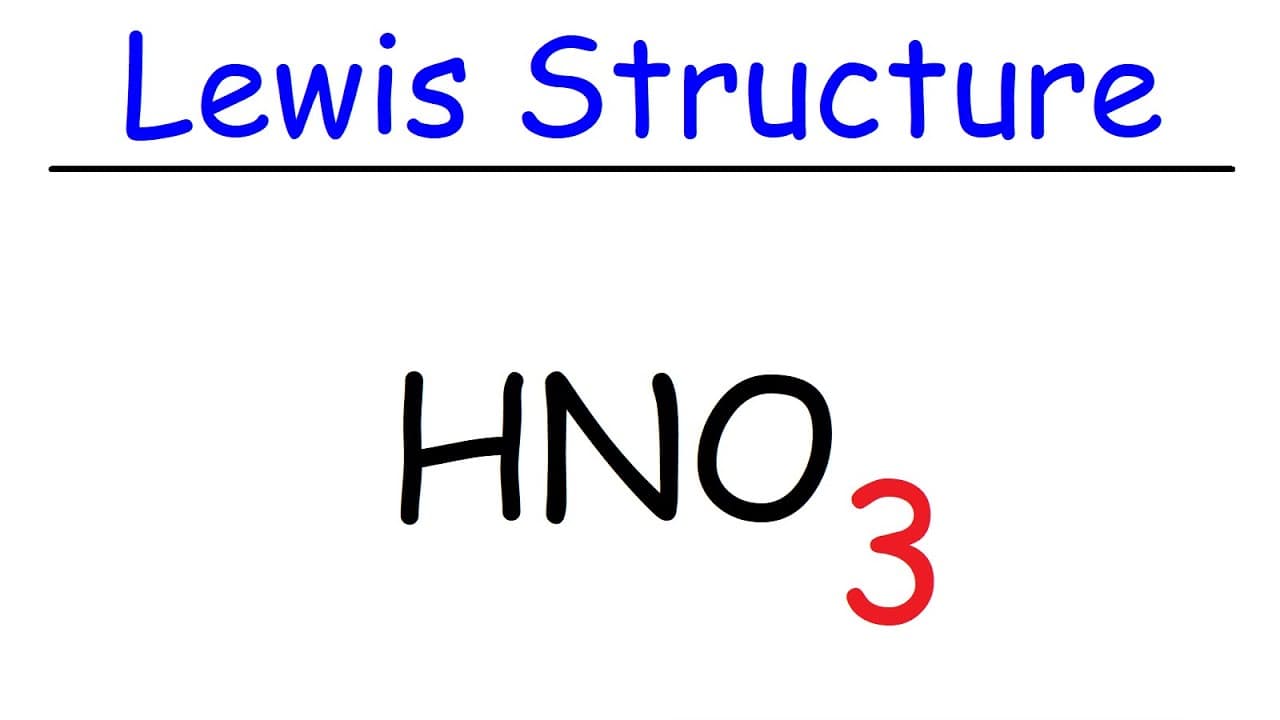
How to Draw the Lewis Structure of Nitric Acid (HNO3)
TL;DR
To draw the Lewis structure of nitric acid (HNO3), start by drawing the nitrate ion, considering valence electrons and formal charges. The central nitrogen atom forms four bonds and has a positive formal charge, while the oxygen atoms may have negative charges. The molecular geometry is trigonal planar around nitrogen, with a bond angle of 120 degrees.
Transcript
in this video we're going to talk about how to draw the lewis structure of hno3 nitric acid now the method that i prefer to use when drawing the lewis structures of acids is i like to take away the hydrogen first so what i'm going to do is i'm going to draw the lewis structure of nitrate and then i'm going to add hydrogen to it so what i need to do... Read More
Key Insights
- ⚾ Drawing the Lewis structure of acids involves removing the hydrogen and starting with the Lewis structure of the acid's base compound.
- 🫀 Nitrogen in the central atom of nitric acid has a positive formal charge, while oxygen atoms can have negative charges.
- 🫀 The molecular geometry of nitric acid's central nitrogen atom is trigonal planar, and the oxygen atom hybridizes to form sp3 orbitals.
- 😐 Nitric acid is a neutral molecule, as the positive and negative charges balance each other.
- 🔺 The bond angle around the central nitrogen atom is 120 degrees, while the bond angle around the oxygen atom might be similar to water's bond angle of 104.5 degrees.
- 👥 Hybridization can be determined by counting the number of bonding groups and lone pairs around an element.
- ❓ Understanding the Lewis structure and molecular geometry provides insights into the arrangement and properties of nitric acid.
Install to Summarize YouTube Videos and Get Transcripts
Explore YouTube Video Summarizer or Get YouTube Transcript Extractor
Questions & Answers
Q: What is the process for drawing the Lewis structure of nitric acid?
The preferred method is to start with the Lewis structure of nitrate and then add hydrogen. Nitrate has a central nitrogen atom bonded to three oxygen atoms, each either with two lone pairs or three lone pairs.
Q: How are formal charges calculated?
Formal charges are determined by subtracting the number of bonds and dots (lone pairs) from the valence electrons of the element. For example, nitrogen in nitric acid has a formal charge of +1 since it has 5 valence electrons and is bonded to 4 other atoms.
Q: How does the Lewis structure of nitric acid form?
Nitric acid is formed by reacting nitrate with a hydrogen ion. Oxygen with a negative charge uses one of its lone pairs to bond with hydrogen, resulting in a neutral molecule with a positive formal charge on the nitrogen atom.
Q: What is the molecular geometry of nitric acid?
The central nitrogen atom in nitric acid has a trigonal planar molecular geometry, meaning it is surrounded by three atoms in a flat triangular arrangement.
Summary & Key Takeaways
-
The preferred method to draw the Lewis structure of acids is to remove the hydrogen first, so the Lewis structure of nitrate is drawn before adding hydrogen.
-
Nitrogen in the central atom is typically bonded to four other atoms, while each oxygen atom can have either two bonds and two lone pairs or three bonds and one lone pair.
-
Formal charges are calculated by subtracting the number of bonds and dots from the valence electrons of the element.
-
Mixing nitrate and a hydrogen ion forms nitric acid with a Lewis structure where an oxygen atom uses one of its lone pairs to bond with hydrogen.
-
The molecular geometry around the central nitrogen atom is trigonal planar, with a bond angle of 120 degrees, while the oxygen atom hybridizes to form sp3 orbitals.
Read in Other Languages (beta)
Share This Summary 📚
Summarize YouTube Videos and Get Video Transcripts with 1-Click
Try YouTube Summary with ChatGPT & Claude or YouTube Transcript Generator
Explore More Summaries from The Organic Chemistry Tutor 📚



Summarize YouTube Videos and Get Video Transcripts with 1-Click
Try YouTube Summary with ChatGPT & Claude or YouTube Transcript Generator