What Are Wade's Rules? - Periodic Table of Videos
TL;DR
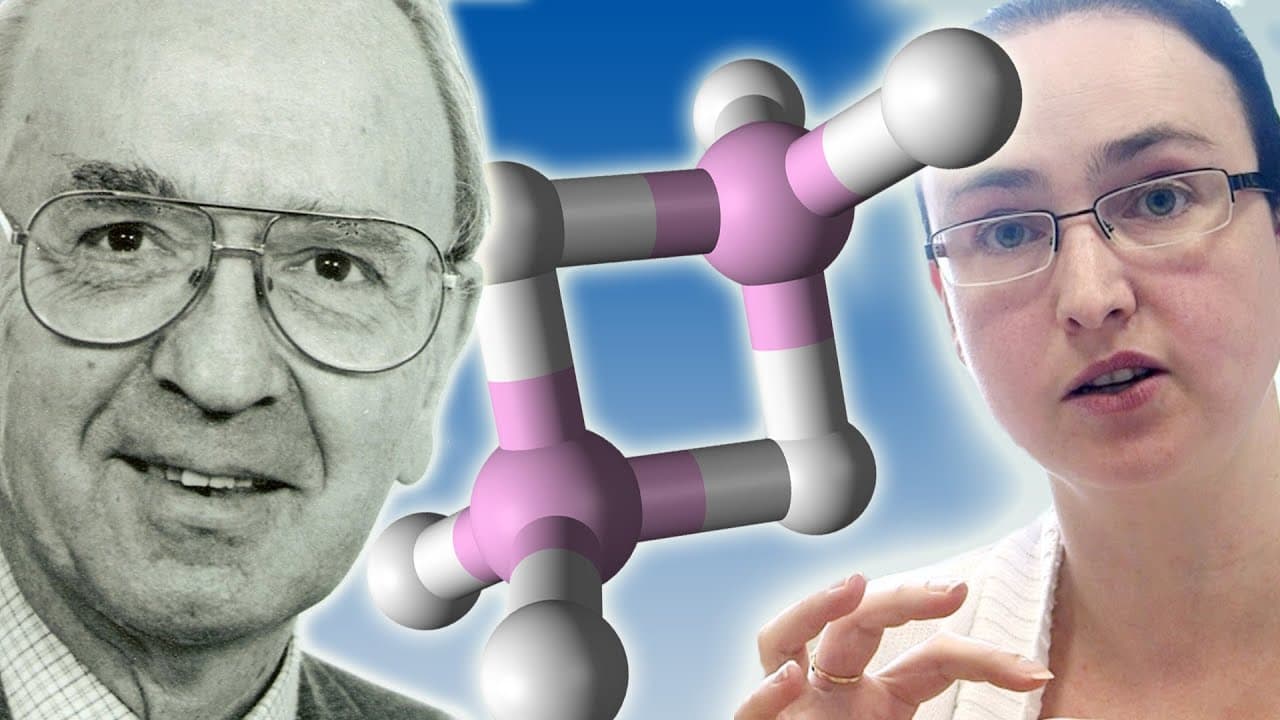
Wade’s rules explain the shapes adopted by clusters of boron compounds by counting the electrons contributed by BH units and remaining hydrides. Developed by British inorganic chemist Ken Wade, the polyhedral skeletal electron pair theory distinguishes closed closo structures from increasingly open nido and arachno structures. Read on to see how the rules also extend to carboranes and metallaboranes.
Transcript
recently a very famous British chemist Ken Wade Kenneth Wade of the University of Durham died and he was also began his career here at the University of Nottingham he was an undergraduate here and a research student and I found his undergraduate record card here it gives his name and so on on the front and on the back it has his photo and it's quit... Read More
Key Insights
- 🏑 Ken Wade, a British chemist, dedicated his career to studying boron compounds and contributed significantly to the field of inorganic chemistry.
- 💠 His development of the polyhedral skeletal electron pair theory provided a framework for understanding the shapes of boron compounds.
- 🏑 Wade's name is associated with various boron compounds, showcasing his impact and expertise in the field.
- 👨🔬 Not only did Ken Wade excel in his research, but he also supported younger researchers, fostering a supportive community.
- 👻 Wade's transition from experimental to theoretical chemistry allowed him to provide valuable insights into experimental results.
- 😫 The significance of a chemist's name being linked to an element or set of rules indicates their knowledge and impact in the field.
- 💢 Wade's thesis provides a glimpse into the past, showcasing the manual typewriting and handwritten diagrams of that era.
Install to Summarize YouTube Videos and Get Transcripts
Explore YouTube Video Summarizer or Get YouTube Transcript Extractor
Questions & Answers
Q: What are Wade’s rules?
Wade’s rules govern the shapes adopted by clusters of boron compounds. Ken Wade called the underlying framework polyhedral skeletal electron pair theory, and it uses electron counting to relate a cluster’s composition to its structure.
Q: How do you apply Wade’s rules to a boron cluster?
Add up the BH units and any hydrides left over. Each BH unit contributes two electrons that help hold the cluster together, and missing vertices lead to more open structures.
Q: What do closo, nido, and arachno mean in Wade’s rules?
Closo describes a fully closed cluster. Nido is slightly open, while arachno is more open again.
Q: Can Wade’s rules be used for compounds containing carbon?
Yes. Using isolobal theory, CH units can replace BH units, producing mixed boron-carbon compounds called carboranes.
Q: Can Wade’s rules be applied to metal-containing clusters?
Yes. Metal fragments can be inserted in place of other cluster units to form metallaboranes. This helps Wade’s rules cover many areas of main-group chemistry.
Q: Who was Ken Wade?
Ken Wade was a British inorganic chemist who spent most of his career studying boron. He attended the University of Nottingham as an undergraduate from 1951 to 1954, later conducted research with Dr Greenwood, and spent most of his career at the University of Durham.
Q: What did Ken Wade study for his PhD?
His thesis was titled “Addition Compounds of Boron Tri Chloride and Gallium Tri Chloride.” It examined compounds such as electron-deficient, planar boron trichloride and how they react with molecules like ammonia that have a spare pair of electrons.
Q: Why was Ken Wade’s move from experimental to theoretical chemistry valuable?
Wade began as an experimental chemist and later became more of a theoretician. His theoretical chemistry helped experimental chemists understand the results of their experiments.
Summary & Key Takeaways
-
Ken Wade, a British chemist, began his career at the University of Nottingham and later became an expert in inorganic chemistry, particularly focusing on the element boron.
-
His groundbreaking work on boron compounds led to the development of the polyhedral skeletal electron pair theory, explaining the shapes of various boron compounds.
-
Wade's research and contributions in chemistry have left a lasting impact, and he was known for his support of young researchers and his transition to theoretical chemistry.
Read in Other Languages (beta)
Share This Summary 📚
Summarize YouTube Videos and Get Video Transcripts with 1-Click
Try YouTube Summary with ChatGPT & Claude or YouTube Transcript Generator
Explore More Summaries from Periodic Videos 📚



Summarize YouTube Videos and Get Video Transcripts with 1-Click
Try YouTube Summary with ChatGPT & Claude or YouTube Transcript Generator