How Can Corporations Collaborate With Startups?
TL;DR
Corporations can innovate faster by combining their scale, resources, and customer access with the agility of startups through open innovation and corporate venturing. Effective collaboration can include startup scouting, proofs of concept, business integration, and investment, creating new revenue opportunities for both sides while helping large companies respond to rapid market transformation.
Transcript
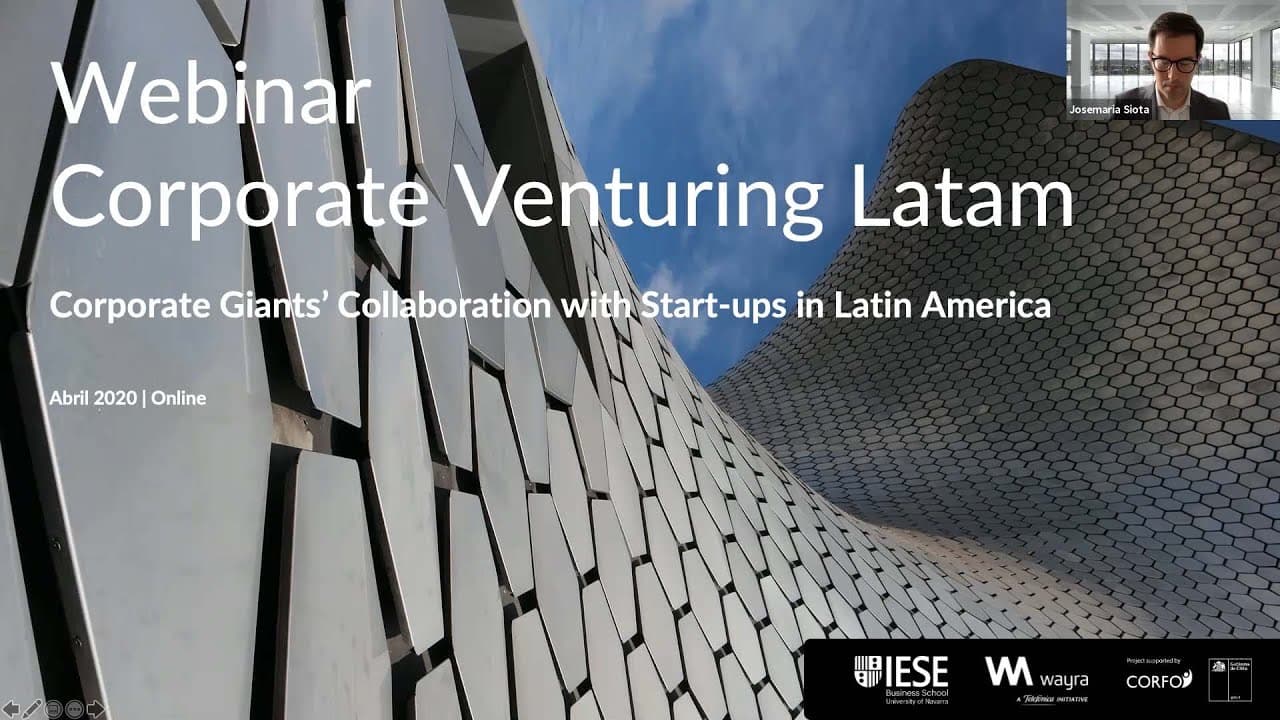
you okay okay okay thank you everyone for being here my name is Luciano salads I am a the head of corporate venturing and permanent chief of wider Argentina Chile and Peru welcome to the corporate venture in Latin talks this is a webinar about corporate venture in Latin America our report that we made between a wider ETS a business school with the ... Read More
Key Insights
- Corporate innovation is a matter of survival because the speed of market transformation requires companies to continually develop new businesses, revenue sources, and ways of reaching customers. Organizations that are not prepared to innovate risk losing relevance as their markets change.
- Internal innovation teams are insufficient by themselves because even teams containing hundreds or thousands of people cannot match every innovation emerging outside a corporation. Open innovation expands the search by allowing companies to discover external technologies, business models, and entrepreneurial capabilities.
- Startups are important sources of external innovation because their youth and agility let them respond rapidly to market needs. Corporations can work alongside these smaller companies to obtain capabilities and ideas that would be difficult or slower to develop entirely in-house.
- Corporate venturing is a growing global practice because corporations participate in approximately one quarter of venture capital deals, according to figures cited in the webinar. The trend extends beyond the United States and Europe and is developing across markets worldwide.
- Corporate-startup collaboration is a reciprocal relationship because corporations seek transformation, revenue, and fresher customer engagement, while startups seek revenue opportunities and access to new customers. Successful programs combine the distinct advantages of both parties instead of treating startups only as investment targets.
- Wayra's model emphasizes commercial collaboration because it invests in companies while seeking business opportunities between portfolio startups, Telefónica, and corporate partners. The webinar reports a portfolio of at least 500 companies, with approximately one third working with Telefónica.
- Wayra Venture Partners supports corporate innovation through startup scouting, proofs of concept, integration, and investment planning. The service emerged because many corporations wanted to work with startups but lacked the knowledge or processes required to establish an effective open-innovation strategy.
- Latin America's corporate venturing ecosystem needs stronger coordination because regional information is limited and decentralized compared with information about the United States and Europe. Mapping initiatives and building networks among corporations, startups, governments, associations, universities, and investors can help create more opportunities.
Install to Summarize YouTube Videos and Get Transcripts
Explore YouTube Video Summarizer or Get YouTube Transcript Extractor
Questions & Answers
Q: Why do corporations need to collaborate with startups?
Corporations need startup collaboration because market transformation is moving too quickly for internal resources to address every innovation opportunity. Startups contribute speed, agility, and new approaches, while corporations contribute scale, commercial relationships, and customer access. Working together can help established companies transform, identify new revenue sources, and reach customers differently, while giving startups opportunities to secure revenue and enter new markets.
Q: What is open innovation in corporate venturing?
Open innovation is the practice of looking beyond a company's internal teams to identify technologies, ideas, and business capabilities being developed elsewhere. In the webinar, startups are presented as a major source of this external innovation because they can respond quickly to market needs. Corporate venturing provides ways to convert those external discoveries into proofs of concept, integrations, commercial relationships, or investments.
Q: Why are internal innovation teams not enough?
Internal teams are not enough because the range and speed of market innovation exceed what one organization can produce alone. The webinar argues that even a corporation with hundreds or thousands of employees dedicated to innovation cannot discover and develop every new business model or customer solution. Looking outside the company expands its access to specialized, agile startups already addressing emerging market needs.
Q: How does corporate-startup collaboration benefit both sides?
Corporate-startup collaboration benefits corporations by supporting transformation, generating potential revenue sources, and enabling fresher customer engagement. It benefits startups by connecting them with established organizations that can provide commercial opportunities and access to new customers. The intended result is a reciprocal relationship that combines corporate strength and reach with startup speed, while avoiding practices that overwhelm or restrict the smaller company.
Q: How can a corporation begin working with startups?
A corporation can begin by defining an open-innovation strategy and scouting for startups whose capabilities address relevant business needs. It can then test the relationship through a proof of concept, integrate a successful solution into corporate operations, and consider investment where appropriate. The webinar presents these activities as practical services for corporations that want startup collaboration but do not know how to organize it.
Q: What results does Wayra report from its corporate venturing activity?
Wayra reports a portfolio of at least 500 companies accumulated over almost ten years, with approximately one third of those companies working with Telefónica. It also reports partnerships with around 300 companies, governments, and nongovernmental organizations, plus investment of almost 170 million euros through Wayra and Telefónica's vehicles. These figures illustrate an approach centered on investment and business collaboration.
Q: Why does Latin America need a corporate venturing map?
Latin America needs a corporate venturing map because information about regional activity is limited and not centralized, unlike the greater volume of information available about the United States and Europe. Mapping and characterizing initiatives can show which corporations, industries, associations, governments, and startups are participating. That shared understanding is presented as the first step toward building a more connected regional ecosystem.
Q: What does the elephant and gazelles metaphor mean in open innovation?
The elephant and gazelles metaphor describes collaboration between large corporations and agile startups. The elephant represents a solid, powerful corporation that needs to become more adaptable, while the gazelles represent smaller companies able to move quickly. The warning that the elephant must dance without stepping on them means corporate partners should contribute scale and strength without suppressing the startup's agility or independence.
Summary & Key Takeaways
-
Corporate innovation has become necessary for survival because markets are transforming faster than internal teams can respond. Open innovation allows corporations to identify ideas and capabilities outside their organizational boundaries, especially among agile startups that can develop new business models, technologies, and approaches more quickly than large established companies.
-
Collaboration creates reciprocal value when corporations gain transformation opportunities, new revenue sources, and a fresher way to reach customers, while startups gain access to corporate customers, commercial opportunities, and organizational resources. The webinar describes this relationship as an elephant dancing with gazelles carefully, combining corporate strength with startup agility.
-
Latin America's corporate venturing ecosystem remains relatively immature and lacks the centralized information available for the United States and Europe. The Corporate Venturing Latam project therefore maps regional activity, connects corporations with startups and peer organizations, and works with local associations to develop a stronger network that can create opportunities across the ecosystem.
Read in Other Languages (beta)
Share This Summary 📚
Summarize YouTube Videos and Get Video Transcripts with 1-Click
Try YouTube Summary with ChatGPT & Claude or YouTube Transcript Generator