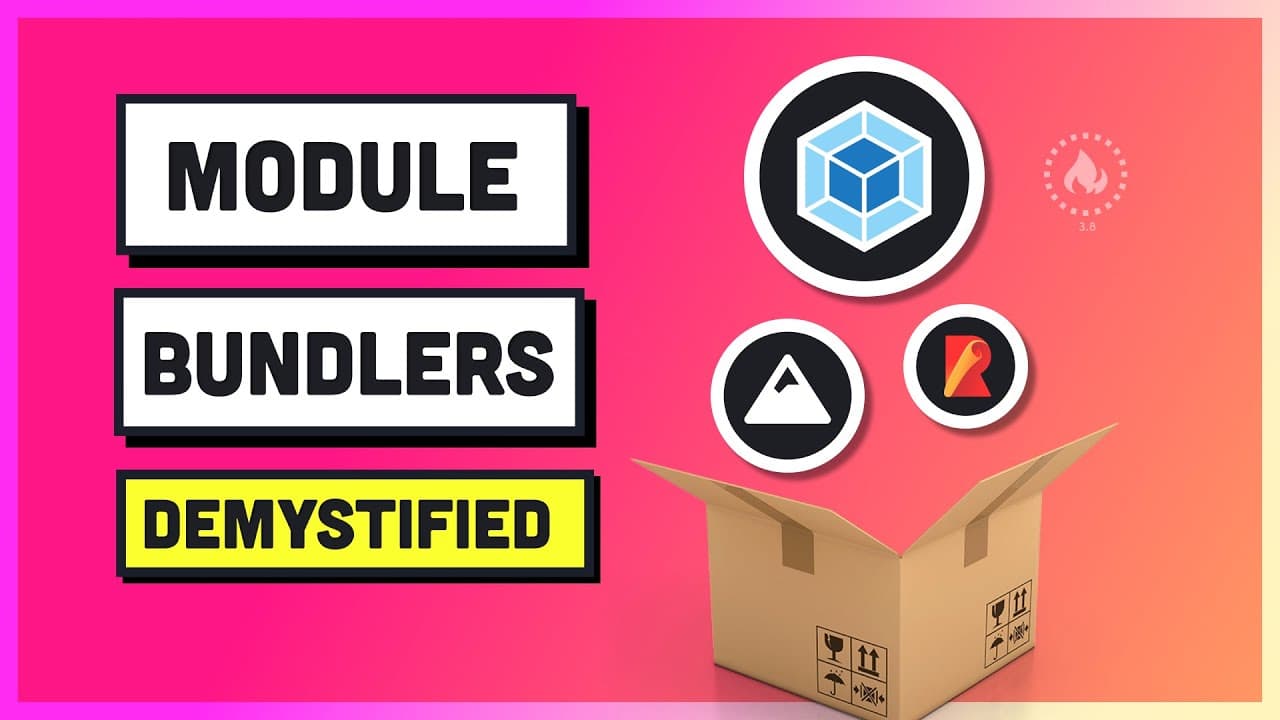
Module Bundlers Explained... Webpack, Rollup, Parcel, and Snowpack
TL;DR
Learn about module bundlers like webpack, rollup, parcel, and snowpack, their role in web development, and why snowpack is a game-changer for faster builds.
Transcript
to build a website you only need three ingredients html css and javascript that sounds pretty straightforward on the surface but here's the problem nobody just uses html css and javascript to build a website you might replace javascript with typescript then throw in a ui library like react to replace html you'll definitely need a css preprocessor l... Read More
Key Insights
- 🫤 Building a website goes beyond HTML, CSS, and JavaScript, requiring the use of additional tools and dependencies.
- 👨💻 Module bundlers like webpack simplify the process by combining code and handling dependencies, resulting in a single, optimized JavaScript file.
- 👻 Customization of webpack configuration allows developers to tailor it to their project's specific requirements.
- 🏛️ Snowpack offers faster build times by building dependencies once and directly shipping them to the browser, making it an appealing choice for larger projects.
- 😒 Webpack, rollup, parcel, and snowpack are popular module bundlers, each with their own advantages and use cases.
- 🍵 Using loaders, developers can handle non-JavaScript files such as SCSS in their projects.
- 👻 Plugins enhance webpack's functionality, allowing developers to tap into the compilation process and optimize their code further.
Install to Summarize YouTube Videos and Get Transcripts
Explore YouTube Video Summarizer or Get YouTube Transcript Extractor
Questions & Answers
Q: What is the role of a module bundler in web development?
A module bundler combines multiple JavaScript files used in a web application into a single file, including dependencies, to improve performance and manage code in a more organized manner.
Q: What are some common challenges in building a web application without a module bundler?
Without a module bundler, developers face problems with resolving dependencies, handling module conflicts, minimizing file sizes for faster loading, and ensuring backward compatibility with older browsers.
Q: How can webpack be customized to fit specific project requirements?
Webpack configuration can be customized by specifying entry points, output file names, using loaders to handle non-JavaScript files like SCSS, and utilizing plugins to tap into the compilation lifecycle for further optimizations.
Q: How does snowpack differ from traditional module bundlers like webpack?
Snowpack takes a different approach by building dependencies once and shipping them directly to the browser, allowing for instant changes without recompiling the entire project. This results in faster build times, especially for larger projects.
Summary & Key Takeaways
-
Building a website requires more than just HTML, CSS, and JavaScript. It involves using various dependencies, handling module conflicts, minifying files, and ensuring compatibility with different browsers.
-
Module bundlers like webpack solve these challenges by combining multiple JavaScript files, managing dependencies, and optimizing code for production.
-
Webpack, the most popular module bundler, allows developers to specify an entry point and creates a bundled JavaScript file that can be used in the browser.
Read in Other Languages (beta)
Share This Summary 📚
Summarize YouTube Videos and Get Video Transcripts with 1-Click
Try YouTube Summary with ChatGPT & Claude or YouTube Transcript Generator
Explore More Summaries from Fireship 📚





Summarize YouTube Videos and Get Video Transcripts with 1-Click
Try YouTube Summary with ChatGPT & Claude or YouTube Transcript Generator