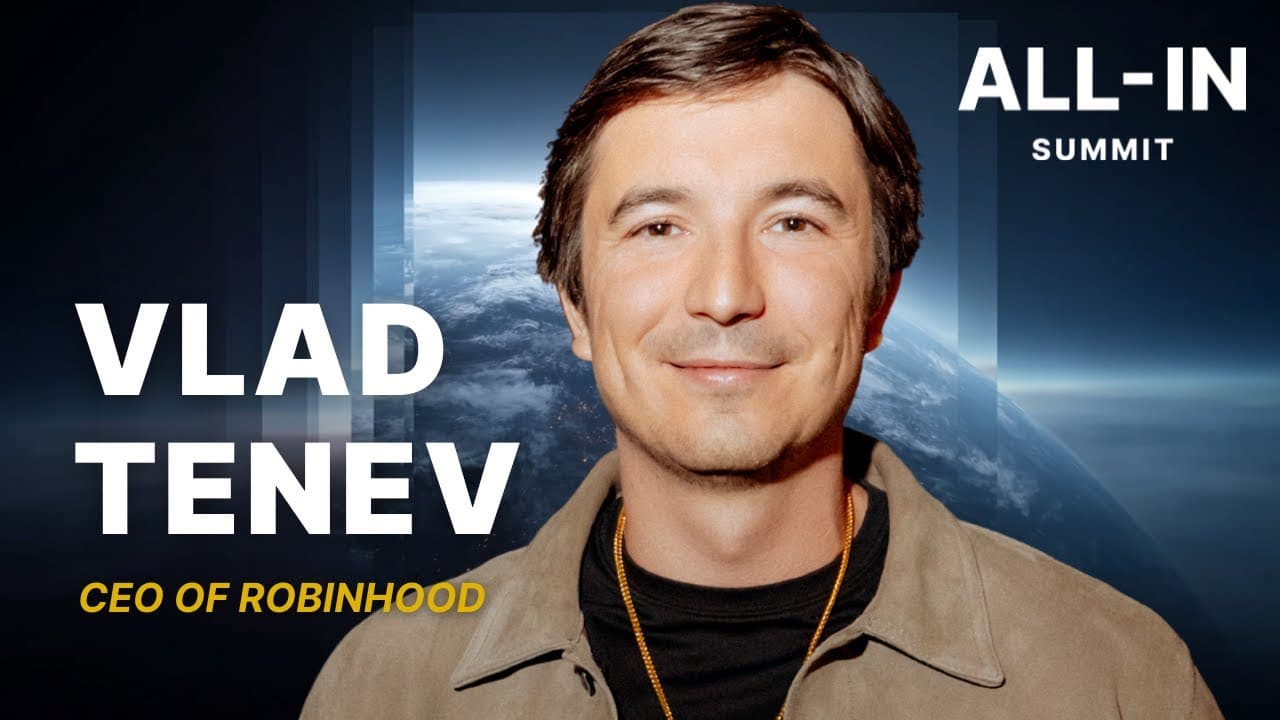
How Does Robinhood CEO Vlad Tenev Plan to Tokenize Stocks, Expand Access to Private Shares, and Shape Fintech’s Future?
TL;DR
Robinhood tokenizes stocks by holding underlying assets in reserve and minting or burning blockchain tokens against that reserve, extending a model similar to stablecoins to public and private securities. The company used this approach to offer tokenized OpenAI and SpaceX shares to European retail customers through a giveaway and has launched in 31 countries. Read on for the benefits, mechanics, controversy, and broader fintech strategy.
Transcript
I am Vlad Tennv, the founder of Robin Hood. We're talking about Robin Hood. The stock's more than doubled since its last report. It stock surged 180% this year after nearly doubling in 2024. The shares of the trading platform now up more than 400% in the last year. Glad your presence there speaks volumes. Robin Hood Gold, which hit a record 3.5 mil... Read More
Key Insights
- Robinhood's stock has surged over 400% in the last year, reflecting strong market performance.
- Tokenizing stocks involves placing them on blockchain, making them more accessible to retail investors.
- Robinhood has tokenized shares of companies like OpenAI and SpaceX, generating both support and controversy.
- The current US administration is more supportive of fintech innovation compared to the previous one.
- Tokenization could revolutionize access to private company shares, though regulatory challenges exist.
- Robinhood aims to become a comprehensive financial platform, integrating various financial services.
- The company is exploring expanding its tokenization efforts to the US market.
- Harmonic, a separate project by Vlad Tenev, focuses on building mathematical superintelligence.
Install to Summarize YouTube Videos and Get Transcripts
Explore YouTube Video Summarizer or Get YouTube Transcript Extractor
Questions & Answers
Q: How does Robinhood tokenize stocks?
Vlad Tenev describes a model similar to stablecoin issuance: underlying assets are kept in a reserve, while tokens are minted and burned against that reserve. Those tokens can then trade publicly on different blockchains, extending tokenization from stablecoins to public and private securities.
Q: Why does Robinhood want to put stocks on blockchains?
Robinhood wants to demonstrate what traditional financial services could look like if built from the ground up with crypto technology. Tenev says 24/7 trading and instant settlement have real value, but the most powerful benefit is making inaccessible, illiquid assets available.
Q: How is Robinhood expanding access to private shares?
Robinhood tokenized shares of OpenAI and SpaceX and made them available to retail customers in Europe through a giveaway. The initiative was designed to show how blockchain-based finance could broaden access to assets that are typically difficult for retail investors to obtain.
Q: Did Robinhood need underlying OpenAI and SpaceX shares for its tokens?
The interviewer describes the process as securing a block of OpenAI and SpaceX stock and placing it in reserve. Tenev compares the structure to keeping dollars or Treasuries in a bucket and minting or burning tokens against it.
Q: What benefits does stock tokenization provide?
Tenev identifies 24/7 stock trading and instant settlement as benefits with real value. He emphasizes that tokenization’s greatest potential is opening inaccessible and illiquid assets to more investors.
Q: Why was Robinhood’s tokenization initiative controversial?
The OpenAI and SpaceX token giveaway generated excitement but also controversy. Tenev says many people support tokenization in principle, while companies focused on their missions may regard a new tokenized offering as a distraction.
Q: Where has Robinhood launched its crypto-based platform offering?
Tenev says Robinhood launched in 31 countries after presenting the initiative at an event in the south of France. The platform combined stocks on blockchains with crypto-native features.
Q: What do Robinhood’s recent growth figures show about the company?
The transcript says Robinhood’s shares rose more than 400% over the prior year, including a 180% surge during the current year after nearly doubling in 2024. Robinhood Gold also reached a record 3.5 million subscribers, and the company was added to the S&P 500.
Summary & Key Takeaways
-
Robinhood's stock performance has been exceptional, with over a 400% increase in the last year. The company is pioneering the tokenization of stocks, allowing retail investors to access shares of private companies like OpenAI and SpaceX. This initiative has sparked both enthusiasm and controversy, as it challenges traditional financial models.
-
Under the current US administration, Robinhood has found a more supportive environment for fintech innovation, which contrasts with the defensive stance it had to adopt previously. The company is working on expanding its tokenization efforts to the US, aiming to democratize access to both public and private securities.
-
Vlad Tenev also discusses Harmonic, a separate venture focused on developing mathematical superintelligence. This project aims to enhance AI capabilities in mathematical reasoning, potentially transforming various industries. Robinhood's broader goal is to integrate financial services, becoming a comprehensive platform for users.
Read in Other Languages (beta)
Share This Summary 📚
Summarize YouTube Videos and Get Video Transcripts with 1-Click
Try YouTube Summary with ChatGPT & Claude or YouTube Transcript Generator
Explore More Summaries from All-In Podcast 📚





Summarize YouTube Videos and Get Video Transcripts with 1-Click
Try YouTube Summary with ChatGPT & Claude or YouTube Transcript Generator