How Do Your Senses Influence Your Lifespan?
TL;DR
Your senses significantly impact not just behavior and emotions but also lifespan. Research indicates that prolonged sensory exposure, such as seeing dead organisms, can affect the lifespans of animals, including fruit flies. This suggests that similar biological processes may influence human aging, emphasizing the role of environmental cues in our health.
Transcript
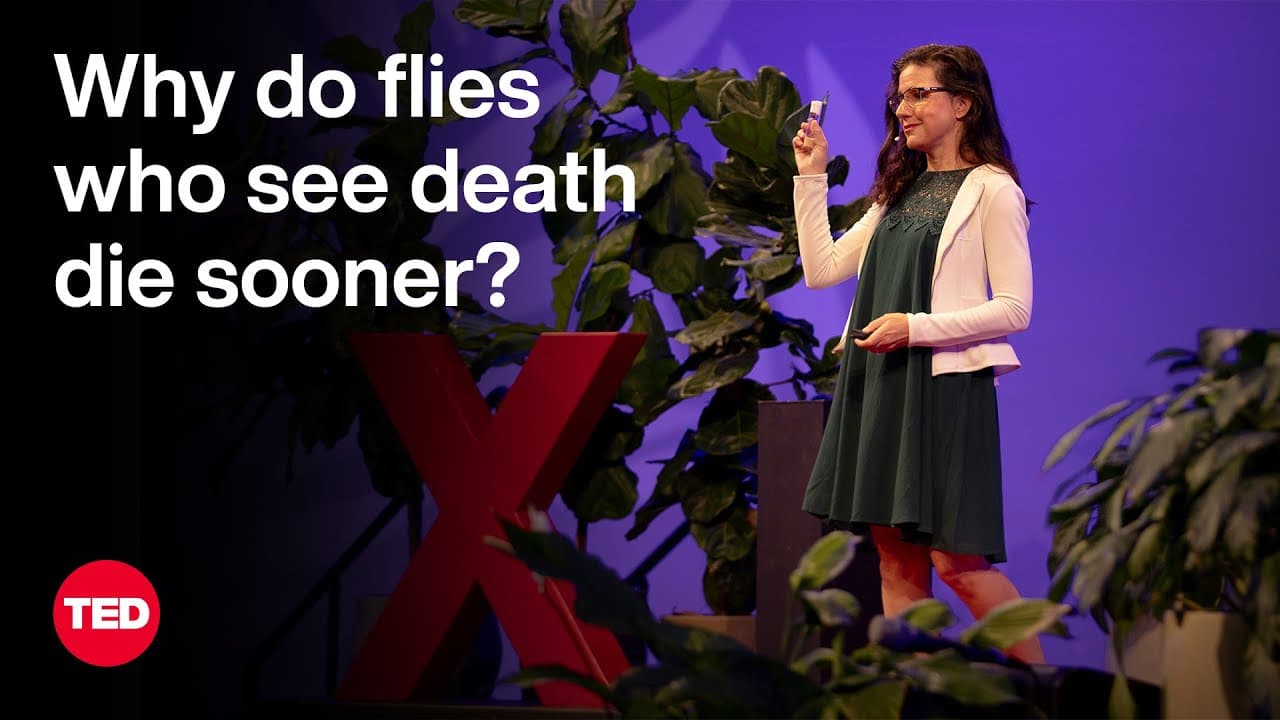
I'm here to tell you that what we sense, meaning what we see, smell, hear, taste and touch, can impact how long we live. Now this may seem extraordinary, but it really isn't. Let's say that you wake up one morning and are trying to decide whether to go to an amusement park. One of the very first things you might do is to step outside and check the ... Read More
Key Insights
- 🖐️ Our sensory perception plays a significant role in decision-making, emotional responses, and physical changes.
- ⛑️ Environmental cues can impact the lifespan of animals, suggesting similar underlying biological processes across species.
- 🤩 The nervous system is key to understanding the impact of sensory perception on lifespan.
- 🪽 Fruit flies serve as a model organism for studying commonalities that affect lifespan, such as how they perceive death.
- 🙂 Different environmental cues, including temperature, smell, light, and pain perception, can affect an animal's lifespan.
- 🪽 The sight of dead flies causes biological changes and can reduce the lifespan of live flies.
- ❓ Molecules like serotonin and insulin, found in our bodies, have a role in the biological processes affected by sensory perception.
Install to Summarize YouTube Videos and Get Transcripts
Explore YouTube Video Summarizer or Get YouTube Transcript Extractor
Questions & Answers
Q: How can the five senses affect lifespan?
Sensory information can change behavior, emotions and physical responses, while prolonged sensory events can alter lifespan in animals. Experiments with worms, flies and mice show that environmental cues such as pheromones can affect how long they live, suggesting that sensory perception may also influence human aging.
Q: How do the senses affect decisions and physical responses?
Seeing blue skies, hearing birds and feeling warmth can help someone decide that it is a good day to visit an amusement park. At the park, seeing and hearing a roller coaster may cause anxiety or excitement accompanied by a racing heartbeat, sweating palms or butterflies in the stomach.
Q: Why might animal lifespan research be relevant to humans?
The genetic material in worms and flies is approximately 60 to 75 percent similar to ours, while the similarity rises to 85 percent for mice. Because all three animals change their lifespan in response to environmental cues, Gendron argues that similar underlying biological processes may affect human aging.
Q: What role does the nervous system play in sensory perception and lifespan?
The nervous system functions as a communication hub that gathers and processes sensory information. It then produces bodily changes, making it a central focus for studying how environmental cues could affect lifespan.
Q: Why does Christi Gendron use fruit flies in lifespan research?
Fruit flies, or Drosophila melanogaster, live only two or three months and have a brain and central nervous system. Researchers can also activate or inhibit specific neurons or molecular activities to observe how those changes affect lifespan.
Q: Can fruit flies recognize dead flies?
Yes. Dead flies send a signal that causes other flies to stay away, and live flies housed with dead ones lose weight and die sooner.
Q: How did researchers determine that seeing dead flies shortened lifespan?
Live flies still died sooner around dead flies under sterile, infection-free conditions, ruling against infection as the explanation. When flies were kept in complete darkness for 24 hours continuously, they lived as long as flies that had never been housed with dead flies, indicating that sight caused the biological changes.
Q: Which molecules are involved when fruit flies perceive death?
Researchers found that serotonin and insulin, molecules also present in human bodies, played a role in the response. They also identified parts of the fly brain that affected lifespan after exposure to dead flies and that share similarities with regions of the human brain.
Summary & Key Takeaways
-
Our sensory perception, such as what we see, hear, and feel, influences our behavior, emotions, and physical responses.
-
Prolonged sensory events can affect the lifespan of animals, including worms, flies, and mice, suggesting that environmental cues impact human aging.
-
The nervous system plays a crucial role in gathering sensory information, processing it, and causing bodily changes.
-
Fruit flies are used in research to understand the commonalities that impact lifespan, and one area of study is how they perceive death and the effects it has on their lifespan.
Read in Other Languages (beta)
Share This Summary 📚
Summarize YouTube Videos and Get Video Transcripts with 1-Click
Try YouTube Summary with ChatGPT & Claude or YouTube Transcript Generator
Explore More Summaries from TED 📚






Summarize YouTube Videos and Get Video Transcripts with 1-Click
Try YouTube Summary with ChatGPT & Claude or YouTube Transcript Generator