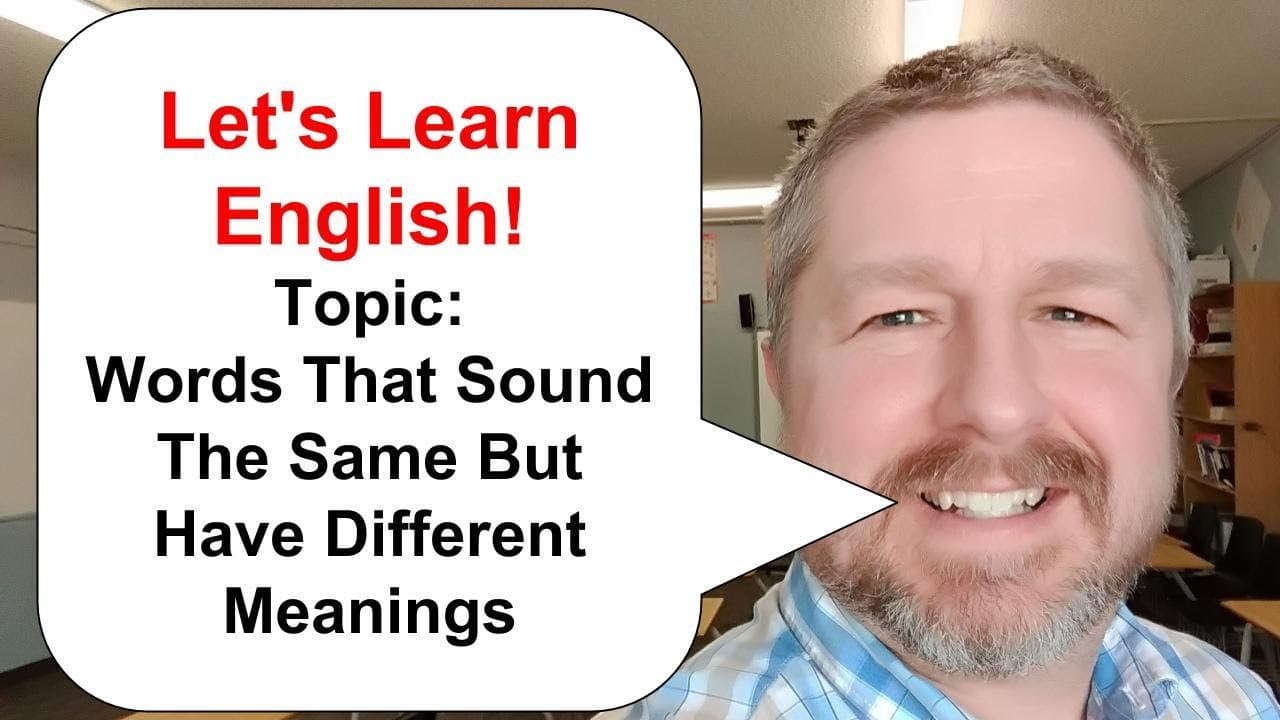
Let's Learn English Words That Sound The Same But Have Different Meanings
TL;DR
Learn about homophones, words that sound the same but have different meanings in English.
Transcript
good morning good morning good afternoon and good evening welcome to this English lesson where we're going to be looking at words that sound the same but have different spellings and different meanings and once again I feel like I need to apologize for the English language we have so many things that are hard to learn and one of those is the the fa... Read More
Key Insights
- ❓ The English language has numerous examples of homophones, which can create confusion in communication.
- ❓ Homophones can have similar pronunciations but different spellings and meanings.
- 🙊 Knowing and recognizing homophones is essential for clear and accurate understanding of spoken and written English.
- ❓ Learning about homophones can improve language proficiency and enhance communication skills.
- ❓ Homophones can vary across different regions and dialects of English.
- 🔇 Homophones can be challenging for non-native English speakers, but with practice and exposure, their understanding and usage can be improved.
- 📢 Homophones can be found in various language contexts, including nouns, verbs, adjectives, and adverbs.
Install to Summarize YouTube Videos and Get Transcripts
Explore YouTube Video Summarizer or Get YouTube Transcript Extractor
Questions & Answers
Q: What are homophones?
Homophones are words that sound the same but have different meanings and spellings, which can often cause confusion in language comprehension.
Q: Why are homophones challenging for non-native English speakers?
Homophones can be challenging for non-native English speakers because they often require memorization of words with different spellings but similar pronunciations.
Q: How can homophones impact communication?
Homophones can lead to misunderstandings and misinterpretations in communication, as the listener may hear one word but interpret it as another, leading to confusion.
Q: Why is it important to learn about homophones?
Learning about homophones is important for clear and effective communication in English. Understanding the differences in meanings and spellings allows for accurate comprehension and expression.
Summary & Key Takeaways
-
The English language has many words that sound the same but have different meanings and spellings.
-
Examples of homophones include: here/hear, accept/except, bye/buy, break/break, peace/piece, stare/stair, raise/rays, bear/bare, eight/ate, do/dew/due, hour/our, right/write, mail/male, meet/meat, etc.
-
Understanding homophones is important for effective communication and comprehension in English.
Read in Other Languages (beta)
Share This Summary 📚
Summarize YouTube Videos and Get Video Transcripts with 1-Click
Try YouTube Summary with ChatGPT & Claude or YouTube Transcript Generator
Explore More Summaries from Learn English with Bob the Canadian 📚






Summarize YouTube Videos and Get Video Transcripts with 1-Click
Try YouTube Summary with ChatGPT & Claude or YouTube Transcript Generator