How Can We Simulate Soft and Bouncy Jelly Realistically?
TL;DR
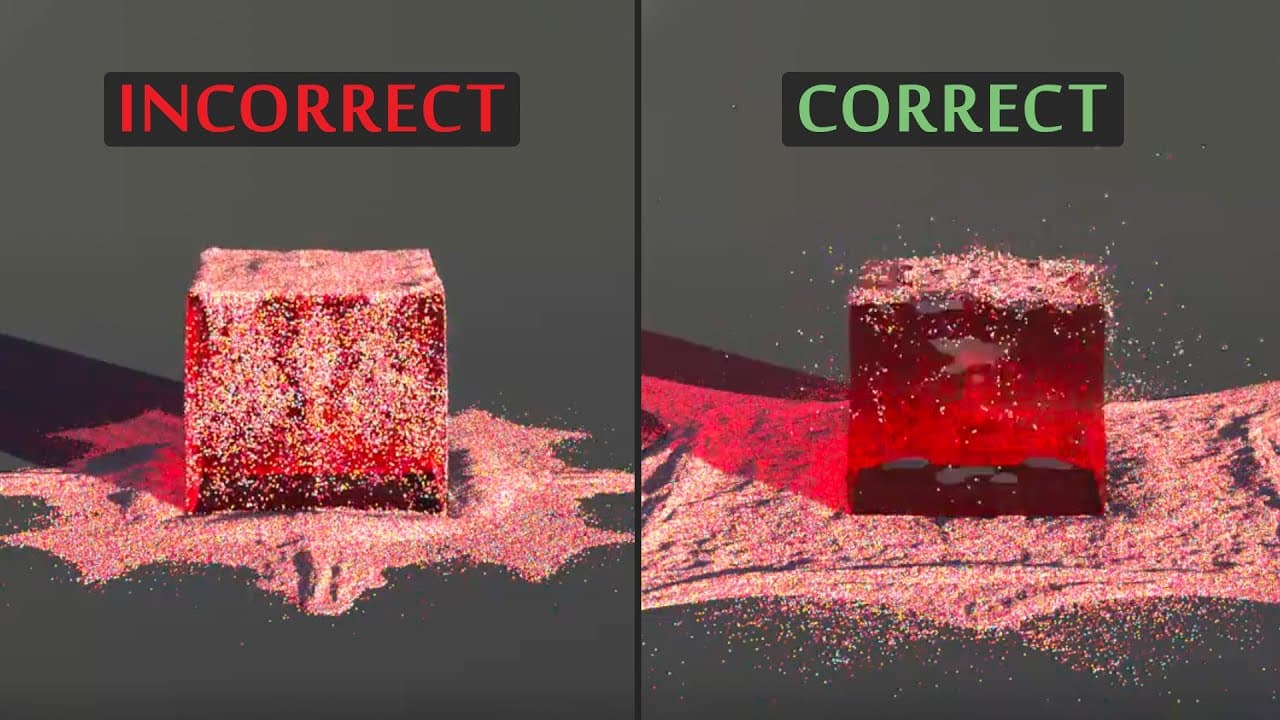
Simulating soft and bouncy jelly realistically is possible using an extended Material Point Method, which efficiently combines particles and grids. This new approach also improves the simulation of elastic materials like hair and skin, allowing for accurate interactions with fluids. While off-line simulations may take longer to process, they result in high-quality, lifelike animations.
Transcript
can make a virtual world come alive by writing a computer program that contains these laws, resulting in beautiful fluid simulations like the one you see here. The amount of detail we can simulate with these programs is increasing every year, not only due to the fact that hardware improves over time, but also, the pace of progress in computer graph... Read More
Key Insights
- 💻 The Material Point Method is a powerful simulation technique for creating fluid animations in computer graphics.
- 🧑🤝🧑 The method struggles with simulating phenomena like cracking and tearing, as well as coupling problems between different materials.
- 👻 The paper introduces an extension that allows for the simulation of elastic objects like hair and skin, improving the accuracy and realism of the simulations.
- 👱 The simulation technique has broad applications, including simulating fluids, hair, and skin interactions.
- 🖼️ The execution time for these simulations is not measured in frames per second but rather seconds or even minutes per frame.
- 🤗 The paper's findings open up possibilities for more complex and realistic simulations in the future.
- ✊ The Lambda GPU Cloud service is recommended for researchers and startups in need of affordable GPU compute power.
Install to Summarize YouTube Videos and Get Transcripts
Explore YouTube Video Summarizer or Get YouTube Transcript Extractor
Questions & Answers
Q: What is the Material Point Method and how does it work?
The Material Point Method is a simulation technique that combines particles and grids to create fluid simulations with increasing levels of detail. It allows for the realistic representation of fluid behavior in computer-generated environments.
Q: What are some limitations of the Material Point Method?
The Material Point Method struggles to accurately simulate phenomena like cracking and tearing. It also poses challenges in handling coupling problems, such as the interaction between sand particles and fluids.
Q: How does the paper's extension improve simulations?
The extension introduced in the paper allows for the simulation of elastic objects like hair and skin, as well as their interactions with other materials. It solves the problem of particles getting stuck when interacting with jello, resulting in more accurate and realistic simulations.
Q: What are the applications of this simulation technique?
This simulation technique has a wide range of applications, including simulating fluids like water and honey, simulating the behavior of hair strands, and even simulating skin interactions. It can be used in computer graphics research and animation production.
Summary & Key Takeaways
-
The Material Point Method is a hybrid simulation technique that combines particles and grids to create fluid simulations.
-
The method faces challenges in simulating phenomena like cracking and tearing.
-
The paper introduces an extension to handle simulating elastic objects, such as hair and skin, and their interactions with other materials.
Read in Other Languages (beta)
Share This Summary 📚
Summarize YouTube Videos and Get Video Transcripts with 1-Click
Try YouTube Summary with ChatGPT & Claude or YouTube Transcript Generator
Explore More Summaries from Two Minute Papers 📚




Summarize YouTube Videos and Get Video Transcripts with 1-Click
Try YouTube Summary with ChatGPT & Claude or YouTube Transcript Generator