What Did NeurIPS 2025 Reveal About AI in 2026?
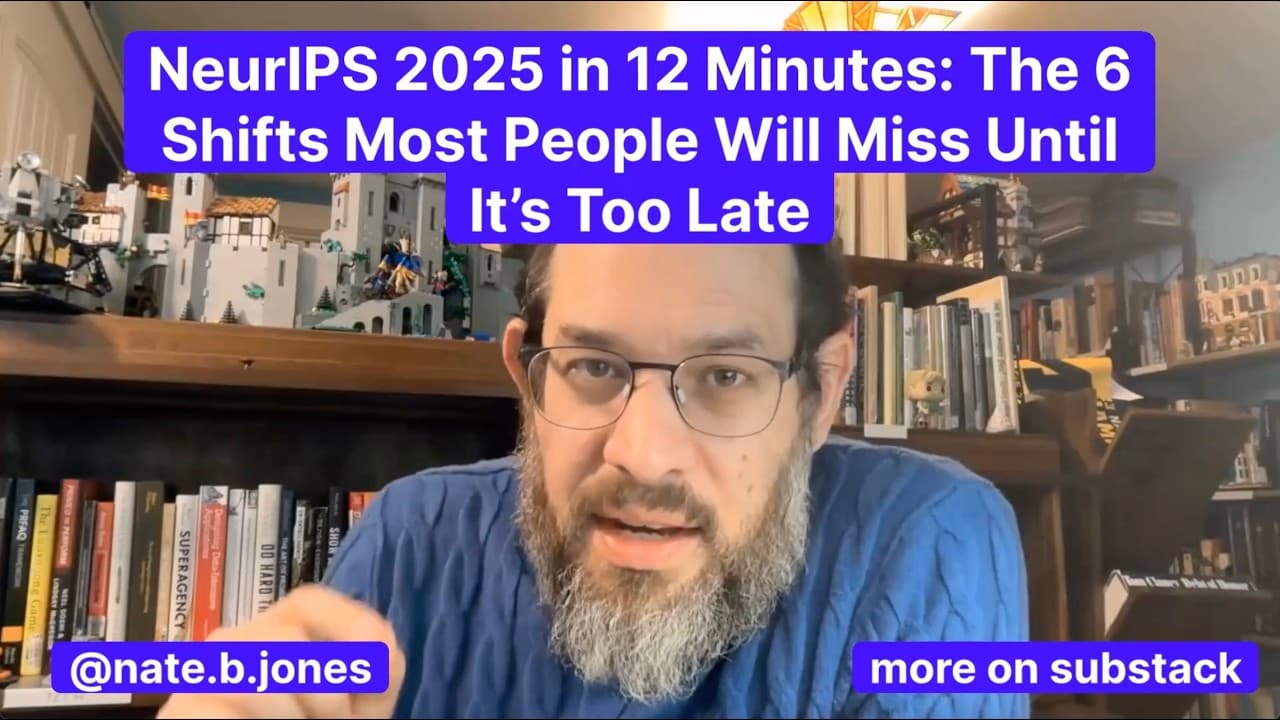
TL;DR
NeurIPS 2025 suggests that AI progress in 2026 will center on better attention, scaled reinforcement learning, measurable reasoning, efficient deployment, and workflow integration rather than model size alone. The conference also exposed a filtering crisis: roughly 20,000 submissions and widespread formulaic or AI-assisted writing make prestige an unreliable quality signal. Read on to understand the six shifts beneath the event’s increasingly corporate surface.
Transcript
In the next 10 minutes, I'm going to give you everything you need to know about Nurups 2025. Nurups is the premier AI conference in the world. And so, understanding what happened at Nurups is critical to understanding where AI is going in 2026. The conference has actually really finished its evolution from a very niche academic conference before LL... Read More
Key Insights
- • NeurIPS has become a corporatized industry event where large booths, product road maps, hardware launches, and enterprise stories share attention with academic work, making it necessary to dig beneath the trade-show layer to understand the actual state of machine-learning research.
- • The conference submission volume has created a serious signal-to-noise problem, with roughly 20,000 papers exceeding any individual's reading capacity. AI-assisted writing and formulaic publications further weaken the value of relying on a conference's brand as a quality filter.
- • Attention research is improving the internal plumbing of language models through gating, sparsity, attention-sink removal, and more stable long-context training. These changes may help similarly sized models process documents, code bases, and messy logs more accurately while using fewer computed tokens.
- • Frontier models are converging toward similar language, structures, values, and answers across vendors and prompts. This behavioral homogeneity can make model selection less consequential, while also allowing shared biases, blind spots, or consensus assumptions to spread across many systems simultaneously.
- • Reinforcement learning is beginning to follow scaling patterns previously associated with language models. Policies hundreds to roughly a thousand layers deep, trained through self-supervised or goal-conditioned methods, suggest that agentic systems may learn more from repeated raw interaction than previously expected.
- • Diffusion training appears to have an early phase that produces diverse, high-quality samples and a later phase associated with overfitting and memorization. Larger datasets push the memorization phase further out, creating a wider training window in which models can remain more generalized.
- • AI research incentives are straining under hyperinflated paper counts, formulaic publication businesses, and impossible reviewer workloads. Experiments using AI to review AI-generated papers illustrate a deeper trust problem that may lead companies, regulators, and practitioners to create independent filtering systems.
- • Major model makers are treating reasoning processes as measurable telemetry by examining intermediate steps, tool calls, and search usage alongside final-answer accuracy. Their broader focus on quantization, edge deployment, low latency, and workflow integration shows that usefulness now extends beyond model size.
Install to Summarize YouTube Videos and Get Transcripts
Explore YouTube Video Summarizer or Get YouTube Transcript Extractor
Questions & Answers
Q: What did NeurIPS 2025 reveal about AI in 2026?
NeurIPS 2025 indicated that progress is shifting toward better attention, deeper reinforcement learning, reasoning evaluation, efficient deployment, and workflow integration. It also showed that research discovery is becoming harder because roughly 20,000 submissions create a severe signal-to-noise problem.
Q: How has NeurIPS changed from an academic conference?
NeurIPS has evolved from a niche academic gathering into an industry trade show attended by tens of thousands of people across San Diego and Mexico City. Large corporate booths, product road maps, hardware launches, and enterprise stories now compete with academic research and help shape the conference agenda.
Q: Why can’t conference prestige alone identify important AI research?
NeurIPS received roughly 20,000 submissions, which is more than any individual can read carefully. AI-assisted writing, formulaic publications, and overwhelming reviewer workloads can bury meaningful work, so readers must examine who produced the research and whether they trust them.
Q: How could better attention mechanisms improve language models?
Research on gating, sparsity, attention-sink removal, and stable long-context training can make attention more selective and reliable. That may help similarly sized models process long documents, large code bases, and messy logs with fewer hallucinations and fewer computed tokens.
Q: Why are frontier AI models producing increasingly similar answers?
Top models from different vendors often converge on similar phrasing, structures, values, and responses to open-ended prompts. The transcript describes this as occupying the same behavioral basin, which makes model choice less consequential but can also spread shared biases and blind spots across systems.
Q: What does scaled reinforcement learning mean for agents and robotics?
Researchers are training reinforcement-learning policies hundreds to roughly a thousand layers deep through self-supervised or goal-conditioned methods. The results suggest that agents may learn more from repeated interaction than previously expected, making robotics, logistics, automation, and simulation-heavy workflows important areas to watch in 2026.
Q: When do diffusion models begin memorizing training data?
Diffusion training appears to have an early phase that produces diverse, high-quality samples and a later phase associated with overfitting and memorization. Larger datasets push the memorization phase further out, widening the training window in which the model remains more generalized.
Q: How should organizations evaluate useful AI models?
Organizations should assess whether a model completes the required job efficiently on the intended device and connects with existing tools and workflows. Final-answer accuracy is not enough: intermediate steps, tool calls, and search usage can provide diagnostic telemetry about how the model reasons.
Summary & Key Takeaways
-
NeurIPS has evolved from a niche academic gathering into a large, corporatized industry event spanning San Diego and Mexico City. Product road maps, hardware launches, enterprise stories, and major corporate booths now compete with academic research, indicating that companies increasingly shape the conference agenda and how its developments are presented.
-
Several research threads could influence AI systems in 2026. Improved attention may support longer contexts with fewer hallucinations and wasted tokens, while deeper reinforcement learning policies may advance agents and robotics. Diffusion research also distinguishes early generalization from later memorization, making training scale and stopping time important considerations.
-
Major model makers are emphasizing measurable reasoning, efficient deployment, and workflow integration instead of model size alone. Step-by-step processes, tool calls, and search usage can become diagnostic telemetry. The practical question is therefore whether a model works efficiently on the required device and connects effectively with the user's tools.
-
Key Insights Only? Too bad.
Read in Other Languages (beta)
Share This Summary 📚
Summarize YouTube Videos and Get Video Transcripts with 1-Click
Try YouTube Summary with ChatGPT & Claude or YouTube Transcript Generator
Explore More Summaries from AI News & Strategy Daily | Nate B Jones 📚






Summarize YouTube Videos and Get Video Transcripts with 1-Click
Try YouTube Summary with ChatGPT & Claude or YouTube Transcript Generator