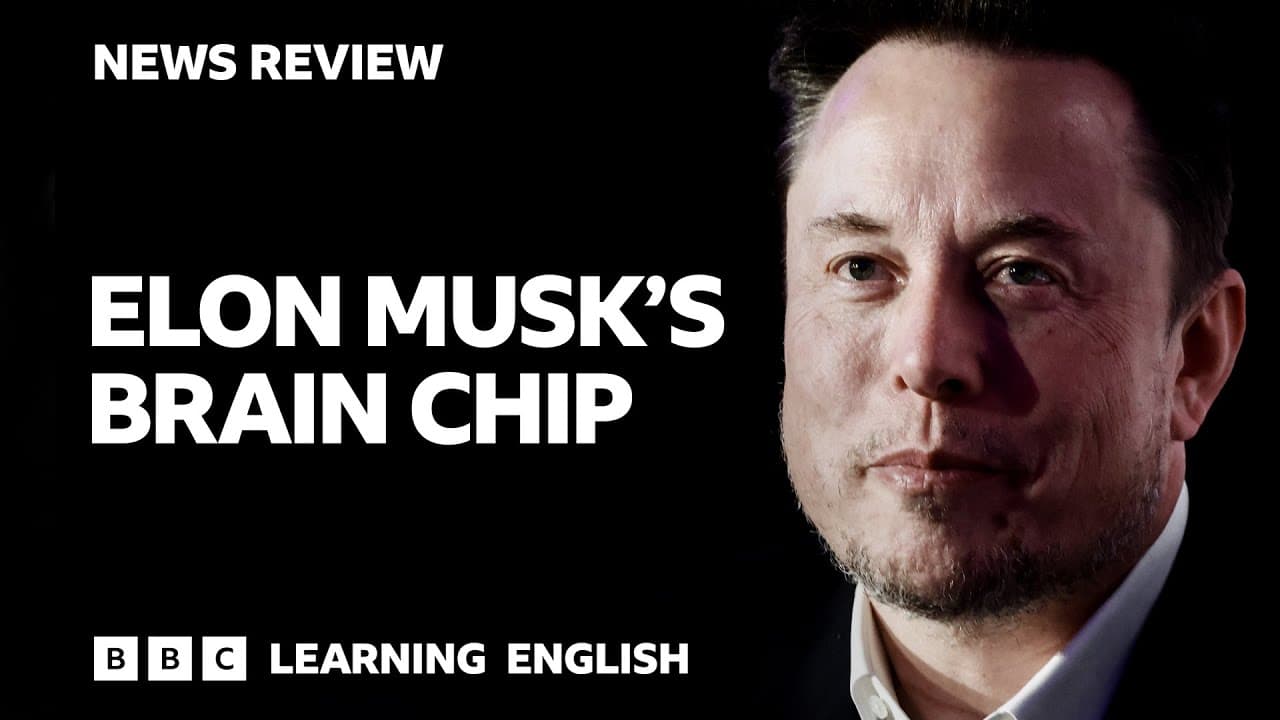
How Does Elon Musk's Brain Chip Work?
TL;DR
Elon Musk's Neuralink has developed a wireless brain chip that can read movement-related brain signals and communicate them to a computer. This technology aims to allow users to control devices using their thoughts, integrating biological and technological systems. The implications raise ethical concerns about the creation of cyborgs, blending human and machine capabilities.
Transcript
Could brain chips let us control our phones with our minds? That's what Elon Musk hopes. This is News Review from BBC Learning English, where we help you understand news headlines in English. I'm Beth. And I'm Phil. Make sure you watch to the end to learn the vocabulary that you need to talk about this story. And remember to subscribe to our channe... Read More
Key Insights
- Elon Musk's Neuralink has successfully implanted a wireless chip in a human brain, marking a significant advancement in brain-computer interfaces.
- The implanted device can read brain signals associated with movement and transmit them to a computer, potentially allowing mind-controlled device operation.
- The concept of 'implant' is explored, highlighting its dual role as a verb and noun, referring to devices placed inside the body.
- Brain-computer interfaces represent a connection between biological and technological systems, enabling communication between the brain and computers.
- The term 'cyborg', originating from science fiction, is used to describe entities that are part-human and part-machine, reflecting futuristic technological integration.
- Public concern is noted regarding the ethical implications of creating 'cyborgs', as expressed in reactions to Neuralink's advancements.
- The vocabulary surrounding this technology includes key terms like 'implant', 'interface', and 'cyborg', each with distinct meanings and applications.
- Neuralink's innovation could redefine human interaction with technology, introducing new paradigms in how we control and communicate with devices.
- More videos with Elon Musk's:
Install to Summarize YouTube Videos and Get Transcripts
Explore YouTube Video Summarizer or Get YouTube Transcript Extractor
Questions & Answers
Q: What is the main innovation introduced by Neuralink?
Neuralink's main innovation is the successful implantation of a wireless chip in a human brain. This chip can read brain signals related to movement and transmit them to a computer, potentially allowing users to control devices such as phones and computers with their thoughts. This represents a significant advancement in brain-computer interfaces.
Q: How does the term 'implant' apply in this context?
In this context, 'implant' refers to the physical device placed inside the human brain by Neuralink. It is used as both a noun and a verb, describing the device itself and the act of placing it. Implants are not new, but Neuralink's application is innovative, aiming to enable mind-controlled device operation.
Q: What does the term 'interface' signify in the Neuralink story?
The term 'interface' in the Neuralink story signifies the connection between the brain and computer systems. It describes how the implanted device allows the brain to communicate with and control a computer, representing a fusion of biological and technological systems. Interfaces can also refer to simpler connections, like software user interfaces.
Q: How is the term 'cyborg' relevant to Neuralink's advancements?
The term 'cyborg' is relevant to Neuralink's advancements as it describes entities that are part-human and part-machine. Originally from science fiction, it is used to highlight the integration of technology into the human body, as seen with Neuralink's brain chip. This raises ethical questions about the future of human-machine hybrids.
Q: What public concerns have arisen from Neuralink's technology?
Public concerns about Neuralink's technology focus on the ethical implications of creating 'cyborgs'. Some people fear the consequences of integrating technology into the human body, such as privacy issues, potential misuse, and the broader impact on human identity. These concerns have been expressed in reactions to Neuralink's recent advancements.
Q: What vocabulary is essential to understanding the Neuralink story?
Essential vocabulary for understanding the Neuralink story includes 'implant', 'interface', and 'cyborg'. 'Implant' refers to the device placed inside the body, 'interface' describes the connection between the brain and computer systems, and 'cyborg' highlights the integration of human and machine elements. These terms are crucial for discussing the technological and ethical aspects of Neuralink's innovations.
Q: How could Neuralink's technology change human interaction with devices?
Neuralink's technology could revolutionize human interaction with devices by enabling mind-controlled operation. By reading brain signals and transmitting them to computers, users could control devices like phones and computers without physical input. This innovation has the potential to redefine how we communicate with technology, introducing new paradigms in device interaction.
Q: What are the broader implications of Neuralink's brain chip innovation?
The broader implications of Neuralink's brain chip innovation include potential advancements in medical technology, such as aiding individuals with disabilities, and raising ethical questions about privacy, security, and human identity. As the technology develops, it could lead to significant changes in how humans interact with machines and challenge current societal norms around technology integration.
Summary & Key Takeaways
-
Elon Musk's company Neuralink has made a breakthrough by implanting a wireless chip in a human brain. This chip can read brain signals related to movement and communicate them to a computer, potentially allowing users to control devices with their thoughts.
-
The term 'implant' is crucial in this context, referring to the physical device placed inside the body. It also serves as a verb, indicating the act of placing such devices, with examples like cochlear implants and pacemakers.
-
Neuralink's brain-computer interface represents a fusion of biological and technological systems, enabling the brain to interact with computers. The concept of 'cyborg' is explored, highlighting its use in describing entities that are part-human and part-machine.
Read in Other Languages (beta)
Share This Summary 📚
Summarize YouTube Videos and Get Video Transcripts with 1-Click
Try YouTube Summary with ChatGPT & Claude or YouTube Transcript Generator
Explore More Summaries from BBC Learning English 📚

Summarize YouTube Videos and Get Video Transcripts with 1-Click
Try YouTube Summary with ChatGPT & Claude or YouTube Transcript Generator