How to Calculate Simple Moving Average in Python
TL;DR
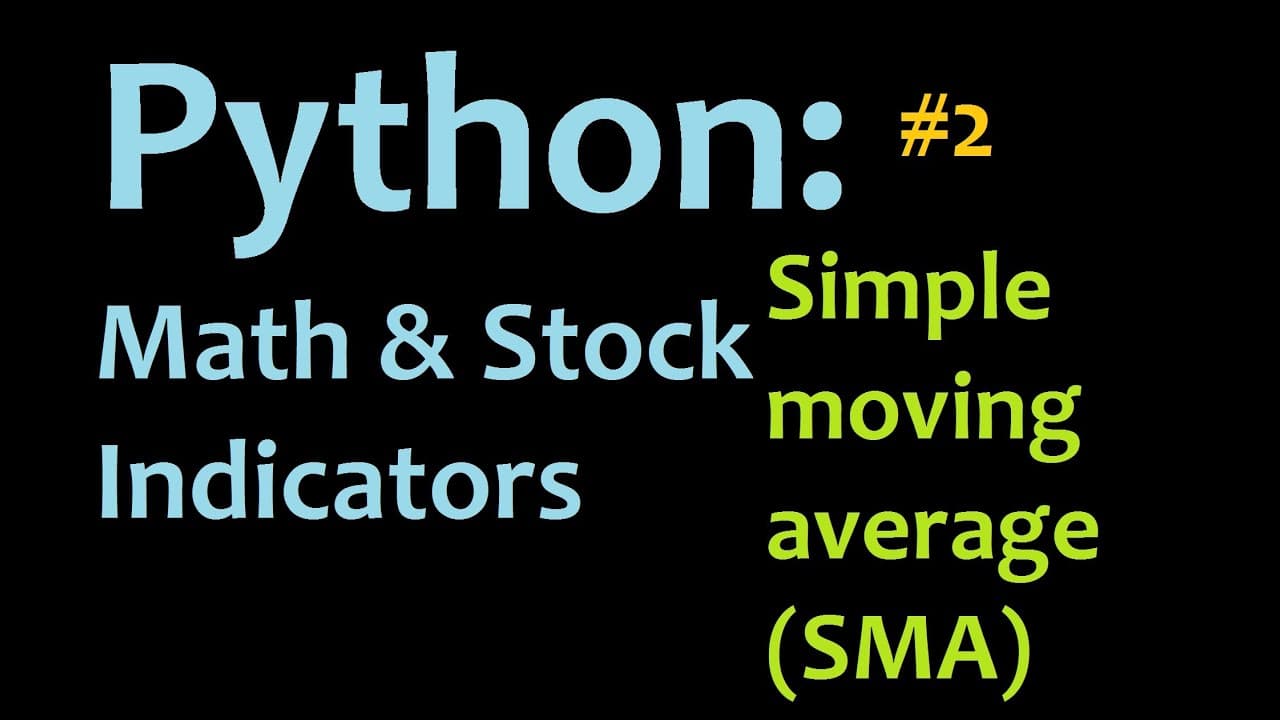
To calculate the simple moving average (SMA) in Python, use the NumPy library's convolve function with a defined window size to smooth data points and identify trends. This method applies to various datasets, allowing for both short-term and long-term analysis. Ensure you use the 'valid' parameter for accurate results.
Transcript
hello and welcome to the second part of uh mathematics stock indicator tutorial series within python uh hopefully you got everything installed and everything's running okay and if so you're at this video ready to learn some awesome stuff so let's go ahead and get started so the first thing we we're to what we're going to cover is a simple moving av... Read More
Key Insights
- 🏑 Moving averages, both simple and exponential, are essential tools for analyzing trends in various fields, not just finance.
- 🏛️ Numpy, a Python library, offers built-in functions that simplify the calculation of moving averages.
- ❓ The "valid" parameter is recommended when calculating moving averages to ensure accurate results.
- ❓ Understanding how to calculate and interpret moving averages is a fundamental skill in data analysis and visualization.
- 🍉 Moving averages can be used to identify short-term and long-term trends in datasets.
- 👨💻 The provided tutorial focuses on calculating simple moving averages, with an example dataset and step-by-step code explanations.
- 💹 The tutorial mentions the incorporation of moving averages into charts using matplotlib, providing additional functionality for data visualization.
Install to Summarize YouTube Videos and Get Transcripts
Explore YouTube Video Summarizer or Get YouTube Transcript Extractor
Questions & Answers
Q: What is the purpose of calculating moving averages?
Moving averages are used to smooth out data and analyze trends over a specific period. They are commonly used in financial analysis but have applications in various fields.
Q: Can you explain the difference between simple moving averages and exponential moving averages?
Simple moving averages calculate the average of a predetermined number of data points at each point, while exponential moving averages give more weight to recent data points.
Q: How can numpy be used to calculate moving averages in Python?
Numpy provides functions like repeat and convolve that facilitate the calculation of moving averages. The repeat function is used to define the weights for the moving average, while convolve performs the actual calculation.
Q: Why is it important to use the "valid" parameter when calculating moving averages?
The "valid" parameter ensures that moving averages are only calculated when there are enough data points available. This prevents inaccurate calculations and provides a more reliable representation of the trend.
Summary & Key Takeaways
-
The video tutorial covers the implementation of simple moving averages and exponential moving averages using Python and numpy.
-
Simple moving averages act as a method of smoothing out data points and can be used to analyze trends in various fields, not just financial analysis.
-
The tutorial provides step-by-step instructions and code examples for calculating simple moving averages.
Read in Other Languages (beta)
Share This Summary 📚
Summarize YouTube Videos and Get Video Transcripts with 1-Click
Try YouTube Summary with ChatGPT & Claude or YouTube Transcript Generator
Explore More Summaries from sentdex 📚


Summarize YouTube Videos and Get Video Transcripts with 1-Click
Try YouTube Summary with ChatGPT & Claude or YouTube Transcript Generator