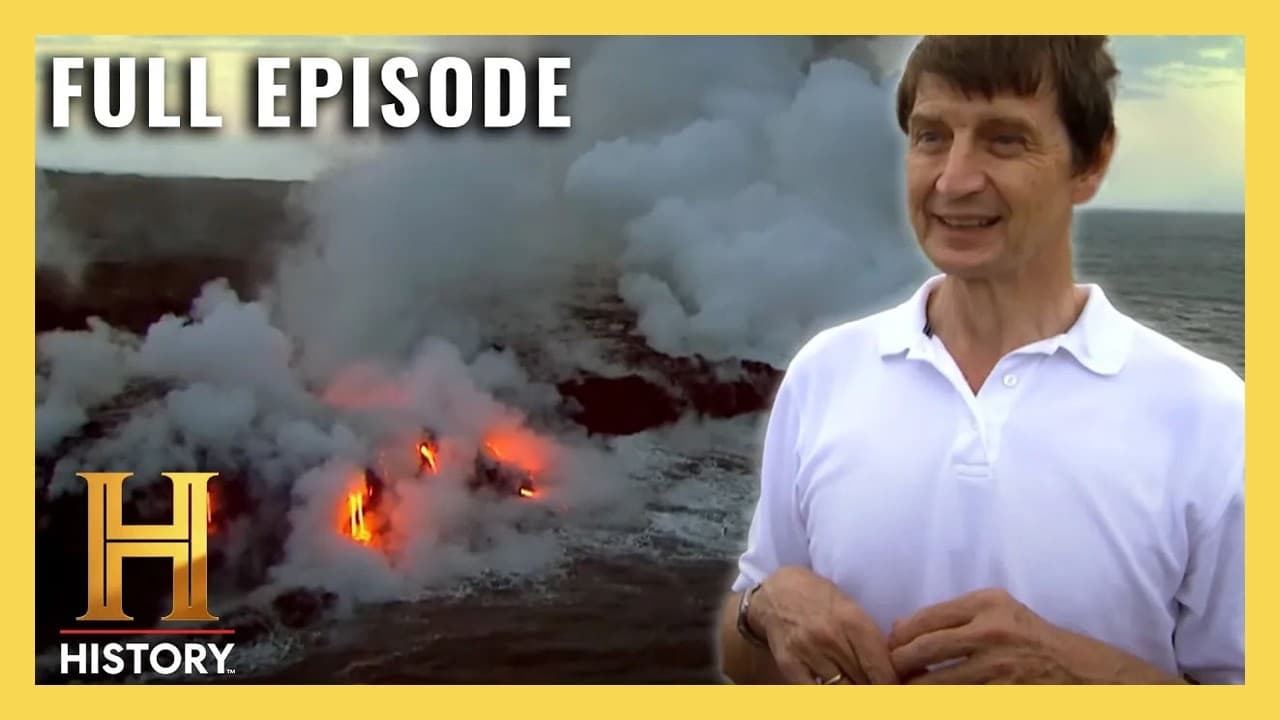
How Did Volcanoes Build Hawaii? | How The Earth Was Made (S1, E12) | Full Episode
TL;DR
Hawaii formed as repeated lava flows from enormous volcanoes built upward from the Pacific seafloor and merged into islands. The Big Island grew over more than a million years from five volcanoes, while Kilauea alone could produce 100 million cubic yards of lava annually. Read on to discover how scientists measured Hawaii’s hidden scale and how lava tubes continue carrying molten rock toward the sea.
Transcript
[music playing] NARRATOR: Earth, a 4.5 billion-year-old planet, still evolving. As continents shift and clash, volcanoes erupt, glaciers grow and recede. The Earth's crust is carved in countless fascinating ways, leaving a trail of geological mysteries behind. This is the story of Hawaii, a mountain chain over 80 million years old and home to the m... Read More
Key Insights
- The Big Island is a mostly submerged volcanic structure, with only its upper portion visible above the Pacific Ocean. Gravimeter measurements made this immense scale clear, and Mauna Kea reaches about 56,000 feet when measured from its base on the ocean floor.
- Kilauea is described as the world’s most active volcano because it had erupted almost continuously since 1983 at the time discussed. Lava from its vents has swallowed homes, towns, and forests while adding successive layers of volcanic rock to the island.
- Sulfur dioxide is an indicator of magma output because the amount released from magma is directly connected to the quantity reaching the surface. By measuring this gas, researchers calculated that Kilauea could produce 100 million cubic yards of lava in a year.
- Lava tubes are natural underground conduits created when the exposed surface of a lava flow cools into a crust while molten material continues moving beneath it. These insulated passages keep lava hot and allow it to travel farther and faster than exposed surface flows.
- An active lava tube can transport approximately five cubic yards of molten material every second. The observed flow was compared with a dump truck of lava passing every two seconds, illustrating how hidden tubes carry enormous quantities beneath apparently solid volcanic terrain.
- New Hawaiian land forms when extremely hot lava reaches seawater, shatters into small pieces, and leaves black sand and rubble behind. This loose material accumulates on the ocean floor, after which later lava flows cool across it and create solid land.
- The Big Island is the combined product of five volcanoes rather than a single volcanic peak. Kohala began the island, Mauna Kea and Hualalai followed, Mauna Loa developed next, and Kilauea is the youngest of the five volcanic structures.
- Hawaiian volcanism does not fit the standard plate-boundary explanation because the islands lie about 2,000 miles from the nearest boundary. Although subduction explains many volcanoes around the Pacific Ring of Fire, Hawaii requires an anomaly that produces melting within a large plate.
Install to Summarize YouTube Videos and Get Transcripts
Explore YouTube Video Summarizer or Get YouTube Transcript Extractor
Questions & Answers
Q: How did volcanoes create the Big Island of Hawaii?
The Big Island formed over more than a million years as lava from five volcanoes accumulated from the Pacific seafloor. Kohala formed first, followed by Mauna Kea, Hualalai, Mauna Loa, and Kilauea. Repeated lava flows joined these volcanic structures into one enormous island.
Q: Which five volcanoes formed Hawaii’s Big Island?
The five volcanoes are Kohala, Mauna Kea, Hualalai, Mauna Loa, and Kilauea. Kohala began the island, while Kilauea is the youngest of the five.
Q: How large is Mauna Kea from its base to its summit?
Mauna Kea rises 13,796 feet above sea level, but its base extends to the ocean floor. From that submerged base to its summit, the volcano is about 56,000 feet high.
Q: Why is most of the Big Island hidden beneath the ocean?
Gravimeter measurements revealed that only the upper portion of the Big Island is visible above the Pacific. Its immense volcanic foundation extends down to the ocean floor, making the island resemble a gigantic iceberg with only its tip exposed.
Q: How do scientists estimate Kilauea’s lava production?
Researchers regularly measure the sulfur dioxide released from Kilauea’s magma. Because the amount of sulfur dioxide is directly tied to the magma rising from the ground, they can use it to calculate lava output. Their measurements indicated that Kilauea could produce 100 million cubic yards of lava in a year.
Q: How do lava tubes form beneath Hawaiian volcanoes?
A lava tube forms when the exposed top of a moving lava flow cools and develops a solid crust. Molten lava continues flowing beneath that crust, creating an insulated underground tunnel that keeps the lava hot and moving efficiently.
Q: How much lava can an active lava tube carry?
The observed active tube carried about five cubic yards of lava every second. That flow was described as the equivalent of a dump truck’s worth of lava passing every two seconds.
Q: How does lava entering the ocean create new Hawaiian land?
When lava at about 2,000 degrees Fahrenheit reaches seawater, it shatters into small pieces that form black sand and rubble. This loose material accumulates on the ocean floor, and later lava flows spread over it and cool into solid volcanic rock, extending the coastline.
Summary & Key Takeaways
-
Hawaii is an isolated 1,500-mile island chain containing eight tropical islands and 15 mammoth volcanoes. Gravity measurements revealed that the Big Island extends far beneath the ocean. Mauna Kea rises 13,796 feet above sea level and approximately 56,000 feet from its base on the ocean floor.
-
Kilauea builds land through sustained volcanic activity. Sulfur dioxide measurements help researchers estimate magma and lava output, while natural underground tubes transport hot lava efficiently toward the sea. When lava reaches seawater, it shatters into black rubble that accumulates before later surface flows cool into solid land.
-
The Big Island developed over more than a million years through lava from five volcanoes. Kohala emerged first, followed by Mauna Kea, Hualalai, Mauna Loa, and Kilauea. Hawaii’s location far from a plate boundary showed that ordinary subduction could not explain its extensive volcanic activity, requiring another geological explanation.
Read in Other Languages (beta)
Share This Summary 📚
Summarize YouTube Videos and Get Video Transcripts with 1-Click
Try YouTube Summary with ChatGPT & Claude or YouTube Transcript Generator
Explore More Summaries from HISTORY 📚


Summarize YouTube Videos and Get Video Transcripts with 1-Click
Try YouTube Summary with ChatGPT & Claude or YouTube Transcript Generator