How Does K-means Clustering Work?
TL;DR
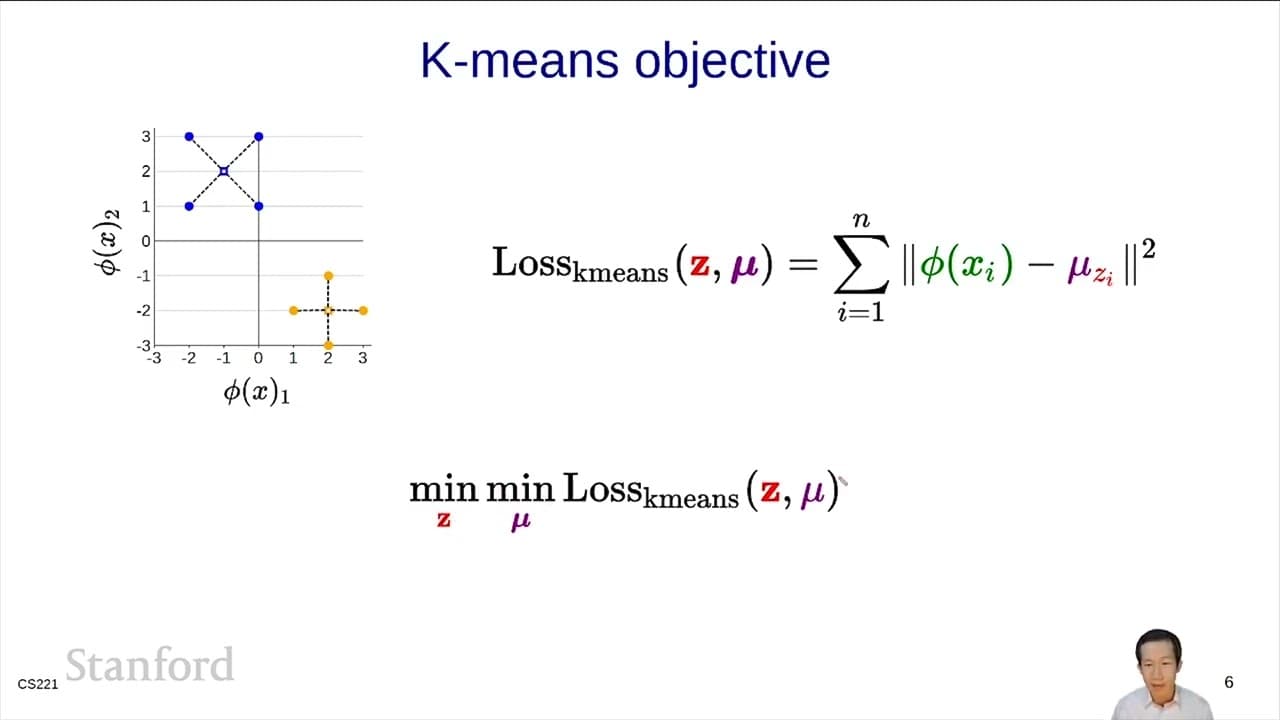
K-means clustering organizes data by grouping similar points based on their proximity to centroids. This algorithm iteratively assigns points to clusters and updates centroids to minimize the squared distances. It's a key technique in unsupervised learning, especially useful when labeled data is limited.
Transcript
hi in this module i'm going to talk about k-means a simple algorithm for clustering one form of unsupervised learning so i want to start with a classical example of clustering from the nlp literature around clustering so this was the unsupervised learning method of choice before word vector or contextualized word so on so the input to the algorithm... Read More
Key Insights
- 👈 K-means clustering can group similar data points together based on their proximity to centroids, providing insights into the underlying structure of the data.
- 🏷️ Unsupervised learning methods like clustering can be particularly valuable when labeled data is scarce or expensive to obtain.
- 👈 The k-means algorithm is an iterative process that alternates between assigning data points to clusters and updating the centroids to minimize the objective function.
- 😉 Although k-means is not guaranteed to find the global optimum, it can still converge to a local minimum and produce effective clustering results.
Install to Summarize YouTube Videos and Get Transcripts
Explore YouTube Video Summarizer or Get YouTube Transcript Extractor
Questions & Answers
Q: How does k-means clustering work?
K-means clustering involves initializing random centroids, then iteratively assigning data points to the closest centroid and updating the centroids based on the assigned points. This process continues until convergence is reached.
Q: What is the objective function of k-means clustering?
The objective function in k-means clustering is to minimize the sum of squared distances between each data point and its assigned centroid. The algorithm aims to find centroids that best represent each cluster.
Q: How does unsupervised learning differ from supervised learning?
Unsupervised learning, such as clustering, does not require labeled data and can discover patterns and structure in unannotated data. Supervised learning, on the other hand, relies on labeled data for training classification algorithms.
Q: What are the potential use cases of clustering in unsupervised learning?
Clustering can be used for data exploration, discovering hidden patterns in unlabeled data, and generating useful features or representations for downstream supervised learning tasks.
Summary & Key Takeaways
-
K-means is a popular example of unsupervised learning for clustering, where raw text data was clustered based on various categories such as days of the week and natural resources.
-
Supervised learning, in contrast to unsupervised learning, requires labeled data, which can be expensive and time-consuming to obtain.
-
The k-means algorithm aims to assign data points to clusters based on their proximity to centroids, with the goal of minimizing the squared distance between each point and its assigned centroid.
Read in Other Languages (beta)
Share This Summary 📚
Summarize YouTube Videos and Get Video Transcripts with 1-Click
Try YouTube Summary with ChatGPT & Claude or YouTube Transcript Generator
Explore More Summaries from Stanford Online 📚
Summarize YouTube Videos and Get Video Transcripts with 1-Click
Try YouTube Summary with ChatGPT & Claude or YouTube Transcript Generator