Microwave tee junctions & H Plane tee junction | Microwave Engineering | Lec-59
TL;DR
The video provides an overview of microwave T-junctions, including types and their impedance matching principles.
Transcript
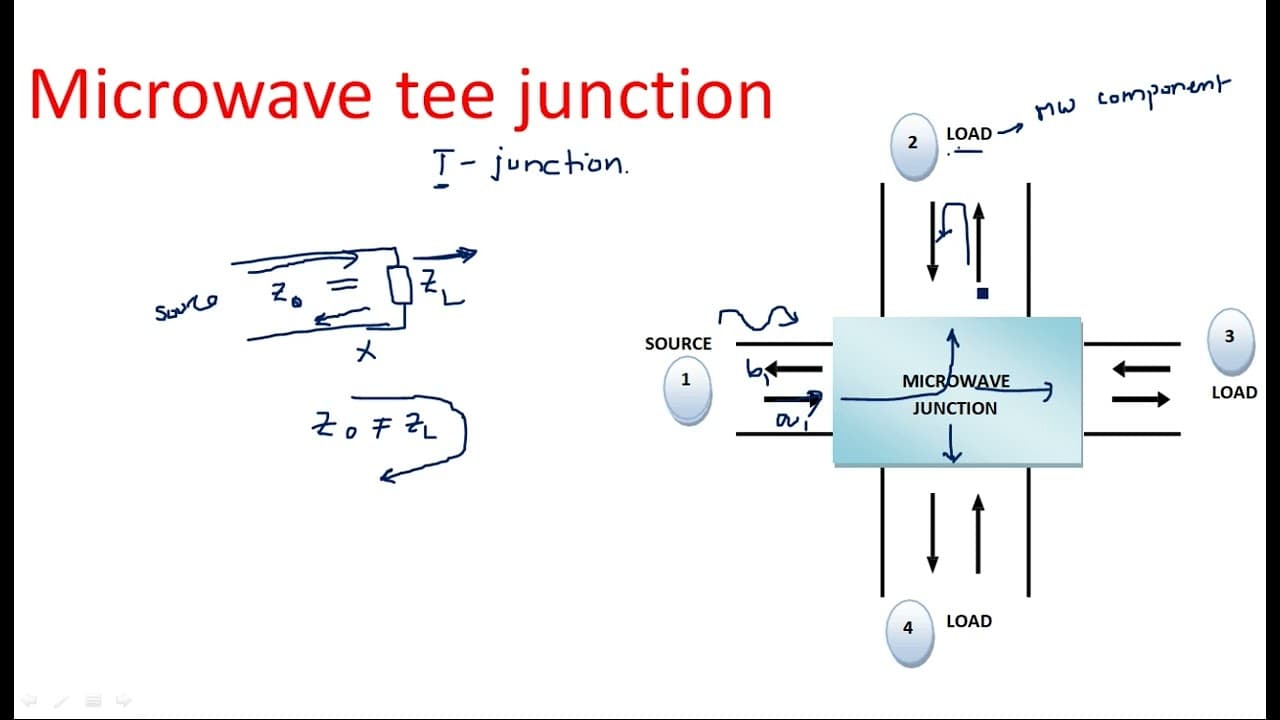
hi everyone in this video I am going to explain about microwave t-junctions and I will explain one of the T Junctions like H plane t-jection also so what do you mean by microwave digction see if you consider any Junction like this Junction is nothing but having two or more directions input Direction and as well as output directions so if you see th... Read More
Key Insights
- 🦖 Microwave T-junctions function as critical components in distributing electromagnetic signals to multiple outputs, enhancing device connectivity.
- 📡 Impedance matching is vital for minimizing signal reflection, ensuring effective energy transfer in microwave applications.
- 👻 The H-plane T-junction allows for seamless signal propagation without phase shifts, making it ideal for certain microwave configurations.
- 🦻 Microwave components, including various T-junction types, are commonly found in laboratories, aiding practical understanding and experimentation.
- ✈️ Different T-junction designs serve specific purposes in an electrical system, with H-plane and E-plane configurations showcasing distinct operational characteristics.
- 🦻 The video clarifies common misconceptions around the terminology of different T-junction types, aiding in better understanding among learners.
- 🎨 Understanding the principles of microwave junctions can significantly enhance design choices in RF technologies and microwave circuitry.
Install to Summarize YouTube Videos and Get Transcripts
Explore YouTube Video Summarizer or Get YouTube Transcript Extractor
Questions & Answers
Q: What are microwave T-junctions used for?
Microwave T-junctions are utilized in microwave technologies to split electromagnetic signals among various output paths. They enable the efficient use of a single source to power multiple devices by directing the same signal to different ports, facilitating more versatile electronic designs.
Q: How does impedance matching affect signal transmission in T-junctions?
Impedance matching is crucial in T-junctions because it prevents signal reflection by ensuring the load impedance matches the characteristic impedance of the transmission line. When impedances are matched, signals are completely absorbed by the load, whereas mismatched impedances result in reflected signals that can disrupt performance.
Q: What distinguishes H-plane from E-plane T-junctions?
H-plane T-junctions have a side arm aligned with the magnetic field of the main waveguide and do not introduce phase shifts between collinear ports, while E-plane T-junctions are structured to align with the electric field and may involve phase shifts, creating different signal propagation characteristics.
Q: Can you explain the structure of an H-plane T-junction?
An H-plane T-junction is formed by cutting a rectangular slot along the width of a main waveguide and attaching a side arm. This configuration allows signals entering one port to split efficiently toward the other ports without changes in phase, supporting smooth signal distribution.
Q: How do waveguide junctions facilitate power distribution in microwaves?
Waveguide junctions are designed to effectively split power in microwave applications. By directing signals into multiple paths, they allow one power source to serve several devices, optimizing resource usage and enhancing performance in RF communication systems.
Q: What happens when there is an impedance mismatch at a T-junction?
An impedance mismatch occurs when the load impedance does not match the characteristic impedance of the transmission line, leading to a portion of the signal being reflected back. This reflection can cause interference, distort the signal, and reduce transmission efficiency, negatively impacting overall system performance.
Summary & Key Takeaways
-
The video introduces microwave T-junctions, explaining their function in splitting electromagnetic signals into multiple directions through various ports.
-
It emphasizes the importance of impedance matching, detailing how perfect impedance alignment between loads and transmission lines prevents signal reflection.
-
Different types of T-junctions are discussed, focusing on the H-plane T-junction, explaining its structure, operation, and the significance of maintaining phase relationships.
Read in Other Languages (beta)
Share This Summary 📚
Summarize YouTube Videos and Get Video Transcripts with 1-Click
Try YouTube Summary with ChatGPT & Claude or YouTube Transcript Generator