What is Deep Learning and How Does Backpropagation Work?
TL;DR
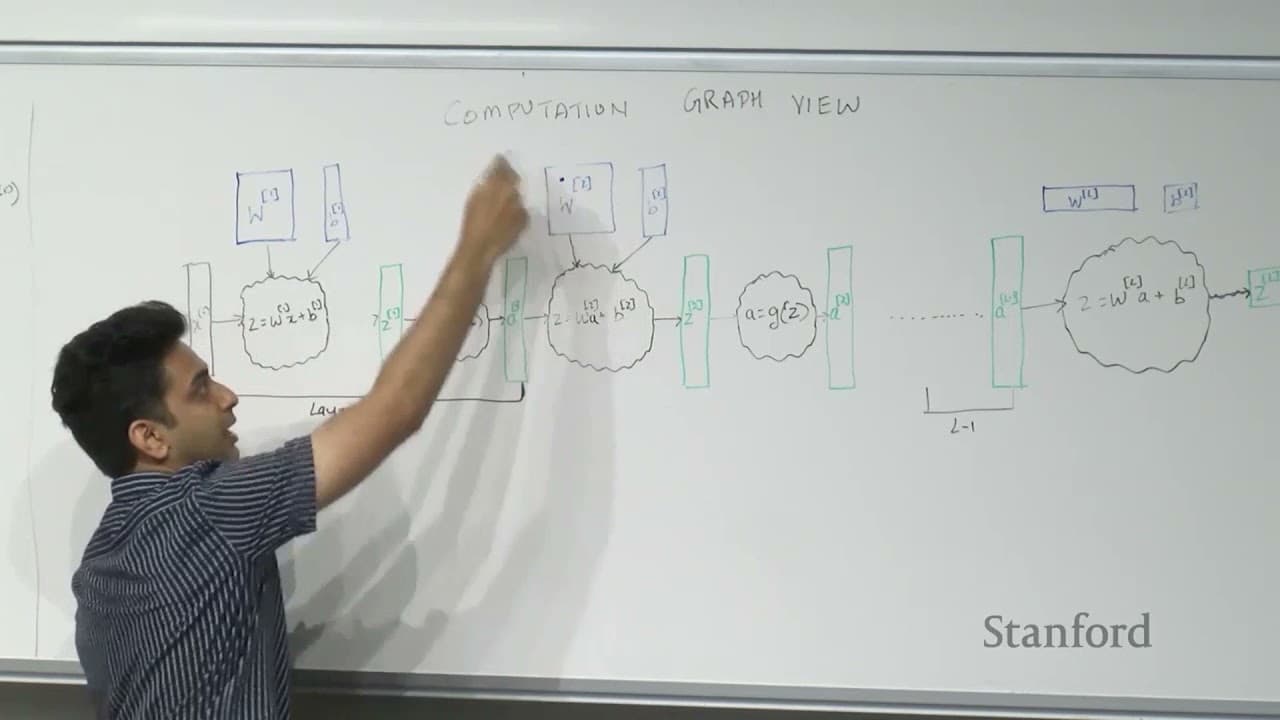
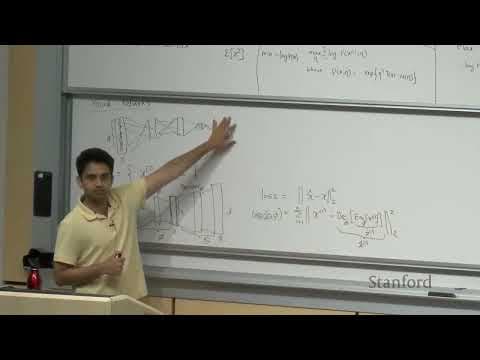
Deep learning involves multiple computational layers that transform input data into outputs. The backpropagation algorithm calculates the gradients needed to update the neural network's parameters using gradient descent, allowing the model to learn from data and improve its performance in tasks such as classification.
Transcript
welcome to lecture 11 of cs229 um the plan today is to wrap up deep learning um and we we left off at the end of back propagation last lecture and we probably the last part was probably a little bit hurried so we're going to cover it again just to make sure you all understood it properly and then once we wrap up deep learning we're going to the goa... Read More
Key Insights
- 🔠 Deep learning is a composition of multiple layers that transform the input data.
- ❓ Backpropagation is used to calculate gradients and update parameters in a neural network.
- ❓ Neural networks learn representations that can be used for further analysis or classification tasks.
- 🚂 Stochastic and mini-batch gradient descent are optimization methods used in training neural networks.
- ❓ Neural networks have connections to Gaussian processes and can be used as kernels.
Install to Summarize YouTube Videos and Get Transcripts
Explore YouTube Video Summarizer or Get YouTube Transcript Extractor
Questions & Answers
Q: How is deep learning structured?
Deep learning is structured as a composition of multiple layers of computation, where the output of one layer becomes the input of the next layer.
Q: What is backpropagation?
Backpropagation is an algorithm used to calculate the gradients of the loss function with respect to the parameters in a neural network, allowing for parameter updates through gradient descent.
Q: What is the purpose of neural networks?
Neural networks learn representations of the input data, which can be used for further analysis or classification tasks. They can identify patterns and extract features from the data.
Q: What is the difference between stochastic and mini-batch gradient descent?
Stochastic gradient descent updates the parameters using one example at a time, while mini-batch gradient descent updates the parameters using a batch of examples. Mini-batch gradient descent reduces the noise in the gradient estimation and takes advantage of parallelism in computation.
Q: How are neural networks related to Gaussian processes?
Neural networks can be used as kernels in Gaussian processes, allowing for the combination of both approaches in machine learning tasks. Neural networks can learn representations and provide a flexible way of modeling data.
Q: What is the universal approximation theorem?
The universal approximation theorem states that a neural network with one hidden layer and a sufficient number of neurons can approximate any continuous function to a desired degree of accuracy. This highlights the expressive power of neural networks.
Summary & Key Takeaways
-
Deep learning is a composition of multiple layers of computation, where each layer performs a transformation on the input.
-
Backpropagation is the algorithm used to calculate the gradients of the loss function with respect to the parameters and update them using gradient descent.
-
Neural networks learn representations of the input data, which can be used for further analysis or classification tasks.
Read in Other Languages (beta)
Share This Summary 📚
Summarize YouTube Videos and Get Video Transcripts with 1-Click
Try YouTube Summary with ChatGPT & Claude or YouTube Transcript Generator
Explore More Summaries from Stanford Online 📚
Summarize YouTube Videos and Get Video Transcripts with 1-Click
Try YouTube Summary with ChatGPT & Claude or YouTube Transcript Generator