Progress update of the DIY tensile testing machine
TL;DR
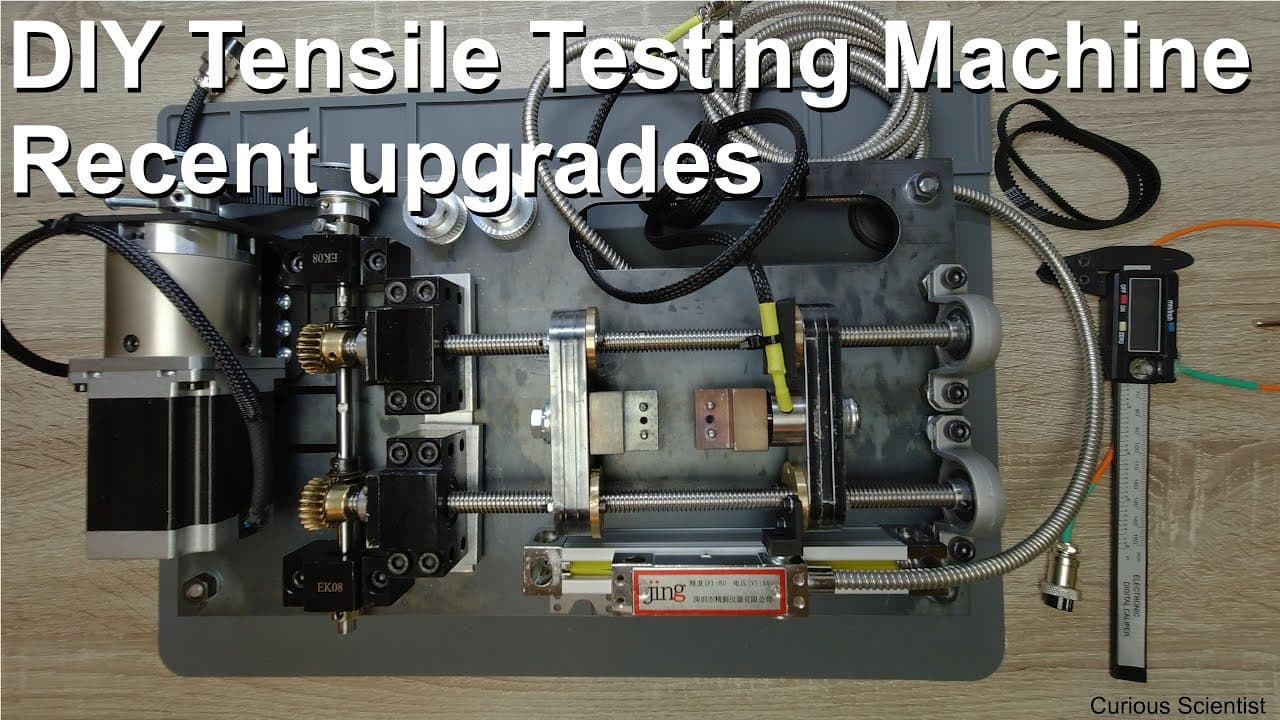
Recent enhancements to a tensile testing machine include better displacement measurement and improved power transmission.
Transcript
welcome arrow in this video I would like to share a few updates regarding my tensile testing machine with you so recently I've been working on this tensile testing machine a lot and I have received some new parts which I could build in in this machine so I would like to talk about those things and I would like to share some ideas about the future p... Read More
Key Insights
- 🪡 Electrical noise can significantly impact the accuracy of measurement devices, necessitating the need for better alternatives like the DRO.
- 🎰 Upgrading critical components like belts and pulleys can greatly enhance the performance and reliability of testing machines under load.
- 🥳 Future enhancements may require CNC machining and careful planning for precise fitting and integration of new parts.
- 🏆 Precision in displacement measurement directly influences the quality and reliability of tensile test outcomes.
- 🚠 Lengthy and unorganized wiring can create safety hazards and reduce operational efficiency, indicating the need for clean cable management.
- 🦾 Understanding the mechanics behind encoders and displacement readouts is essential for effective control in experimental setups.
- 🏆 Planned calibrations for sensors are crucial for ensuring the validity of the test results in engineering contexts.
Install to Summarize YouTube Videos and Get Transcripts
Explore YouTube Video Summarizer or Get YouTube Transcript Extractor
Questions & Answers
Q: What prompted the need for upgrades on the tensile testing machine?
The initial use of a digital caliper for displacement measurement proved problematic due to electrical noise and inaccuracies, making it difficult to trust the readings while under operation. This led to the decision to upgrade to a more reliable DRO system that eliminated those issues and provided better precision.
Q: How does the new DRO system improve the measurement process?
The new DRO system measures displacement directly and provides consistent readings free from electrical interference. By installing the scale on a fixed plate and calculating displacement as twice the movement from one crosshead, it ensures accurate distance measurements needed for tensile testing.
Q: What changes were made to the power transmission system?
The transition from a thin pulley belt to a thicker, more robust timing belt with deeper teeth allows the system to handle stronger materials without snapping. This increases the reliability of power transmission from the motor to the machine’s shaft, critical during high-stress tests.
Q: What are the current limitations of the DRO system installed?
While the new DRO setup provides better measurements, it is only capable of measuring the displacement of one crosshead. The assumption that both sides will move evenly may not always hold, introducing a slight margin for error in readings which can affect test accuracy.
Q: What are the presenter’s future plans for the machine?
The presenter intends to reduce the size of the setup by shortening long cables for better organization and potentially replacing the motor for improved efficiency. Furthermore, there are plans to conduct new tensile tests and to replace certain components to enhance overall functionality and precision.
Q: Why was the old pulley system replaced, and what benefits does the new system bring?
The original pulley system was not sturdy enough to handle high-stress tests, resulting in failures during experiments. The new wider and deeper pulley belt ensures a stronger grip and better transmission of power, enhancing the machine’s capability to perform rigorous tests on robust materials.
Q: What calibration plans are in place for the load cell?
To ensure accurate force readings, the presenter plans to calibrate the load cell using known weights. This calibration will refine the measurements and improve the confidence in the load readings gathered during tensile testing.
Q: What challenges did the presenter face when upgrading the tensile testing machine?
The presenter faced various challenges, including drilling through thick steel for the new DRO install, ensuring the new system was properly parallel, and managing potential electrical interference. Each upgrade required careful planning and execution to avoid compromising the machine’s functionality.
Summary & Key Takeaways
-
The presenter discusses upgrades made to a tensile testing machine, focusing on enhancing displacement measurement capabilities by replacing an unreliable digital caliper with a new digital readout (DRO) system.
-
The power transmission system has also been significantly improved by swapping out a thin pulley belt for a thicker one with deeper teeth, allowing for stronger and more reliable operation under load.
-
Future plans for the machine include efforts to shorten long cable lengths for a neater setup, as well as additional tests to calibrate the load cell and ensure accurate force measurements.
Read in Other Languages (beta)
Share This Summary 📚
Summarize YouTube Videos and Get Video Transcripts with 1-Click
Try YouTube Summary with ChatGPT & Claude or YouTube Transcript Generator
Explore More Summaries from Curious Scientist 📚
![Building a Peltier cooler-based cooling box - First iteration, improvements [Part 2/6] thumbnail](/_next/image?url=https%3A%2F%2Fi.ytimg.com%2Fvi%2F0YlNw0EGnzI%2Fhqdefault.jpg&w=750&q=75)

Summarize YouTube Videos and Get Video Transcripts with 1-Click
Try YouTube Summary with ChatGPT & Claude or YouTube Transcript Generator