OpenClaw Creator Peter Steinberger: Why Will 80% of Apps Disappear?
TL;DR
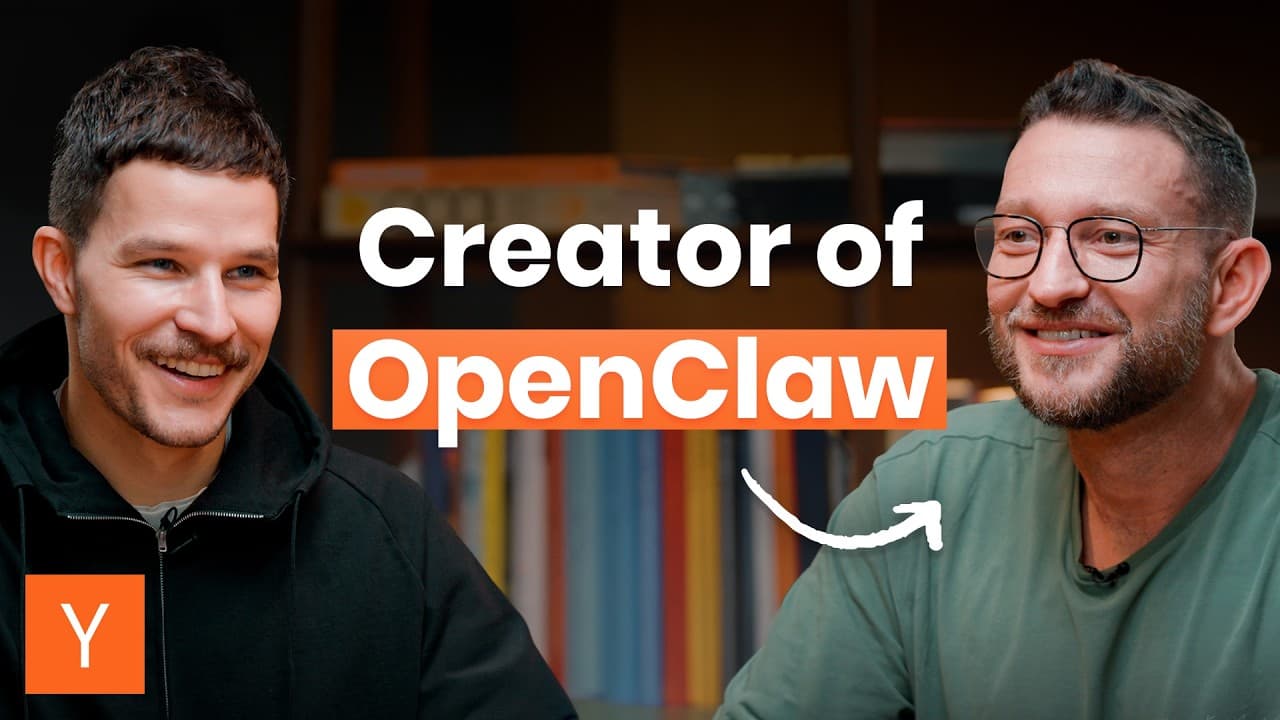
Peter Steinberger argues most apps will vanish because his open-source agent OpenClaw runs directly on your computer rather than in the cloud, so it can do anything you can do with the machine: search your entire drive, manage tasks, and control your oven, Tesla, lights, and Sonos. Its GitHub repo passed 160,000 stars almost overnight, and the community is already building bots that negotiate with each other and even hire humans for real-world tasks. Read on for his contrarian take on swarm intelligence.
Transcript
Today I'm sitting down with Peter Steinberger, the creator of OpenClaw, the open- source personal AI agent that has completely taken over the internet. The GitHub repo exploded to over 160,000 stars practically overnight. [music] The community has built countless projects like Maltbook where bots talk among themselves. And now the bots are even ren... Read More
Key Insights
- OpenClaw is a personal AI agent that operates locally on user devices, offering more power and flexibility than cloud-based AI solutions.
- The ability of OpenClaw to access and manage a device's entire data set allows it to perform tasks beyond the scope of typical apps.
- Peter Steinberger believes 80% of current apps may become obsolete as AI agents like OpenClaw take over their functions.
- AI agents can facilitate bot-to-bot and bot-to-human interactions, automating tasks such as booking reservations or managing schedules.
- The shift from centralized 'God AI' to swarm intelligence allows for distributed and specialized AI functions.
- OpenClaw maintains user privacy by storing data locally, giving users control over their information.
- The open-source nature of OpenClaw encourages community development and innovation, leading to rapid advancements.
- Peter Steinberger uses a contrarian approach to development, favoring local execution and multiple repository checkouts over cloud solutions.
Install to Summarize YouTube Videos and Get Transcripts
Explore YouTube Video Summarizer or Get YouTube Transcript Extractor
Questions & Answers
Q: Why does Peter Steinberger believe 80% of apps will disappear?
Steinberger's core argument is that a personal AI agent running on your own computer can do anything you can do with that machine, which makes most single-purpose apps unnecessary. Because OpenClaw has access to your whole device and all your data, it can handle the tasks that individual apps were built for. As agents absorb those functions, he expects the vast majority of today's apps to become obsolete.
Q: What makes OpenClaw different from other AI assistants?
Steinberger says his big difference is that OpenClaw actually runs on your computer, whereas everything he had seen before runs in the cloud. Cloud tools can do a few things, but a local agent can do every single thing you can do with the machine. That means it can connect to your oven, your Tesla, your lights, your Sonos, and even control the temperature of his bed, which cloud AI cannot.
Q: How popular is OpenClaw and how fast did it grow?
OpenClaw exploded across the internet, with its GitHub repository reaching over 160,000 stars practically overnight. Steinberger describes the past week or two as absolutely wild and says he needs a cave and a week of solitude just to recover and answer all his emails. He clearly hit something that stirred up emotions and inspired a lot of people.
Q: What can OpenClaw do that cloud-based AI can't?
Because OpenClaw can search your entire computer and you also give it all your data, it can surprise you in ways cloud tools cannot. Steinberger recounts a friend who asked it to write a narrative of his last year, and OpenClaw found weekly audio recordings the friend had forgotten existed from more than a year ago. It can also connect to and control physical devices around you.
Q: What are bot-to-bot and bot-to-human interactions in OpenClaw?
Steinberger sees a natural next step where your bot talks to other bots on your behalf. For example, to book a restaurant, your bot reaches out to the restaurant's bot to negotiate because it is more efficient. If the restaurant is old-fashioned and dislikes bots, your bot can instead hire a human to call or physically walk over and stand in line.
Q: What is swarm intelligence and how does it differ from centralized AI?
Steinberger contrasts the idea of a single centralized 'god intelligence' that everyone was chasing with the swarm or community intelligence that emerged around OpenClaw. He points out that one human alone could barely find food, but as a larger society we specialize and achieve far more. Applying that to AI means specialized agents working together rather than one all-powerful model.
Q: When and how did Peter Steinberger have his OpenClaw aha moment?
He first wanted something simple: to type instructions and have his computer do stuff. He built an early version in May or June that was cool but not quite it, then built many other tools, with roughly 40 projects on his GitHub. The real moment came in November, when the need resurfaced while he was in the kitchen wanting to check whether his computer had finished a coding task.
Summary & Key Takeaways
-
OpenClaw, created by Peter Steinberger, is an open-source AI agent that runs locally on devices, offering more comprehensive control and integration than cloud-based solutions. This local operation allows it to perform tasks beyond the scope of typical apps, potentially rendering many obsolete.
-
The unique capabilities of OpenClaw include facilitating bot-to-bot and bot-to-human interactions, automating tasks such as booking reservations or managing schedules. This shift from centralized AI to swarm intelligence allows for distributed and specialized AI functions.
-
Peter Steinberger believes that 80% of current apps may become obsolete as AI agents like OpenClaw take over their functions. OpenClaw maintains user privacy by storing data locally, giving users control over their information, and its open-source nature encourages community development and innovation.
Read in Other Languages (beta)
Share This Summary 📚
Summarize YouTube Videos and Get Video Transcripts with 1-Click
Try YouTube Summary with ChatGPT & Claude or YouTube Transcript Generator
Explore More Summaries from Y Combinator 📚
Summarize YouTube Videos and Get Video Transcripts with 1-Click
Try YouTube Summary with ChatGPT & Claude or YouTube Transcript Generator