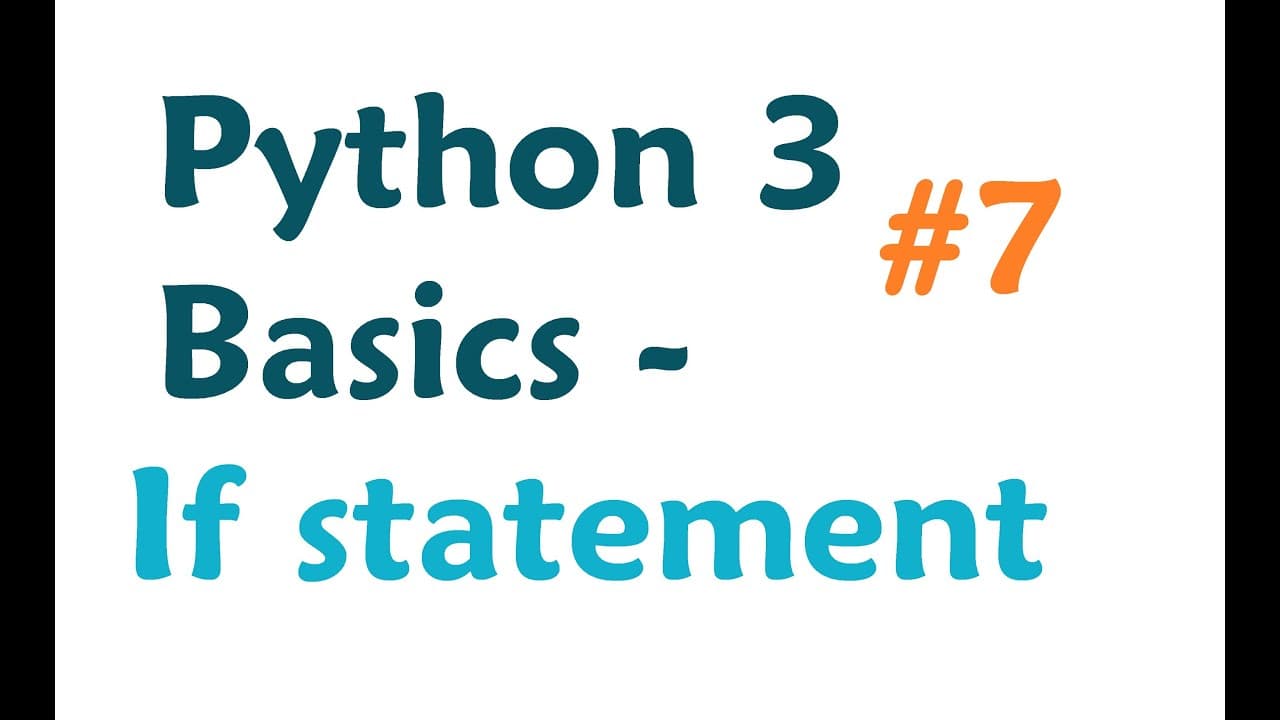
How to Use If Statements in Python Programming
TL;DR
To use if statements in Python, start by checking a condition and executing a block of code if the condition is true. Combine with assignment operators like '>', '<', '>=', '<=', and '==' to create complex logical expressions. Mastering if statements is essential for introducing decision-making in your programs.
Transcript
hello everybody and welcome to my tutorial on the if statement as well as assignment operators I've decided to just combine the two since they're used very often together anyway in programming it can be useful very quickly to begin adding some degrees of logic to your program and one of the most basic forms of logic that you can use is just the if ... Read More
Key Insights
- 💄 The "if" statement is fundamental for adding logic and decision-making capabilities to programs.
- 🟰 Assignment operators like greater than, less than, and equal to are commonly used with "if" statements.
- ❓ Multiple conditions and logical operators can be used to create complex conditions.
- ❓ Variables can be used to make conditions more dynamic in "if" statements.
- ❓ Proper syntax, such as using "== " for equality comparison, is crucial for accurate condition checking.
- 📔 The next topic to be covered is the "else" statement, which adds an alternative action when the "if" condition is not met.
- ❓ Understanding basic "if" statements is essential before moving on to more advanced programming concepts.
Install to Summarize YouTube Videos and Get Transcripts
Explore YouTube Video Summarizer or Get YouTube Transcript Extractor
Questions & Answers
Q: What is the purpose of the "if" statement in programming?
The "if" statement allows programmers to check if a condition is true and execute a block of code accordingly. It adds logic and decision-making capabilities to programs.
Q: How do assignment operators work with "if" statements?
Assignment operators like greater than, less than, greater than or equal to, less than or equal to, and equal to are used in "if" statements to compare values and determine if a condition is met.
Q: Can multiple conditions be used in a single "if" statement?
Yes, multiple conditions can be combined using logical operators (such as "and" or "or") to create more complex expressions in an "if" statement.
Q: Can variables be used in "if" statements?
Yes, variables can be used in "if" statements. The values of those variables are evaluated to determine if the condition is true or false.
Summary & Key Takeaways
-
The "if" statement is used to check if a condition is true, and if it is, perform a specific action.
-
Assignment operators like greater than, less than, greater than or equal to, less than or equal to, and equal to are commonly used with "if" statements.
-
Multiple conditions and variables can be used together to create complex logical statements.
Read in Other Languages (beta)
Share This Summary 📚
Summarize YouTube Videos and Get Video Transcripts with 1-Click
Try YouTube Summary with ChatGPT & Claude or YouTube Transcript Generator
Explore More Summaries from sentdex 📚


Summarize YouTube Videos and Get Video Transcripts with 1-Click
Try YouTube Summary with ChatGPT & Claude or YouTube Transcript Generator