How to Define Angles Between Vectors
TL;DR
Understanding angles between vectors starts with the Koshi-Schwartz inequality, which links the inner product of vectors to their norms. This foundation allows the calculation of angles even in high dimensions, providing insights into how similar or dissimilar vectors are in various applications.
Transcript
our next topic is angle so we'll be able to define the angle between two vectors it's gonna it's gonna be the same as the angle between vectors that are have dimension two and three uh but we're going to be able to talk about things like the angle between two vectors of dimension a thousand uh which is a very interesting concept so we're going to s... Read More
Key Insights
- 🍽️ The Koshi-Schwartz inequality is a fundamental concept in mathematics that relates the inner product and norms of vectors.
- 💨 The triangle inequality can be derived from the Koshi-Schwartz inequality, providing a way to measure the distance between vectors.
- 👻 Angles can be defined between vectors using the Koshi-Schwartz inequality, allowing for the measurement of deviation and similarity between vectors.
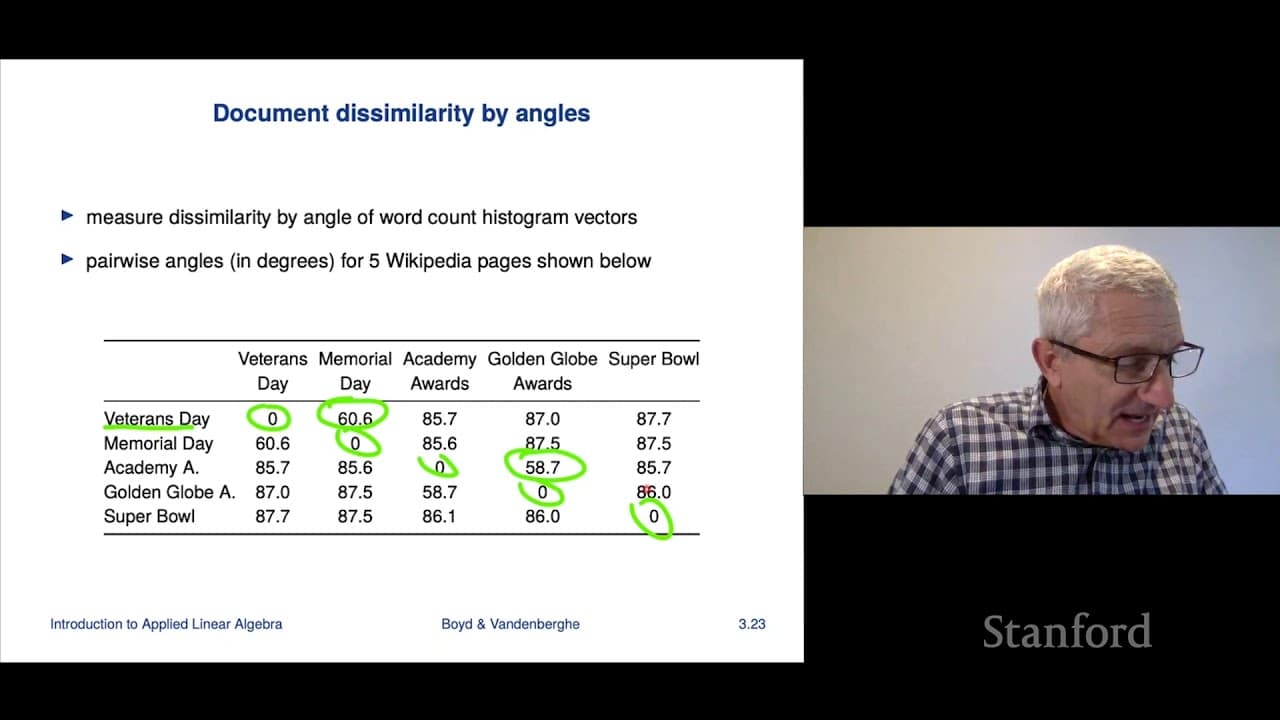
- ☀️ Correlation coefficients provide a measure of the linear relationship between vectors and can be used in various fields such as finance, weather analysis, and document similarity.
- ❓ Highly correlated vectors exhibit similar patterns and behaviors, while uncorrelated vectors have no apparent relationship.
- 🏙️ Practical examples of highly correlated vectors include daily rainfall data in adjacent cities and daily returns of similar companies in the same industry.
- 📌 Examples of uncorrelated vectors include daily temperature data in different locations and audio signals from different sources.
Install to Summarize YouTube Videos and Get Transcripts
Explore YouTube Video Summarizer or Get YouTube Transcript Extractor
Questions & Answers
Q: What is the Koshi-Schwartz inequality and how does it relate to the triangle inequality?
The Koshi-Schwartz inequality states that the absolute value of the inner product of two vectors is less than or equal to the product of their norms. It is related to the triangle inequality because it can be used to prove that the norm of the sum of two vectors is less than or equal to the sum of their norms.
Q: How can angles be defined between vectors using the Koshi-Schwartz inequality?
The Koshi-Schwartz inequality provides a ratio that lies between -1 and 1. By taking the arc cosine of this ratio, we can associate an angle with two non-zero vectors. The angle between the vectors is defined as the angle that satisfies the inner product equal to the product of the norms multiplied by the cosine of the angle.
Q: How are angles classified based on their values?
Angles can be classified as orthogonal (90 degrees), aligned (0 degrees), anti-aligned (180 degrees), acute (less than 90 degrees), or obtuse (greater than 90 degrees). These classifications depend on the inner product and the relationship between the vectors.
Q: What is the correlation coefficient and how is it calculated?
The correlation coefficient is a measure of the linear relationship between two vectors. It is calculated by taking the inner product of the demeaned vectors divided by the product of their norms. The correlation coefficient ranges from -1 to 1, where 0 indicates no correlation, -1 indicates perfect negative correlation, and 1 indicates perfect positive correlation.
Summary & Key Takeaways
-
The content introduces the Koshi-Schwartz inequality, which states that the absolute value of the inner product of two vectors is less than or equal to the product of their norms.
-
The content demonstrates how the Koshi-Schwartz inequality can be used to establish the triangle inequality, which states that the norm of the sum of two vectors is less than or equal to the sum of their norms.
-
The content explains how angles can be defined between vectors using the Koshi-Schwartz inequality, and how angles can be used to measure deviation and similarity between vectors.
Read in Other Languages (beta)
Share This Summary 📚
Summarize YouTube Videos and Get Video Transcripts with 1-Click
Try YouTube Summary with ChatGPT & Claude or YouTube Transcript Generator
Explore More Summaries from Stanford Online 📚




Summarize YouTube Videos and Get Video Transcripts with 1-Click
Try YouTube Summary with ChatGPT & Claude or YouTube Transcript Generator