Art We Launched Into Space
TL;DR
Humans have launched art into space to commemorate exploration, memorialize lost astronauts, and communicate who we are. Alexei Leonov sketched an orbital sunrise aboard Voskhod 2 in 1965, while the first confirmed artwork sent from Earth was Paul van Hoeydonck’s Fallen Astronaut on Apollo 15 in 1971. Read on to discover the artists, missions, and meanings behind art beyond Earth.
Transcript
You may know that the first human to spacewalk was cosmonaut Alexei Leonov. But did you know that he was also the first human to make art in space? In 1965, while wedged into the tight quarters of the Soviet space program’s Voskhod 2, Leonov sketched an orbital sunrise with some colored pencils he’d customized by attaching them to a box with thread... Read More
Key Insights
- 🛰️ The first human-made artwork in space was by cosmonaut Alexei Leonov in 1965, marking the beginning of art in space exploration.
- 🛰️ NASA established an art program in 1962 to document space activities and capture the emotional impact of these events through art.
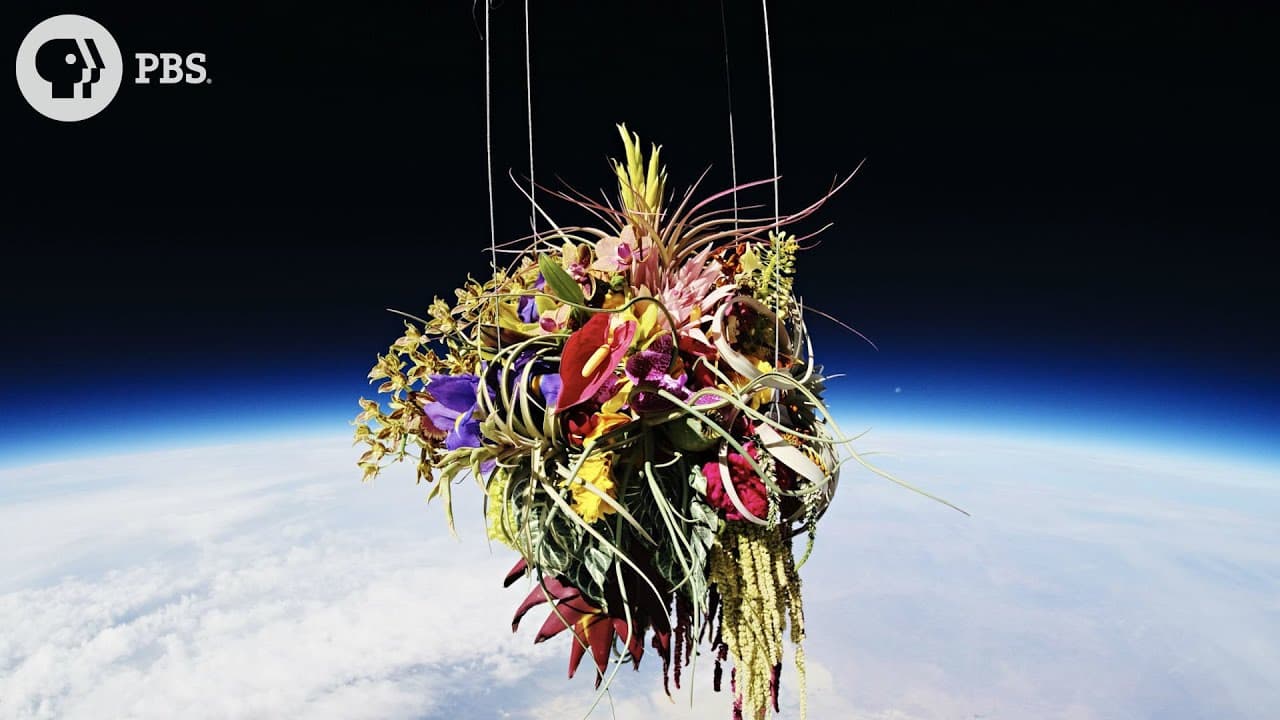
- 💐 Artists have sent various forms of artworks into space, including drawings, sculptures, music recordings, and even bonsai trees and flower bouquets.
Install to Summarize YouTube Videos and Get Transcripts
Explore YouTube Video Summarizer or Get YouTube Transcript Extractor
Questions & Answers
Q: What was the first artwork sent into space?
A tiny ceramic chip created for Apollo 12 may have been the first artwork sent from Earth into space in 1969, but its presence aboard the mission remains unconfirmed. The first confirmed example was Fallen Astronaut, a small aluminum sculpture by Belgian artist Paul van Hoeydonck, sent with Apollo 15 in 1971.
Q: Who was the first person to make art in space?
Cosmonaut Alexei Leonov was the first human to make art in space. In 1965, aboard the Soviet Voskhod 2 spacecraft, he sketched an orbital sunrise using colored pencils that he had attached to a box with thread.
Q: Why did NASA create an art program?
NASA created its art program four years after the agency was established in 1958. It commissioned astronaut portraits and invited artists to document NASA’s work while exploring the significance and emotional impact of events that could change humanity’s destiny.
Q: What artwork may have traveled to the Moon on Apollo 12?
Apollo 12 may have carried a postage-stamp-sized, iridium-plated ceramic chip conceived by Forrest Myers as a miniature museum for the Moon. It featured contributions by Myers, Andy Warhol, David Novros, John Chamberlain, Claes Oldenburg, and Robert Rauschenberg, but only an unidentified contact’s report indicates that it reached the mission.
Q: How was the Apollo 12 art chip created?
Forrest Myers assembled six artists through his connection to Experiments in Art and Technology, a group founded to bring artists and engineers together. Bell Labs engineer Fred Waldhauer used technology then employed to make telephone circuits to inscribe the designs on ceramic wafers.
Q: What is Fallen Astronaut, and why was it placed on the Moon?
Fallen Astronaut is a small aluminum sculpture by Belgian artist Paul van Hoeydonck that memorializes people who died in the space exploration effort. It was installed on the Moon on August 2, 1971, beside a plaque naming fourteen deceased American and Soviet astronauts.
Q: What requirements shaped the design of Fallen Astronaut?
The sculpture had to be light, sturdy, and capable of enduring extreme temperatures. It also needed to remain neutral in its representation of gender and ethnicity.
Q: What information do the Pioneer 10 and 11 plaques contain?
The gold-anodized aluminum plaques include a hydrogen diagram, the Sun’s position relative to 14 pulsars, a solar-system diagram, and each spacecraft’s trajectory past Jupiter. They also show the spacecraft at scale beside figures representing a human man and woman, helping a possible finder infer where the craft came from and who created it.
Summary & Key Takeaways
-
Art has been present in space since cosmonaut Alexei Leonov's sketch of an orbital sunrise in 1965.
-
NASA established an art program in 1962 to document its space activities and invite artists to portray the significance and emotional impact of these events.
-
Artists have sent their works to space, including pieces on the moon, sculptures on Mars, and even art sent through balloons and rockets.
Read in Other Languages (beta)
Share This Summary 📚
Summarize YouTube Videos and Get Video Transcripts with 1-Click
Try YouTube Summary with ChatGPT & Claude or YouTube Transcript Generator
Explore More Summaries from The Art Assignment 📚

Summarize YouTube Videos and Get Video Transcripts with 1-Click
Try YouTube Summary with ChatGPT & Claude or YouTube Transcript Generator