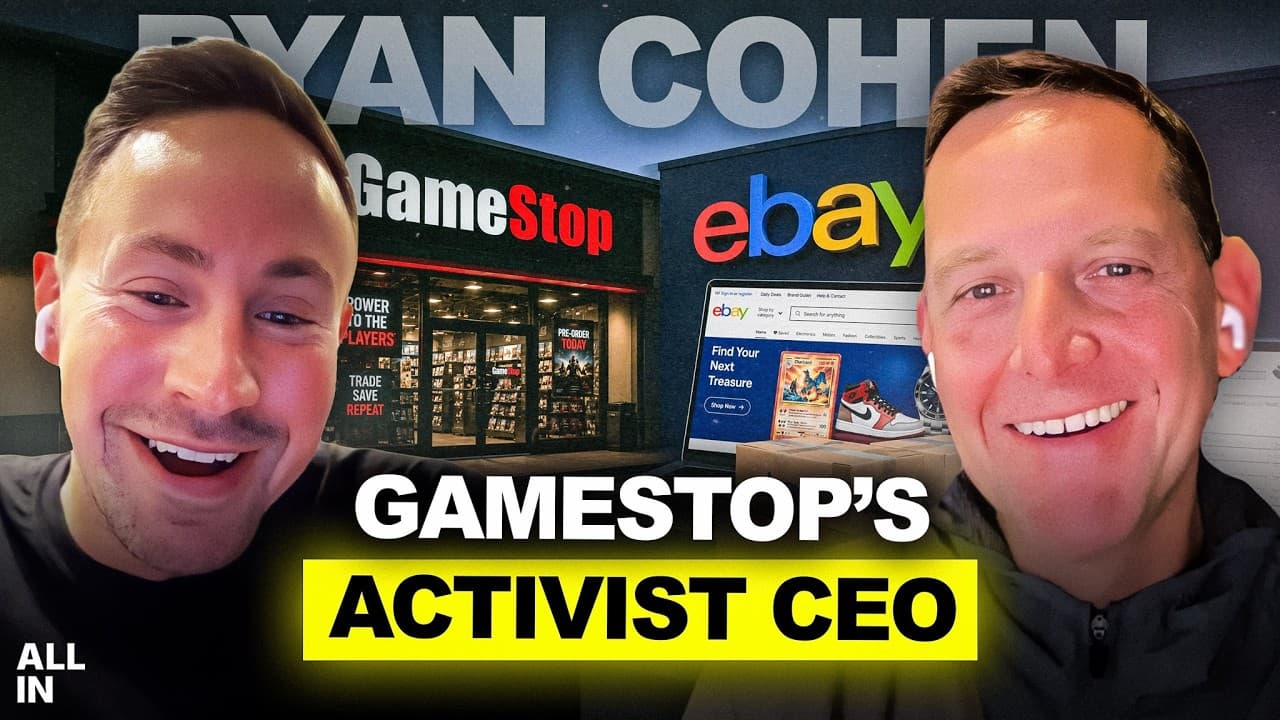
Why Does Ryan Cohen Want GameStop to Buy eBay?
TL;DR
Ryan Cohen wants to acquire eBay for $56 billion because he sees substantial potential trapped behind slow growth, rising expenses, weak execution, and damaged seller relationships. His plan centers on cutting costs, expanding live commerce, and building a marketplace for digital in-game collectibles, applying the operational intensity and customer focus he developed while building Chewy and leading GameStop.
Transcript
Everyone hates GameStop and it seems like everyone in the media basically wants us to fail and wants them to succeed and you've got a board that's making hundreds of thousands of dollars a year. They don't buy stock with their own money. They end up showing up to a handful of board meetings and they're making a fortune. You've got a management team... Read More
Key Insights
- Chewy originated from Cohen's realization that pet products were more familiar, recurring, and defensible than the jewelry inventory he had initially purchased. He saw a fragmented market where neighborhood pet stores remained relevant despite competition from Petco, PetSmart, and Amazon.
- Chewy's customer proposition combined Amazon-style supply-chain practices with neighborhood pet-store service. Fast shipping, broad selection, competitive pricing, knowledgeable employees, handwritten holiday cards, pet portraits, and round-the-clock support helped retain customers and generate referrals among pet owners.
- Chewy's economics depended on operational precision because selling heavy pet food was a low-margin business. Cohen describes the difference between failure and success as pennies, making supplier pricing, warehouse labor, shipping rates, inventory scale, and execution central to the company's survival.
- Negative working capital allowed Chewy to grow to billions of dollars in revenue without consuming large amounts of capital. That structure supported rapid expansion while the company pursued market leadership against Amazon and other competitors in a category investors initially considered difficult.
- Cohen's management style is based on constant attention to operating details. He personally managed Google AdWords campaigns until early morning, negotiated with major suppliers, watched company metrics continuously, and treated tough supplier reactions as evidence that Chewy had secured favorable pricing.
- Cohen's hiring philosophy favors determination over conventional qualifications. He recounts hiring a persistent customer-service applicant from an elderly care facility after initially overlooking her experience, and says she became an exceptional employee because she had drive, motivation, and willingness to work.
- Cohen's case against eBay is that valuable marketplace potential has been weakened by slow growth, increasing expenses, poor execution, and damaged seller relationships. He also questions a governance model in which board members receive substantial compensation without buying shares using their own money.
- Cohen's eBay strategy has three stated components: cut costs, expand live commerce, and establish a marketplace for digital in-game collectibles. The $56 billion acquisition proposal has been rejected by eBay, while Cohen argues that media coverage favors eBay and expects GameStop to fail.
Install to Summarize YouTube Videos and Get Transcripts
Explore YouTube Video Summarizer or Get YouTube Transcript Extractor
Questions & Answers
Q: How did Ryan Cohen come up with the idea for Chewy?
Ryan Cohen was preparing to launch an online jewelry business despite knowing little about jewelry and having already purchased hundreds of thousands of dollars in inventory. While shopping at a neighborhood pet store for his poodle, he recognized that pet supplies were familiar, frequently repurchased products in a fragmented market. He shifted toward recreating the neighborhood pet-store experience online and at scale.
Q: How did Chewy compete with Amazon in online pet retail?
Chewy adopted Amazon's strongest supply-chain practices, including fast shipping, broad selection, competitive pricing, efficient warehouses, and aggressive carrier negotiations. It paired those capabilities with specialized pet knowledge and personal service associated with neighborhood stores. Handwritten holiday cards, pet portraits, round-the-clock customer support, and prompt resolution of problems encouraged repeat purchases and word-of-mouth referrals from pet owners.
Q: Why were recurring pet purchases important to Chewy's strategy?
Recurring purchases gave Chewy an opportunity to build durable customer relationships rather than depend on isolated transactions. The company initially concentrated on food, treats, litter, and other products customers bought repeatedly. Cohen believed that customers treated well would continue shopping with Chewy, and cohort data showed that customers were sticky. Consistent service then reinforced retention and referrals.
Q: How did Ryan Cohen manage Chewy's low-margin economics?
Cohen treated Chewy as a business where pennies could separate failure from success. He pushed for scale so the company could move from pallets to truckloads, buy directly rather than through distribution, and negotiate lower product costs. He also focused on warehouse labor, warehouse management, shipping prices, advertising performance, and continuous measurement to keep the operation highly efficient.
Q: What management and hiring principles did Ryan Cohen use at Chewy?
Cohen stayed closely involved in operations, watched key numbers continuously, managed advertising campaigns himself, and negotiated directly with major suppliers. In hiring, he preferred will over skill and sought relentless people willing to commit fully. His example of a persistent customer-service applicant shows that motivation and determination could outweigh an unconventional résumé when identifying people capable of exceptional performance.
Q: Why does Ryan Cohen want GameStop to acquire eBay?
Cohen believes eBay has massive potential that current leadership has not realized. The stated problems include slow growth, rising expenses, poor execution, and failure in relationships with sellers. His acquisition case rests on the belief that stronger cost discipline, marketplace innovation, and more accountable ownership could improve the business, although eBay has rejected the $56 billion offer.
Q: What is Ryan Cohen's three-part plan for eBay?
Cohen's plan has three main elements. First, he wants to cut costs and address rising expenses. Second, he wants to expand eBay's presence in live commerce. Third, he proposes creating a marketplace for digital in-game collectibles. Together, these initiatives are intended to improve execution and open new marketplace opportunities while addressing the company's slow growth.
Q: Why does Ryan Cohen criticize eBay's board and management?
Cohen argues that eBay's board members earn hundreds of thousands of dollars annually, attend only a limited number of meetings, and do not purchase shares with their own money. He also describes management as grossly overpaid. His criticism centers on incentives and accountability, contrasting that structure with his belief that risking personal capital represents genuine commitment to a company's outcome.
Summary & Key Takeaways
-
Ryan Cohen traces his operating philosophy to Chewy, which began after he abandoned an online jewelry concept for the more familiar pet category. He combined Amazon-inspired supply-chain practices with neighborhood pet-store service, emphasizing recurring purchases, competitive prices, fast shipping, broad selection, and unusually attentive customer support to establish market leadership.
-
Chewy operated as a low-margin business where small cost differences could determine success or failure. Cohen personally monitored advertising, negotiated fiercely with suppliers, optimized warehouses and shipping, and pursued scale to secure lower product costs. Negative working capital helped the company reach billions of dollars in revenue without consuming substantial capital before its $3.35 billion sale.
-
Cohen argues that eBay has massive unrealized potential but suffers from slow growth, rising expenses, poor execution, and failed seller relationships. His three-part vision is to reduce costs, expand live commerce, and create a marketplace for digital in-game collectibles. He also criticizes eBay's board incentives and its decision to reject the $56 billion proposal.
Read in Other Languages (beta)
Share This Summary 📚
Summarize YouTube Videos and Get Video Transcripts with 1-Click
Try YouTube Summary with ChatGPT & Claude or YouTube Transcript Generator
Explore More Summaries from All-In Podcast 📚






Summarize YouTube Videos and Get Video Transcripts with 1-Click
Try YouTube Summary with ChatGPT & Claude or YouTube Transcript Generator