How Does Hamming Distance Help in Error Detection?
TL;DR
Hamming distance is used to measure the differences between code words, enabling the detection of single-bit errors by ensuring the minimum distance between valid code words is at least 2. By adding parity bits, single-bit errors can be identified, as they would create code words with an odd number of 1-bits, indicating a parity error. This method, however, is ineffective for detecting multiple-bit errors.
Transcript
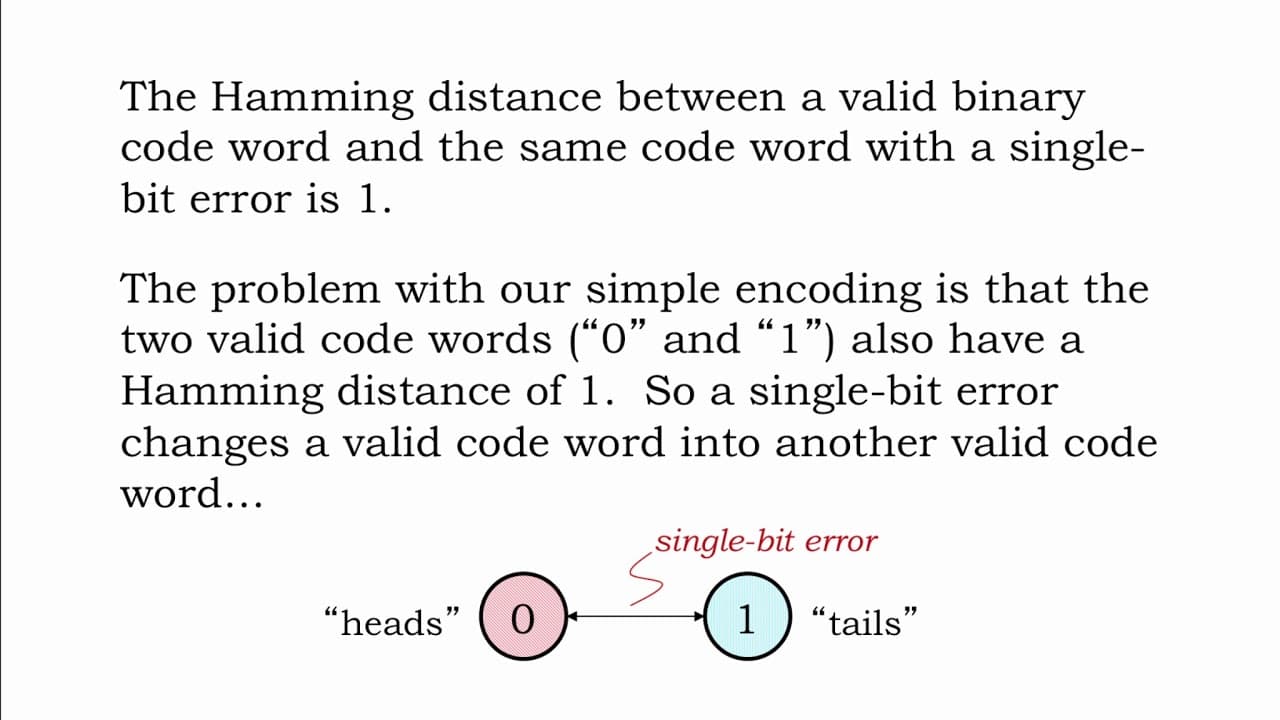
Now let's think a bit about what happens if there's an error and one or more of the bits in our encoded data gets corrupted. We'll focus on single-bit errors, but much of what we discuss can be generalized to multi-bit errors. For example, consider encoding the results of some unpredictable event, e.g., flipping a fair coin. There are two outcomes:... Read More
Key Insights
- 🥺 Single-bit errors in encoded data can lead to misinterpretation of the data.
- 🆘 Hamming distance measures the differences between encodings, which can help identify errors.
- 🫦 A minimum Hamming distance of at least 2 is needed to detect single-bit errors using parity.
- 🕵️ Parity can only detect single-bit errors, and a more sophisticated encoding is needed to detect multiple errors.
- #️⃣ To detect a certain number of errors, the minimum Hamming distance between code words should be one more than the number of errors.
Install to Summarize YouTube Videos and Get Transcripts
Explore YouTube Video Summarizer or Get YouTube Transcript Extractor
Questions & Answers
Q: What is the purpose of Hamming distance in error detection?
Hamming distance helps measure the differences between encodings, allowing us to identify single-bit errors in code words.
Q: How does the simple encoding of "heads" and "tails" fail in error detection?
The simple encoding has a Hamming distance of 1 between the code words "0" and "1", making it impossible to differentiate between an uncorrupted encoding of "tails" and a corrupted encoding of "heads".
Q: How does adding a parity bit help in error detection?
Adding a parity bit increases the minimum Hamming distance between code words from 1 to 2. This enables the detection of single-bit errors since corrupted code words will have an odd number of 1-bits.
Q: Can parity detect errors with an even number of bit errors?
No, parity can only detect single-bit errors. If there are an even number of bit errors, corrupted code words will have an even number of 1-bits and may appear to be valid.
Summary & Key Takeaways
-
Single-bit errors in encoded data can occur during transmission and lead to misinterpretation of the data.
-
Hamming distance is defined as the number of differing positions between two encodings of the same length.
-
By choosing code words with a minimum Hamming distance of at least 2, single-bit errors can be detected using parity bits.
Read in Other Languages (beta)
Share This Summary 📚
Summarize YouTube Videos and Get Video Transcripts with 1-Click
Try YouTube Summary with ChatGPT & Claude or YouTube Transcript Generator
Explore More Summaries from MIT OpenCourseWare 📚


Summarize YouTube Videos and Get Video Transcripts with 1-Click
Try YouTube Summary with ChatGPT & Claude or YouTube Transcript Generator