How to Write VHDL Code for a 3 to 8 Decoder
TL;DR
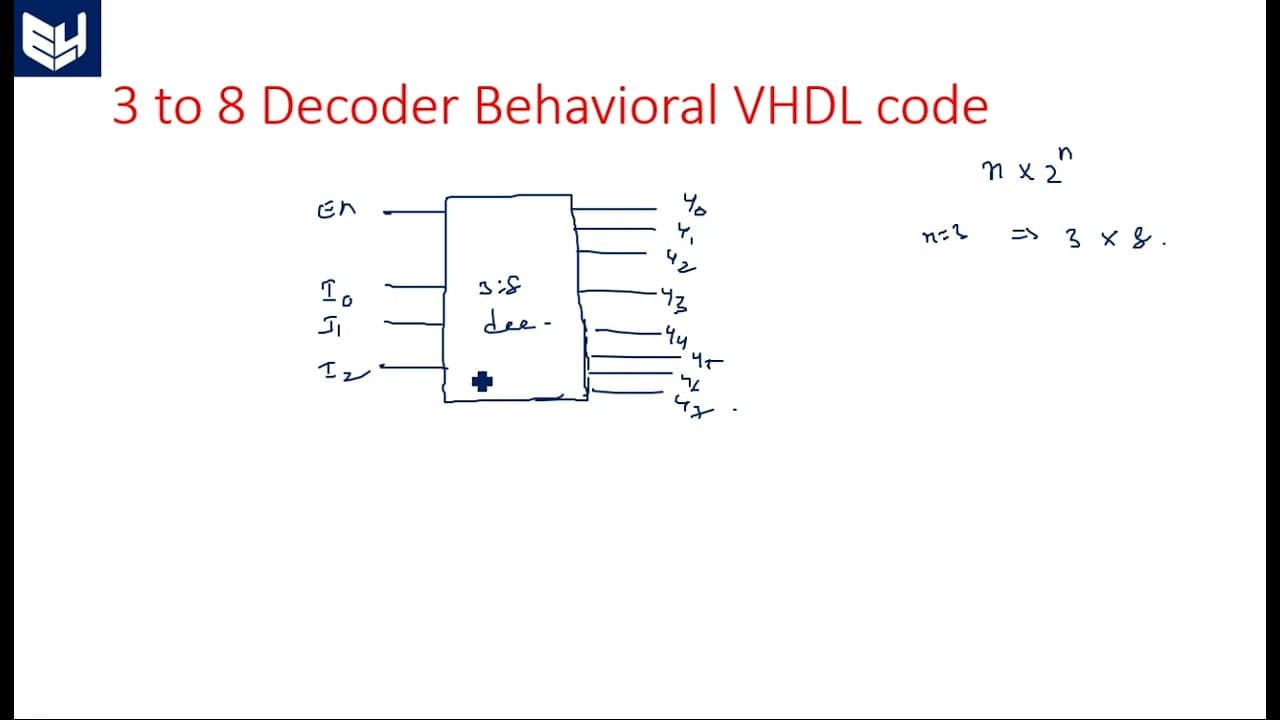
To write VHDL code for a 3-to-8 decoder, define the entity with an enable pin and three input bits, and use conditional statements like 'if' and 'case' to determine which output line is activated based on input values. Outputs are only enabled when the enable pin is high, ensuring precise control in digital systems.
Transcript
hi everyone in this video I'm going to explain about the behavioral model of 32A decoder phdl code so behavior model is very very important where we are writing the process statement and then conditional statements in that to according to the behavior of the particular logic gate logic function so 32A decoder we know very well it is is having an en... Read More
Key Insights
- 😴 A 3-to-8 decoder converts 3 input binary values into a single active output among eight, controlled by an enable pin.
- 🔠 The conditional statements include both 'if' and 'case' structures to manage output assignments based on input conditions effectively.
- 🎨 The VHDL behavioral model focuses on describing how a system behaves, which is vital for complex logic circuit designs.
- 😴 Outputs are activated only when the enable pin is high, ensuring control over the decoder's operation in a digital circuit.
- 🔡 Each input combination corresponds to a specific output line being turned on while others remain low, demonstrating a clear mapping of binary values to outputs.
- 🔠 The use of "others" in case statements simplifies code by handling any unmatched input combinations in a single line.
- 🎨 Understanding VHDL syntax, including the handling of vectors and processes, is essential for effective hardware design.
Install to Summarize YouTube Videos and Get Transcripts
Explore YouTube Video Summarizer or Get YouTube Transcript Extractor
Questions & Answers
Q: What is the significance of the enable pin in a 3-to-8 decoder?
The enable pin is crucial in a 3-to-8 decoder as it must be set to '1' for the decoder to function. When the enable pin is '0', all outputs are inactive, effectively setting them to zero. This feature allows for control over when the decoder should be operational, preventing unintended output when not enabled.
Q: How does the process statement function in the VHDL code for the decoder?
The process statement in VHDL serves as a control block that executes code contained within it whenever its specified signals change—in this case, the enable signal and the inputs. This allows the system to respond dynamically to changes, ensuring that the correct output is activated according to the input combination when the decoder is enabled.
Q: Can you explain the use of conditional statements in the behavioral model of the decoder?
Conditional statements in the behavioral model of the decoder are utilized to determine which output line to activate based on the input values. The code uses an 'if' condition to check if the enable pin is active. Subsequently, a case statement identifies the specific binary input and assigns the appropriate output line to '1' while setting others to '0', thereby implementing the decoder's logic.
Q: What is the role of the architecture name in VHDL?
The architecture name in VHDL specifies the behavior and structure of the design entity, such as the decoder in this case. It labels the block of code that describes how the circuit functions. By defining the architecture as "Behavior", it indicates that the model emphasizes procedural statements and logical flow rather than structural or data flow modeling, providing clarity in the design description.
Summary & Key Takeaways
-
The video outlines the behavioral model of a 3-to-8 decoder using VHDL, emphasizing the importance of process and conditional statements in logic design.
-
It describes the decoder's structure, including the enable pin and inputs, which determine how outputs are activated based on the input combinations.
-
A detailed example of VHDL code is provided, illustrating conditions for enabling outputs and the case structure to handle different input values.
Read in Other Languages (beta)
Share This Summary 📚
Summarize YouTube Videos and Get Video Transcripts with 1-Click
Try YouTube Summary with ChatGPT & Claude or YouTube Transcript Generator