What Are Key Computer Security Mechanisms?
TL;DR
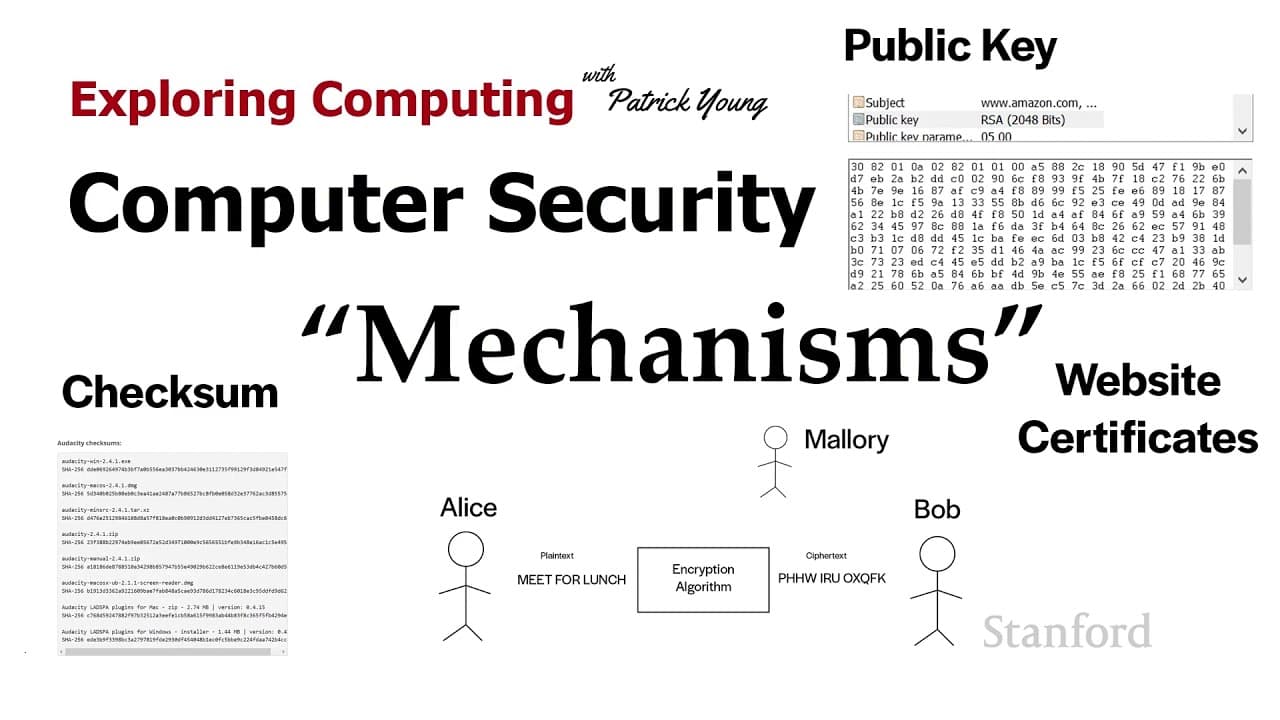
Computer security relies on mechanisms like encryption and the Caesar cipher to ensure confidentiality, authentication, integrity, and non-repudiation. While the Caesar cipher demonstrates basic encryption, its limitations highlight the importance of more advanced methods, such as asymmetric encryption. Understanding how these mechanisms work is essential for secure communications online.
Transcript
welcome to exploring computing today's video is computer security mechanisms so in this video we're going to look at the different mechanisms that we use to keep computers secure on the network and you'll recall from the last lecture uh we talked about four different network security concerns confidentiality making sure that our communications are ... Read More
Key Insights
- 💌 The Caesar cipher is a simple encryption technique that illustrates the concept of shifting letters in a message.
- 🤩 Symmetric encryption relies on a shared key, while asymmetric encryption uses a pair of mathematically related public and private keys.
- ⏯️ Certification authorities play a crucial role in verifying the authenticity of websites through the use of public key cryptography.
- 🕵️ Checksums and cryptographic hash functions help ensure data integrity by detecting accidental or deliberate changes in files.
Install to Summarize YouTube Videos and Get Transcripts
Explore YouTube Video Summarizer or Get YouTube Transcript Extractor
Questions & Answers
Q: What are the four network security concerns mentioned in the video?
The four network security concerns are confidentiality, authentication, integrity, and non-repudiation. Confidentiality ensures secure communication, authentication verifies the identity of the communicating parties, integrity ensures messages are not tampered with, and non-repudiation prevents the denial of actions.
Q: How does the Caesar cipher work?
The Caesar cipher shifts each letter in the message by a fixed number of positions. For example, with a shift of 3, 'a' becomes 'd', 'b' becomes 'e', and so on. This process is applied to encrypt a message, and the reverse process is used for decryption.
Q: What are the weaknesses of the Caesar cipher?
The Caesar cipher has a small key size since it can only shift up to 26 characters, making it susceptible to brute force attacks. It is also vulnerable to cryptanalysis, where patterns in the ciphertext can be analyzed to reveal information about the message and key.
Q: How does asymmetric encryption differ from symmetric encryption?
In symmetric encryption, the same key is used for both encryption and decryption. In asymmetric encryption, there are two mathematically related keys: a public key for encryption and a private key for decryption. Asymmetric encryption allows secure communication without the need to exchange a shared key.
Summary & Key Takeaways
-
The video explores computer security concerns such as confidentiality, authentication, integrity, and non-repudiation.
-
It explains the concept of encryption and decryption, using the Caesar cipher as an example of a simple encryption technique.
-
The weaknesses of the Caesar cipher are discussed, including its vulnerability to brute force attacks and cryptanalysis.
Read in Other Languages (beta)
Share This Summary 📚
Summarize YouTube Videos and Get Video Transcripts with 1-Click
Try YouTube Summary with ChatGPT & Claude or YouTube Transcript Generator
Explore More Summaries from Stanford Online 📚




Summarize YouTube Videos and Get Video Transcripts with 1-Click
Try YouTube Summary with ChatGPT & Claude or YouTube Transcript Generator