How Can Smart Cities Manage Cybersecurity Risk?
TL;DR
Smart communities become wiser by managing cybersecurity, privacy, legacy systems, and new technology as parts of one connected ecosystem. Cities must understand what data they collect, how combined datasets can expose personal information, where devices operate, and how third parties manage infrastructure, while still using technology to deliver essential services efficiently.
Transcript
Okay. Are we live? All right. Oh, awesome. All right, we're gonna go ahead and, uh, and get started. You know, typically, they go in, and they come up here, and they announce you and everything, but it's like, uh, I just wanna go ahead and talk. So, you know, I, I kinda look at these talks as discussions. I like to just be able to get people togeth... Read More
Key Insights
- Smart communities are ecosystems that include municipal governments, small businesses, universities, hospitals, and other connected organizations. These participants often operate similar infrastructure and face overlapping cybersecurity challenges, so city security cannot be managed effectively by treating municipal technology as an isolated environment.
- Smart-city development is driven by the need to serve increasingly concentrated urban populations. Technology is intended to help cities continue providing clean water, power, education, transportation, and other essential services efficiently as large numbers of people gather in dense metropolitan environments.
- A smart-city architecture is built from sensors or other data-collection technologies, a network layer that transports their data, and a service layer that uses the information. Each layer introduces operational dependencies and security questions that must be considered together rather than as separate projects.
- Municipal data can become personally revealing when separate datasets are combined. Information without a citizen's name may still expose movement or service-use patterns when correlated with other records, which means open-data decisions require careful analysis of indirect privacy risks before publication.
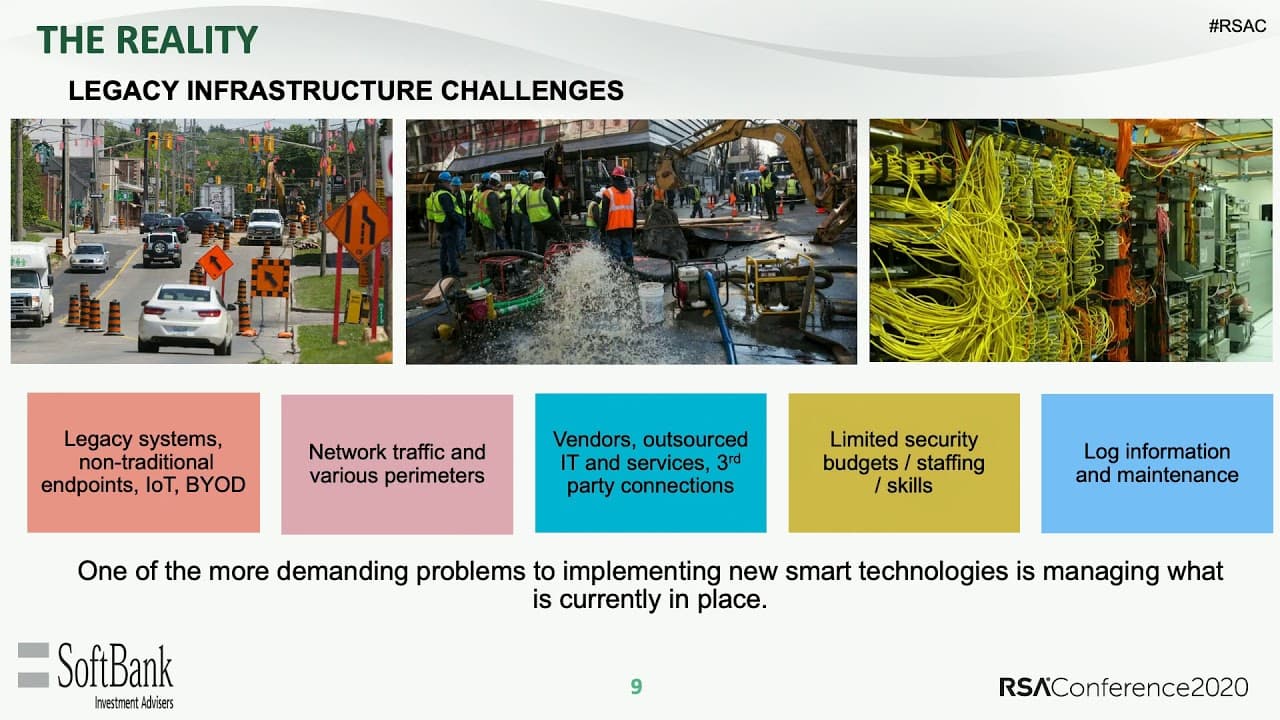
- Legacy infrastructure is a central obstacle to secure modernization. Cities, hospitals, and universities often depend on older products that remain operational and valuable, including systems from vendors that no longer exist, so organizations cannot always remove and replace them when adding connected technologies.
- Non-traditional endpoints can make municipal networks difficult to understand. San Diego's security team encountered moving devices that vulnerability tools could not readily identify and eventually determined that they were handheld water-meter units running Windows CE rather than conventional desktop computers.
- Network boundaries can become unclear when cities combine old systems, sensors, mobile equipment, and other connected infrastructure. Effective risk management begins with discovering what devices exist, identifying their functions, and understanding how they communicate across an environment whose perimeter may not be obvious.
- Wise smart-city security enables innovation while managing the risks created by converged infrastructure. Security professionals must work across legacy and newer technologies, account for privacy and third-party dependencies, and build programs that support useful public services without ignoring the complexity of the surrounding ecosystem.
Install to Summarize YouTube Videos and Get Transcripts
Explore YouTube Video Summarizer or Get YouTube Transcript Extractor
Questions & Answers
Q: What is a smart city or smart community?
A smart city uses technology and data to provide public services more efficiently, but the relevant environment extends beyond municipal government. The broader smart community includes small businesses, universities, hospitals, and other organizations that form a connected ecosystem. These participants operate similar kinds of infrastructure and often confront common issues involving legacy systems, connected devices, data governance, privacy, and cybersecurity.
Q: Why do cities invest in smart technology?
Cities invest in smart technology because they must continue delivering essential services as populations become concentrated in large urban communities. Those services include clean water, power, education, and transportation. Sensors, networks, and data-driven applications can help governments understand infrastructure and provide services more efficiently, although the resulting connections and datasets also create security, privacy, and management challenges.
Q: How does smart-city technology work?
Smart-city technology can be understood as three connected layers. Sensors or other technology collect information, a network layer moves that information, and a service layer applies it to deliver a public function. San Diego projects collected GPS information about municipal assets, including manhole covers, fire hydrants, and city-owned trees, demonstrating how physical infrastructure becomes part of a data-driven service environment.
Q: What privacy risks can municipal open data create?
Municipal data can create privacy risks even when individual records do not contain people's names. San Diego reviewed more than six hundred datasets during its open-data work and found that some information could not be released because combining it with other data could reveal where citizens moved or used services. Publication decisions must therefore consider what correlated datasets can disclose, not merely whether names are present.
Q: Why are legacy systems difficult for smart cities to secure?
Legacy systems are difficult to secure because cities depend on infrastructure that is continuously used and cannot always be removed or replaced. Some products remain operational even after their vendors cease to exist, and organizations may still rely on them to generate revenue or provide services. New sensors and connected projects must therefore coexist with older technology, producing complicated dependencies and security risks.
Q: How can non-traditional endpoints affect city cybersecurity?
Non-traditional endpoints can confuse asset inventories and vulnerability-management tools because they may not resemble ordinary workplace computers. In San Diego, security personnel observed endpoints that repeatedly moved and initially could not determine what they were. Research showed that the devices were handheld water-meter units running Windows CE, illustrating why municipal security teams need operational context to identify and assess unfamiliar equipment.
Q: Why are smart-city network perimeters hard to define?
Smart-city network perimeters are hard to define because the environment contains legacy systems, mobile devices, sensors, service infrastructure, and equipment operated or managed by outsourced third parties. Devices may move between locations or communicate in unexpected ways. Before managing vulnerabilities effectively, security teams need to identify these endpoints, understand their purposes, and map how information moves through the connected municipal ecosystem.
Q: How can a smart city become wise about cybersecurity?
A smart city becomes wise by treating modernization as a combined operational, privacy, and cybersecurity challenge. It must understand its data, devices, network traffic, legacy dependencies, and third-party management arrangements while introducing new services. The goal is a security program that manages risk across both traditional and connected technologies, allowing useful innovation while protecting citizens and essential community functions.
Summary & Key Takeaways
-
Smart cities use sensors, networks, and service layers to collect and apply data so municipal services can operate more efficiently. The broader smart-community concept includes cities, universities, hospitals, and small businesses because their infrastructures are connected and they face similar operational and cybersecurity problems, including attacks involving ransomware.
-
Technology projects can produce valuable but sensitive information. San Diego collected GPS data about assets such as manhole covers, fire hydrants, and city-owned trees, while its open-data work involved more than six hundred datasets. Combining apparently anonymous records with other information could reveal citizens' movements or service usage, creating privacy concerns.
-
Cities cannot simply replace every older system when deploying connected infrastructure. Legacy products may remain essential even when their original vendors no longer exist, while unfamiliar mobile devices and outsourced management further obscure network boundaries. Wise security therefore requires understanding assets, data, dependencies, and risks across both established systems and newer projects.
Read in Other Languages (beta)
Share This Summary 📚
Summarize YouTube Videos and Get Video Transcripts with 1-Click
Try YouTube Summary with ChatGPT & Claude or YouTube Transcript Generator
Explore More Summaries from RSAC Cybersecurity 📚





Summarize YouTube Videos and Get Video Transcripts with 1-Click
Try YouTube Summary with ChatGPT & Claude or YouTube Transcript Generator