How Large Can Black Holes Grow in the Universe?
TL;DR
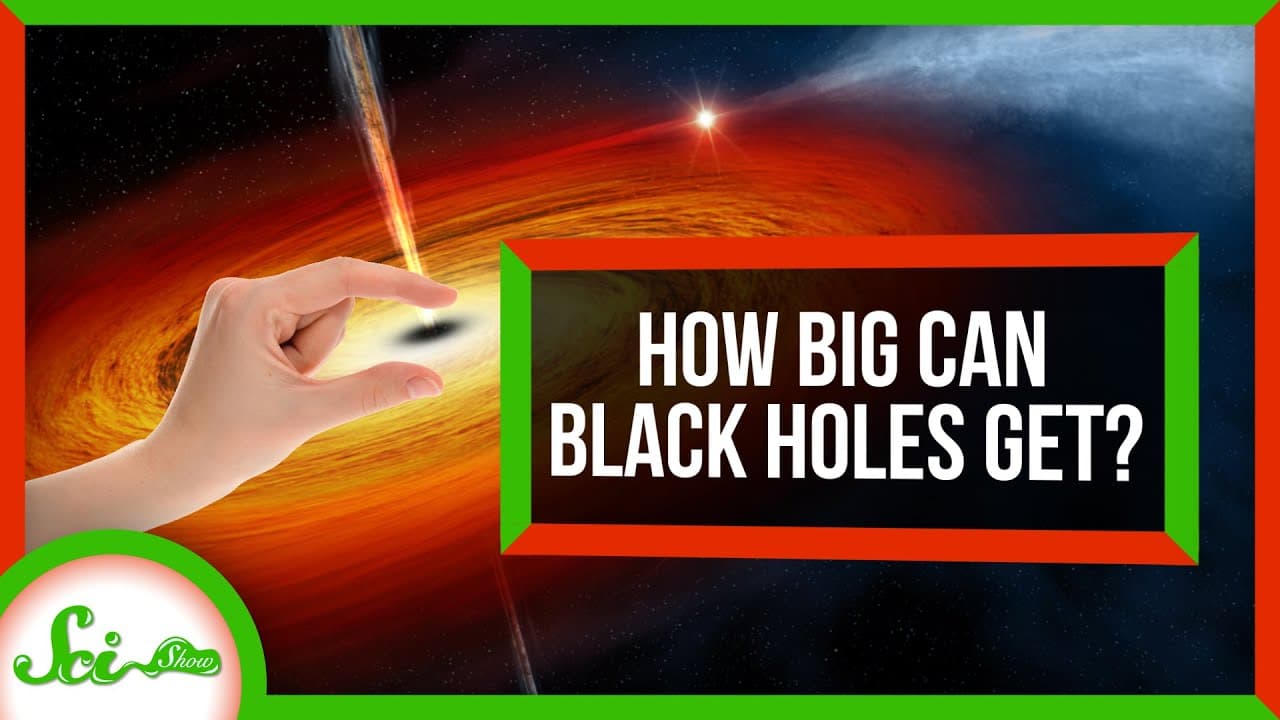
Black holes can theoretically grow to between 50 and 270 billion solar masses. Their growth is limited by the innermost stable circular orbit (ISCO), which moves outward as black holes gain mass. Once they reach a certain size, black holes can only grow further through rare collisions with other black holes, preventing them from consuming additional matter.
Transcript
Thanks to Brilliant for supporting this whole week of SciShow! Go to Brilliant.org/SciShow to learn more. [ intro ] Nearly every large galaxy hosts a supermassive black hole at its center. The one at the heart of the Milky Way, for instance, is four million times the mass of our Sun. Which is…big. But despite the name “supermassive,” here are black... Read More
Key Insights
- ✴️ Black holes grow by slowly consuming stars, gas, and dust, but most matter gets flung beyond their reach due to orbital paths and collisions.
- 🚥 The innermost stable circular orbit (ISCO) is the distance from a black hole where only light can maintain a stable orbit, and anything closer will spiral toward the event horizon.
- 💆 As a black hole's mass increases, the ISCO moves outward, allowing it to access more matter and continue growing until a certain mass is reached.
- ✴️ Beyond the mass limit, matter clumps up into stars rather than falling into the black hole.
- 💗 Black holes can theoretically grow to between 50 and 270 billion solar masses, accounting for factors such as spin.
- 🖤 Once a black hole reaches its mass limit, it can only continue growing through collisions and mergers with other black holes.
- ⬛ Collisions and mergers between black holes result in the pooling of their masses into larger black holes, but they cannot consume new matter.
Install to Summarize YouTube Videos and Get Transcripts
Explore YouTube Video Summarizer or Get YouTube Transcript Extractor
Questions & Answers
Q: How do black holes grow?
Black holes grow by consuming stars, gas, and dust, but most matter gets flung beyond their grasp due to orbital paths and collisions.
Q: What is the innermost stable circular orbit (ISCO)?
The ISCO is the distance from a black hole where only light can maintain a stable orbit, and anything closer will spiral downward towards the event horizon.
Q: Is there a limit to how big a black hole can get?
Yes, there is a limit determined by the mass at which the ISCO aligns with the distance from the event horizon. Beyond this point, matter clumps up into stars rather than falling in.
Q: Can black holes continue growing after reaching their mass limit?
Black holes can still grow through collisions and mergers with other black holes, pooling their masses into even larger black holes. However, they cannot consume new matter.
Summary & Key Takeaways
-
Black holes grow slowly as they consume stars, gas, and dust, but most matter gets flung beyond their grasp due to orbital paths.
-
The innermost stable circular orbit (ISCO) is the distance from a black hole at which only light can maintain a stable orbit.
-
As a black hole's mass increases, the ISCO moves outward, allowing it to access more matter and continue growing until a certain mass is reached.
Read in Other Languages (beta)
Share This Summary 📚
Summarize YouTube Videos and Get Video Transcripts with 1-Click
Try YouTube Summary with ChatGPT & Claude or YouTube Transcript Generator
Explore More Summaries from SciShow 📚


Summarize YouTube Videos and Get Video Transcripts with 1-Click
Try YouTube Summary with ChatGPT & Claude or YouTube Transcript Generator