How to Profile and Exploit IoT RF Signals
TL;DR
RF exploitation starts by profiling a device’s normal behavior, identifying its operating frequency, and capturing its wireless transmissions with software-defined radio tools. Analysts can then inspect waveforms, reduce patterns to binary, convert them to hexadecimal, and test attacks such as sniffing, replay, evil twins, and jamming against IoT and OT communication systems.
Transcript
Hello, RSA 2019. We are gonna be talking about a series of offensive RF exploitation techniques, particularly ones aimed at the physical and MAC layers of wireless communication systems. Reason: why is because mobile and IoT means that wireless technology is more diverse and increment than it's ever been. So with that comes many more attack surface... Read More
Key Insights
- IoT expansion increases the wireless attack surface because connected devices use diverse and growing communication technologies. Organizations may also lack control over the origin and design of the software and hardware used by smart devices, making security assessment and maintenance more difficult.
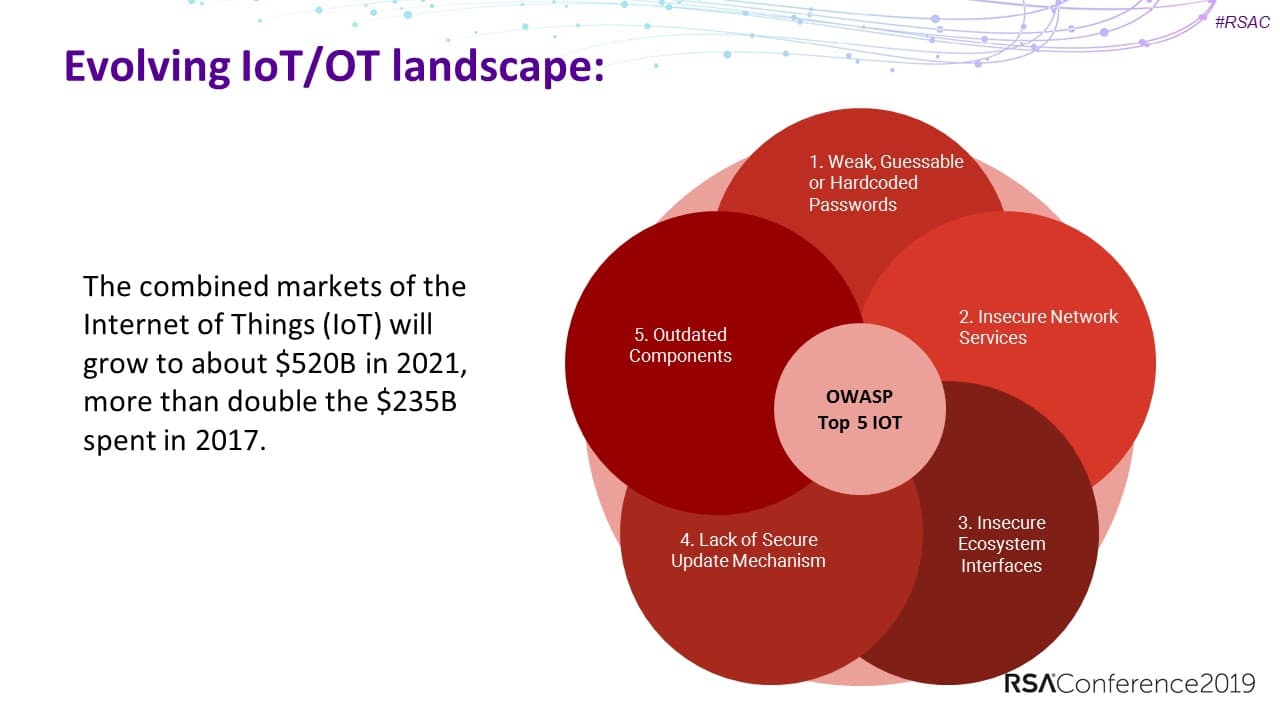
- IoT security weaknesses include weak, guessable, or hard-coded passwords, insecure network services, insecure ecosystem interfaces, missing secure update mechanisms, and outdated components. The talk presents these issues as part of the OWASP IoT vulnerability categories relevant to connected devices and smart infrastructure.
- Software-defined radio tools make non-Wi-Fi wireless traffic more accessible to security practitioners. The talk identifies RTL-SDR, GNU Radio, HackRF, Arduino, and GQRX as tools that can help monitor signals, determine frequencies, capture transmissions, inspect waveforms, and conduct controlled transmission experiments.
- RF profiling begins by documenting what a target device does during normal operation and how its components communicate. In the example system, a receiving station triggers alarms when doors open, a motion sensor detects movement, or someone presses a wireless doorbell.
- Frequency identification is necessary before an unknown wireless system can be meaningfully analyzed. When devices communicate only by radio and are not connected through wires or a local network, analysts must first determine the frequency carrying their transmissions before attempting deeper inspection.
- Replay attacks work by retransmitting a previously captured raw physical-layer payload or synthesizing a new frame from decoded data. A basic replay can reproduce legitimate functionality, while deeper traffic analysis can provide greater precision and reveal additional attack vectors.
- Signal decoding involves capturing radio traffic, reducing observed waveform patterns to binary, converting the binary data into hexadecimal form, and transmitting the resulting message through another device. The process is described as tedious during initial setup but not inherently complicated.
- Jamming attacks disrupt communication by transmitting noise within the target network’s radio-frequency channel using sufficient bandwidth and power. Other attack categories discussed include promiscuous sniffing, non-802.11 war driving, and evil twin systems that imitate trusted infrastructure.
Install to Summarize YouTube Videos and Get Transcripts
Explore YouTube Video Summarizer or Get YouTube Transcript Extractor
Questions & Answers
Q: How do you begin profiling an IoT device for RF attacks?
Begin by documenting what the device does during normal operation and identifying every component involved. Determine which actions cause transmissions, such as opening a door, detecting motion, or pressing a doorbell. Next, establish how the components connect. If they communicate only wirelessly, the operating frequency must be discovered before traffic can be captured, decoded, or retransmitted.
Q: How can you determine and inspect an unknown RF transmission?
First observe the target while deliberately triggering its normal actions, then monitor the relevant radio spectrum to locate the frequency associated with those actions. Tools such as GQRX and GNU Radio can support transmission monitoring, while HackRF can test whether captured functionality can be replayed. Correlating visible waveforms with known device events helps establish which signals belong to the target.
Q: How can captured RF waveforms be converted into reusable messages?
Capture the target device’s traffic and examine the repeating waveform patterns associated with a known action. Reduce those patterns to binary values, convert the resulting binary representation into hexadecimal form, and send the constructed message through another radio device. This method requires careful adjustment, but it provides more precision and learning value than simply replaying an unexamined raw transmission.
Q: What is an RF replay attack?
An RF replay attack involves transmitting a raw physical-layer payload that was captured earlier or creating a new frame from data that has already been decoded. In the demonstrated approach, HackRF can reproduce a device’s functionality after the relevant transmission is captured. A basic replay may generate only a false alarm, while detailed decoding can support more precise testing and expose additional attack vectors.
Q: What is wireless sniffing in RF security testing?
Wireless sniffing is the passive observation of network traffic transmitted over radio. The wireless domain permits promiscuous monitoring without direct physical access to the device or its communication medium. Consumer-grade RTL-SDR equipment and open-source tools have enabled practitioners to observe signals associated with airplanes, ships, and cars, as well as traffic generated by IoT and OT devices.
Q: What is an evil twin attack against wireless infrastructure?
An evil twin attack uses a decoy device or rogue access point that imitates trusted infrastructure. The objective is to make the target system believe it is communicating with the legitimate device and connect to the imitation instead. The talk compares this technique with familiar Wi-Fi evil twin attacks and includes it among the principal mechanisms used for wireless exploitation.
Q: How does an RF jamming attack disrupt a wireless system?
An RF jamming attack transmits noise inside the radio channel used by the target network. For the attack to interfere effectively, the transmitted noise must have sufficient bandwidth and power. Because the target’s devices depend on that channel for wireless communication, added interference can obstruct their transmissions and undermine the availability of the system’s normal functions.
Q: Why are IoT and smart-city systems exposed to RF attacks?
IoT and smart-city deployments rely on connected devices, sensors, and communication infrastructure, but many implementations fail to secure those components or adequately protect citizen privacy. Organizations may not control the source or nature of device hardware and software. Weak passwords, insecure services and interfaces, outdated components, and inadequate update mechanisms further expand the opportunities for attacks against connected environments.
Summary & Key Takeaways
-
IoT growth has expanded the wireless attack surface while organizations often lack control over the software and hardware inside connected devices. Common weaknesses include guessable or hard-coded passwords, insecure network services and ecosystem interfaces, inadequate update mechanisms, and outdated components, all of which complicate the security of smart environments.
-
Software-defined radio tools make it possible to observe and interact with wireless systems operating beyond conventional Wi-Fi. RTL-SDR, GNU Radio, GQRX, HackRF, and Arduino can support frequency discovery, signal capture, waveform inspection, and transmission experiments involving systems such as alarms, sensors, doorbells, aircraft broadcasts, cars, and key fobs.
-
A practical RF assessment begins with understanding normal device operations and connections, then determining the unknown operating frequency. Analysts can capture traffic, translate waveform patterns into binary and hexadecimal representations, and retransmit precise messages. The resulting attack possibilities include passive sniffing, war driving, evil twins, replay attacks, and deliberate channel jamming.
Read in Other Languages (beta)
Share This Summary 📚
Summarize YouTube Videos and Get Video Transcripts with 1-Click
Try YouTube Summary with ChatGPT & Claude or YouTube Transcript Generator
Explore More Summaries from RSAC Cybersecurity 📚




Summarize YouTube Videos and Get Video Transcripts with 1-Click
Try YouTube Summary with ChatGPT & Claude or YouTube Transcript Generator