What Is a Hybrid Ring Junction and How Does It Work?
TL;DR
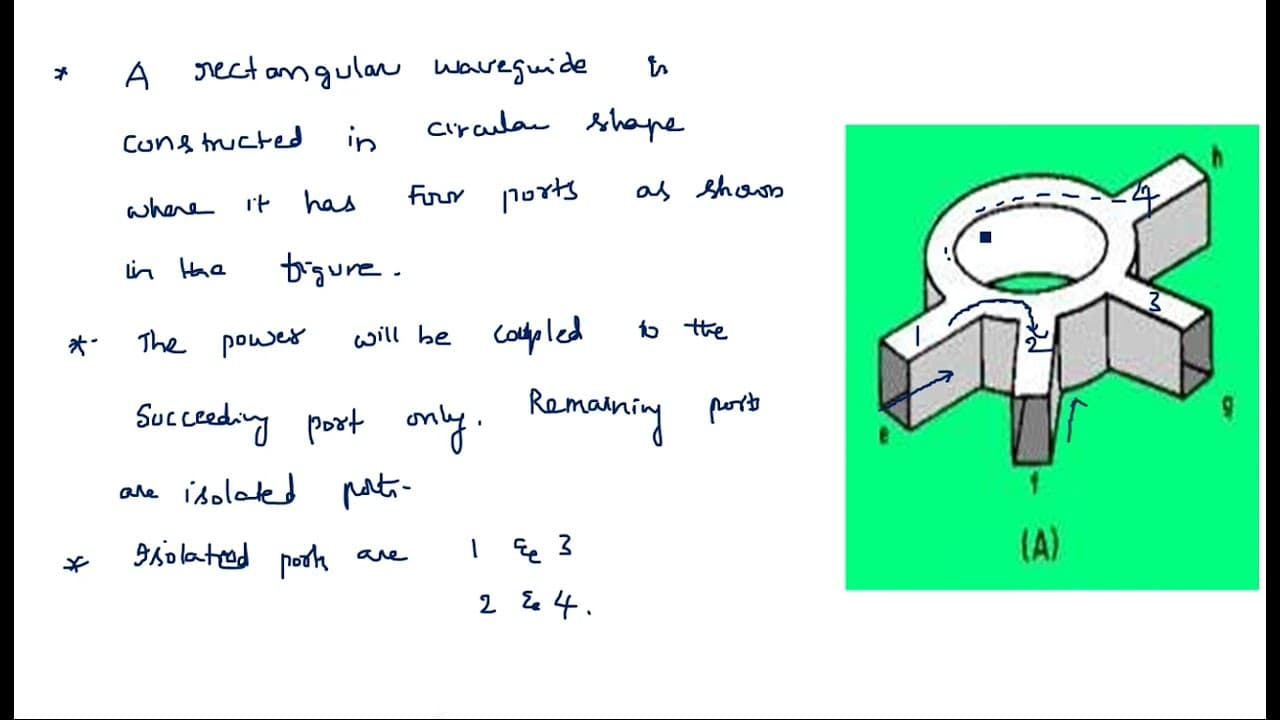
A hybrid ring junction, or rat race junction, is a four-port device in a rectangular waveguide designed for efficient signal transmission. Input power entering one port exits exclusively through its succeeding port, while other ports remain isolated. This functionality, along with perfect impedance matching, enables its use in applications like duplexers in microwave engineering.
Transcript
hi everyone in this video I am going to explain about hybrid ring or rat race sanction hybrid ring or later extension hybrid ring or retrace Junction is the fourth type of T Junctions okay previous uh videos I have explained e plain D Junction that is the first one like H plenty Junction second one e plane T Junction third one is Magic T which is a... Read More
Key Insights
- 😋 Hybrid ring junctions are constructed from a rectangular waveguide shaped into a circle and connect four ports for efficient signal handling.
- 🥳 The term "rat race" describes how signals efficiently move between ports without interference, akin to how rats may navigate through holes.
- 🚙 Each port interacts with its succeeding port exclusively, while other ports are ideally isolated from signal transmission.
- 🎅 The scattering matrix (S matrix) outlines the relationship between the ports, showing which are isolated and which are coupled for signal routing.
- 💯 Perfect impedance matching between ports and the main waveguide is critical for efficient operation, ensuring minimal reflection and maximum signal integrity.
- 🚙 Isolated ports in the matrix indicate where no signal will be present, helping to simplify circuit design and improve performance.
- 😋 Hybrid ring junctions can function similarly to other multiplexers, making them versatile for various microwave and RF applications.
Install to Summarize YouTube Videos and Get Transcripts
Explore YouTube Video Summarizer or Get YouTube Transcript Extractor
Questions & Answers
Q: What is a hybrid ring or rat race junction?
A hybrid ring or rat race junction is a type of waveguide junction constructed in a circular shape that connects four ports. It is designed to direct input signals from one port to the next succeeding port, ensuring that only one output port receives the signal while others remain isolated. This unique construction allows for efficient signal routing in microwave applications.
Q: How does the signal routing work in a hybrid ring junction?
In a hybrid ring junction, when input is applied at one port (e.g., first port), the output signal emerges only from the succeeding port (e.g., second port). The other ports (third and fourth) remain isolated, preventing any signal from emerging from them. This pattern continues sequentially from port to port, ensuring controlled signal distribution.
Q: What are the applications of hybrid ring junctions in telecommunications?
Hybrid ring junctions are commonly used as duplexers in telecommunications, allowing simultaneous transmission and reception of signals. They facilitate efficient communication by optimizing signal routing, enhancing device performance in transmitters and receivers to improve overall system reliability.
Q: What is the significance of the scattering matrix parameters in hybrid ring junctions?
The scattering matrix parameters quantify how signals interact at the ports of a hybrid ring junction. They provide essential information about signal transmission, reflection, and isolation between ports, helping engineers design systems with precise control over signal paths and minimizing interference among multiple channels.
Summary & Key Takeaways
-
The video introduces hybrid ring or rat race junctions, detailing their structure and how they function within a rectangular waveguide with four ports.
-
It emphasizes that input power traveling through one port exits through a designated succeeding port, while the others remain isolated from signal transmission.
-
The content also covers the parameters of the scattering matrix for the hybrid junction, explaining how it is derived based on port characteristics and symmetry.
Read in Other Languages (beta)
Share This Summary 📚
Summarize YouTube Videos and Get Video Transcripts with 1-Click
Try YouTube Summary with ChatGPT & Claude or YouTube Transcript Generator