Thallium - Periodic Table of Videos
TL;DR
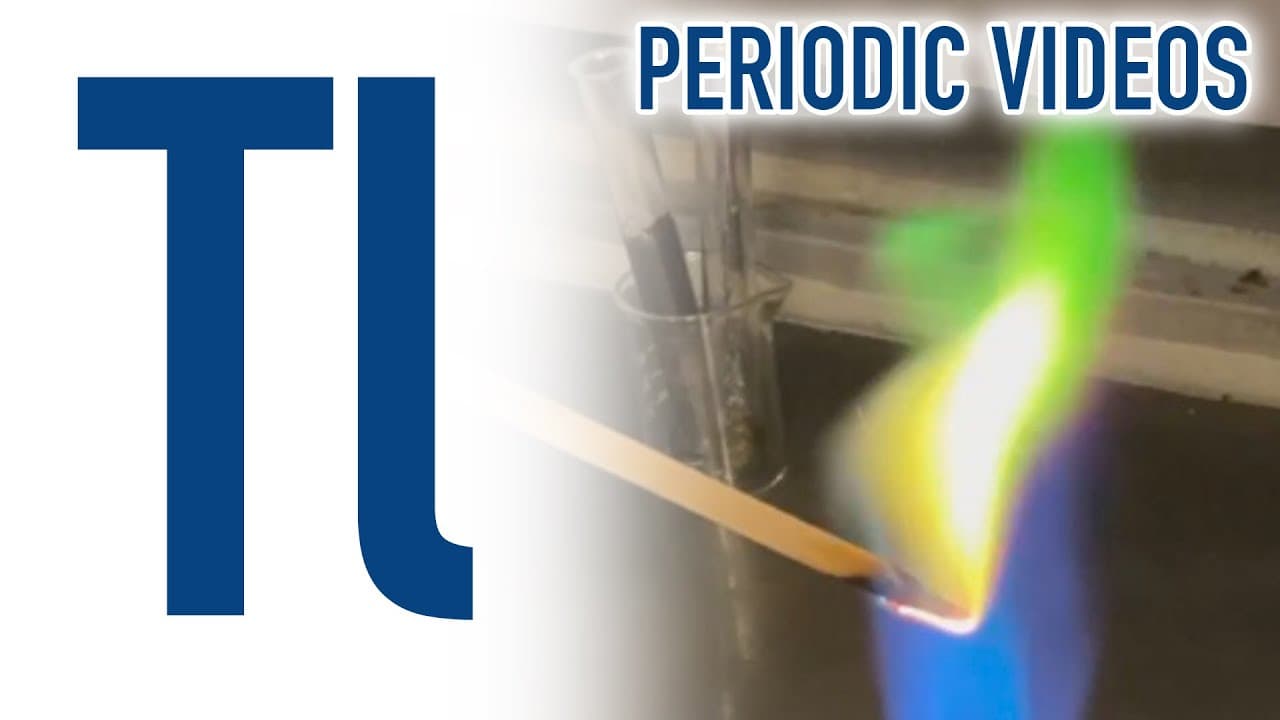
Thallium is a highly poisonous group 13 element known for its green flame, low melting temperature, and striking precipitates. A nearly 50 g sample melts into a silver-colored metal but oxidizes easily in air; thallium-1 also forms yellow thallium iodide and an almost black sulfide. Its name and disputed 1861 discovery by William Crooks and Léon Lamy add a fascinating scientific rivalry worth reading about.
Transcript
we're going to talk about thallium lots of exciting things murders a fantastic flame color nice precipitates and it's very poisonous i wasn't in the lab when the experiments were done and i was quite pleased because italian poisoning makes your hair fall out doesn't worry neil but makes me feel very nervous you look like you've had some hair fall o... Read More
Key Insights
- 👱 Thallium is a highly toxic element that can cause hair loss and is handled with caution.
- 💁 The element can form different salts, thallium-1 and thallium-3, which have distinct properties.
- 💁 Thallium forms visually striking precipitates when mixed with iodide and sodium sulfide.
- 🧑🔬 The element was discovered by two rival scientists, William Crooks and Léon Lamy, who both claimed credit for its discovery.
- ❓ The importance of communication and language skills in scientific collaboration is highlighted by the language barrier between Crooks and Lamy.
- 😒 Thallium's flame color and its use in infrared absorption studies make it a fascinating element for research.
- ❓ Thallium's potential involvement in poisonings has been featured in Agatha Christie's murder mystery novels.
Install to Summarize YouTube Videos and Get Transcripts
Explore YouTube Video Summarizer or Get YouTube Transcript Extractor
Questions & Answers
Q: What are the main properties of thallium?
Thallium is highly poisonous, and thallium poisoning can cause hair loss. It melts at a relatively low temperature into a silver-colored metal and oxidizes easily when exposed to air.
Q: Why can thallium form both thallium-1 and thallium-3 salts?
Thallium belongs to group 13 and has three electrons in its outer shell. When forming a salt, it can lose either one electron or three electrons, producing thallium-1 or thallium-3 compounds.
Q: Why did thallium-3 nitrate turn brown in water?
The colorless thallium-3 nitrate turned brown whenever water was added, even after clean water was tried. Adding acid made no difference, and the presenters concluded that some form of decomposition was probably occurring.
Q: What happens when solid thallium nitrate is heated?
Heating solid thallium nitrate produces large clouds of brown nitrogen dioxide gas. This matches the described tendency of heavy-metal nitrates to decompose into nitrogen dioxide and an oxide.
Q: What precipitate forms when thallium-1 reacts with iodide?
A colorless thallium-1 solution reacts with iodide ions to form a beautiful yellow precipitate. The solid is thallium iodide, and the demonstration was repeated to observe it again.
Q: What happens when a thallium solution reacts with sodium sulfide?
Mixing the colorless thallium solution with colorless sodium sulfide produces a strong, almost black precipitate. It is thallium sulfide and may contain a mixture of thallium-1 and thallium-3.
Q: How did thallium get its name?
William Crooks observed a previously unknown green line while studying the spectra of high-temperature salt samples. He named the element after a Greek word referring to the green color of a tree shoot as it bursts into leaf.
Q: Who discovered thallium?
William Crooks in the UK and Léon Lamy in France discovered thallium almost simultaneously in 1861. Crooks published first and supplied spectral evidence, while Lamy brought a large lump of thallium metal to a London exhibition and initially received the medal; Crooks protested and also received one.
Summary & Key Takeaways
-
Thallium is a poisonous element that melts at a low temperature and oxidizes easily when exposed to air.
-
When dissolved in water, thallium-3 nitrate turns brown, while thallium-1 salt remains colorless.
-
Thallium forms a stunning yellow precipitate when reacted with iodide and a black precipitate when reacted with sodium sulfide.
Read in Other Languages (beta)
Share This Summary 📚
Summarize YouTube Videos and Get Video Transcripts with 1-Click
Try YouTube Summary with ChatGPT & Claude or YouTube Transcript Generator
Explore More Summaries from Periodic Videos 📚

Summarize YouTube Videos and Get Video Transcripts with 1-Click
Try YouTube Summary with ChatGPT & Claude or YouTube Transcript Generator