What Does OpenAI’s GPT-3.5 Fine-Tuning Announcement Mean for ChatGPT?
TL;DR
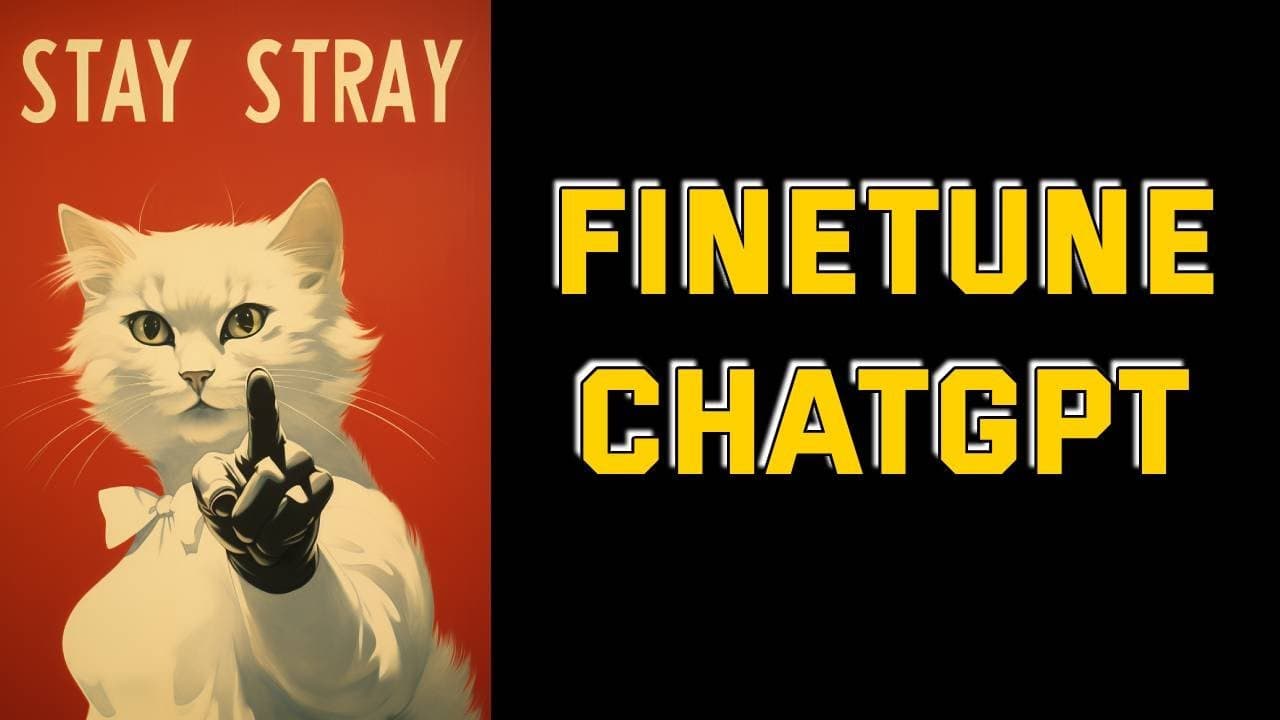
OpenAI’s announcement means users can specialize GPT-3.5 for narrow tasks such as customer service, code completion, translation, tutoring, gaming, and legal research. Fine-tuning can improve control, formatting, tone, and response speed while shortening prompts, although its per-1,000-token cost is six to eight times higher and abilities outside the specialization may degrade. Read on to understand the benefits, tradeoffs, and strongest use cases.
Transcript
so open AI just announced that users will be able to fine-tune their GPT 3.5 model and looks like the ability to fine-tune gpt4 will be coming in a few months according to open AI early test I've shown that a fine-tuned version of GPT 3.5 turbo can match or even outperform base gpt4 level capabilities on certain narrow tasks so what is fine tuning ... Read More
Key Insights
- 👻 Fine-tuning allows for a custom, controlled AI experience in various applications (customer service, gaming, code completion).
- 🐕🦺 It can enhance reliability, output formatting, and output tone, crucial in areas like customer service.
- 🪡 Fine-tuning is cost-effective for specific tasks, reducing the need for extensive training examples.
- 👨🔬 It has significant applications in customer service chatbots, language translation, education, gaming, and legal research.
- 🥠 Collaborative AI agents may utilize both base models and fine-tuned models for more specialized tasks.
- 💁 Fine-tuning is ideal for tasks that require specific style, tone, or format.
- 🦔 It can help correct failures in following complex prompts and handle edge cases effectively.
- 🥺 Fine-tuning can lead to reductions in latency without compromising quality.
Install to Summarize YouTube Videos and Get Transcripts
Explore YouTube Video Summarizer or Get YouTube Transcript Extractor
Questions & Answers
Q: What does OpenAI’s GPT-3.5 fine-tuning announcement mean for ChatGPT users?
Users can specialize GPT-3.5 for a particular task instead of relying only on the base model and repeated prompting. OpenAI also said GPT-4 fine-tuning was expected in a few months, and early tests showed that fine-tuned GPT-3.5 Turbo could match or outperform base GPT-4 on certain narrow tasks.
Q: What is fine-tuning an AI model?
Fine-tuning means specializing a model for a specific task, such as answering questions about one product or portraying a game character. The tradeoff is that some abilities outside the specialized task may degrade.
Q: What advantages does fine-tuning provide?
Fine-tuning can create a more custom and controlled experience with reliable formatting and a consistent tone. It can also help a model stay in character, avoid unwanted introductory text, return code or API calls in a required format, and produce a specific error message when necessary.
Q: Can fine-tuning GPT-3.5 reduce costs?
It can reduce total costs for some specialized tasks by shortening input and output and eliminating the need to include multiple examples in every prompt. However, the transcript says the fine-tuned model’s cost per 1,000 tokens is six to eight times higher than the base model, so savings depend on the use case.
Q: How can fine-tuning improve prompts and response speed?
A fine-tuned model can be trained with more examples than would fit inside a normal prompt, including hundreds or a thousand examples. Because the learned behavior permits shorter prompts and fewer output tokens, requests can also have lower latency and return answers faster.
Q: How can businesses use fine-tuned GPT-3.5 for customer service and code?
Businesses can fine-tune customer-service or email chatbots to answer questions about a particular product while following stricter response behavior. For code completion and API calls, the model can be trained to output only the required code or format rather than adding conversational text.
Q: How could fine-tuning be used in education, translation, and gaming?
For translation, a model can be trained to respond consistently in a specified language. The transcript also identifies tutoring, learning, code searching, and therapy-related applications, while games could use fine-tuned characters that share a backstory but respond individually in character.
Q: How might fine-tuned models work with AI agents?
Multiple AI agents could divide a mission among specialized roles, such as making decisions or writing scripts. The speaker suggests combining a base model with a fine-tuned model for a particular job, or fine-tuning one model to create prompts for another base model.
Summary & Key Takeaways
-
OpenAI has announced the ability to fine-tune the GPT-3.5 model, with GPT-4 fine-tuning expected in a few months.
-
Fine-tuning involves specializing a model for specific tasks, allowing for custom experiences, cost reduction, and improved output formatting and tone.
-
Use cases include customer service, language translation, education, gaming, legal research, and AI agents working collaboratively.
Read in Other Languages (beta)
Share This Summary 📚
Summarize YouTube Videos and Get Video Transcripts with 1-Click
Try YouTube Summary with ChatGPT & Claude or YouTube Transcript Generator
Explore More Summaries from AI Unleashed - The Coming Artificial Intelligence Revolution and Race to AGI 📚


Summarize YouTube Videos and Get Video Transcripts with 1-Click
Try YouTube Summary with ChatGPT & Claude or YouTube Transcript Generator